

Which Devices Can Actually Run Apple Music
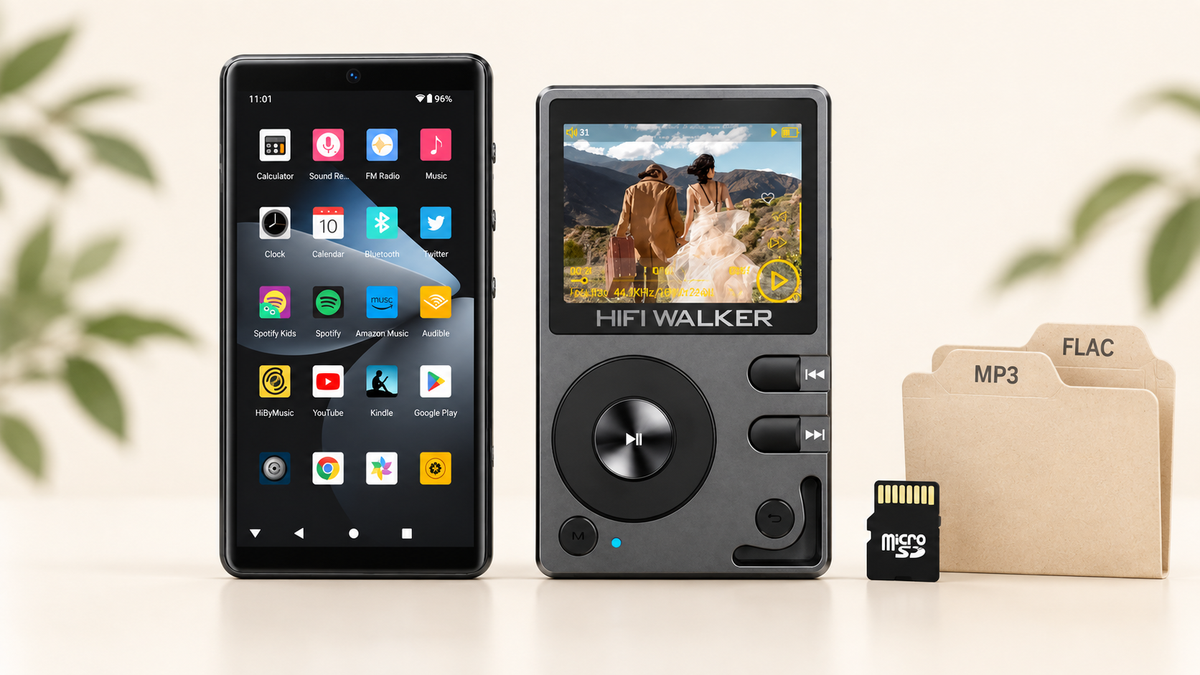
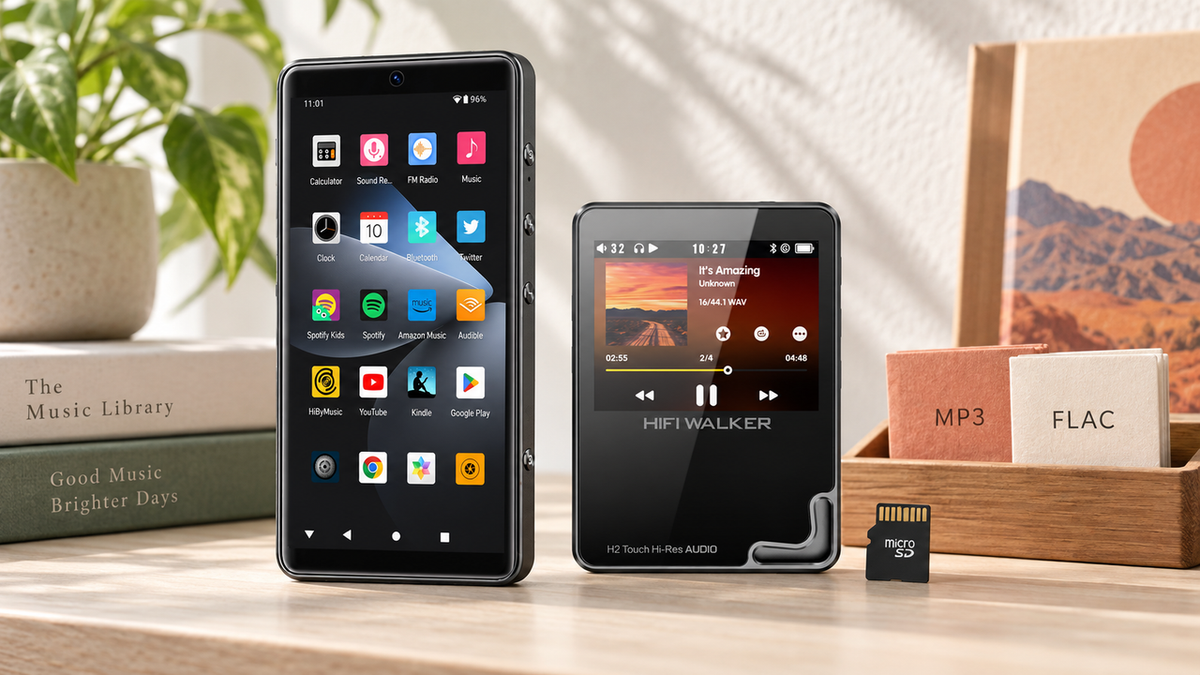
Short answer: it depends on what the player runs. The Apple Music app runs on your iPhone. Android-based players can install apps from Google Play. The HIFI WALKER Linux-based players - H2 Mini, H2, H2 Touch, H20 Pro and H20 Ultra - do not run the Apple Music app at all; they play local files you already own.
That one fact settles most of the confusion around the phrase apple music player device. A Linux DAP is not an Apple Music player, and pairing it with a phone does not turn it into one. What it is instead is a player for the FLAC, DSD and other supported files already sitting on your own drive.
Runs the Apple Music App
- iPhone: the Apple Music app, including its in-app downloads for offline listening
- Android-based players such as the HIFI WALKER G7 line, which install apps from Google Play
- What the app can do is set by Apple and by the app store, not by the player
Plays Local Files Only
- HIFI WALKER Linux models: H2 Mini, H2, H2 Touch, H20 Pro, H20 Ultra
- FLAC, DSD and other supported files copied to a microSD or T Card
- No app store, no Apple Music app, no subscription downloads on the device
Expert Insights: Key Takeaways
- The first question is not which device sounds better - it is which devices run the app at all. Apple Music runs on iPhone and on Android players that can install it; the HIFI WALKER Linux models play local files instead.
- Dedicated Hi-Res players are not a replacement for Apple Music streaming; they are a parallel path for listeners who already own local lossless files and want hardware built around playing them well.
- Balanced output (like the 4.4mm on the H20 Ultra) matters most to listeners already using headphones capable of showing the difference — it is not a universal upgrade for every pair of earbuds.
- ►1. Which Devices Can Actually Run Apple Music
- ►2. What Apple Music Actually Sends to Your Device
- ►3. iPhone vs a Local-File DAP: Side by Side
- ►4. Three Paths, and What Each One Does
- ►5. Storage and Battery on a Local-File Player
- ►6. Which Path Fits Your Situation
- ►7. Protecting the Investment
- ►8. Making the Final Call
What Apple Music Actually Sends to Your Device
Apple Music streams lossless and Hi-Res Lossless files up to 24-bit/192kHz through its own app, on devices where that app runs. What reaches your ears then depends on the rest of the chain: the app's own quality settings, the output you plug into, and the headphones on the other end.
A phone converts that stream using the audio hardware built into its system-on-chip. A dedicated player uses a separate DAC and amplifier stage. Whether you can hear a difference depends on the recording, the matched listening level, your headphones and your own ears - it does not follow automatically from the hardware layout.

That is why the two device types are described differently. A phone is built to do everything. A player like the HIFI WALKER H20 Ultra Hi-Res Audio Player is built around audio hardware and local file playback. That describes what each one was designed to do, not which one will sound better to you.
iPhone vs a Local-File DAP: Side by Side
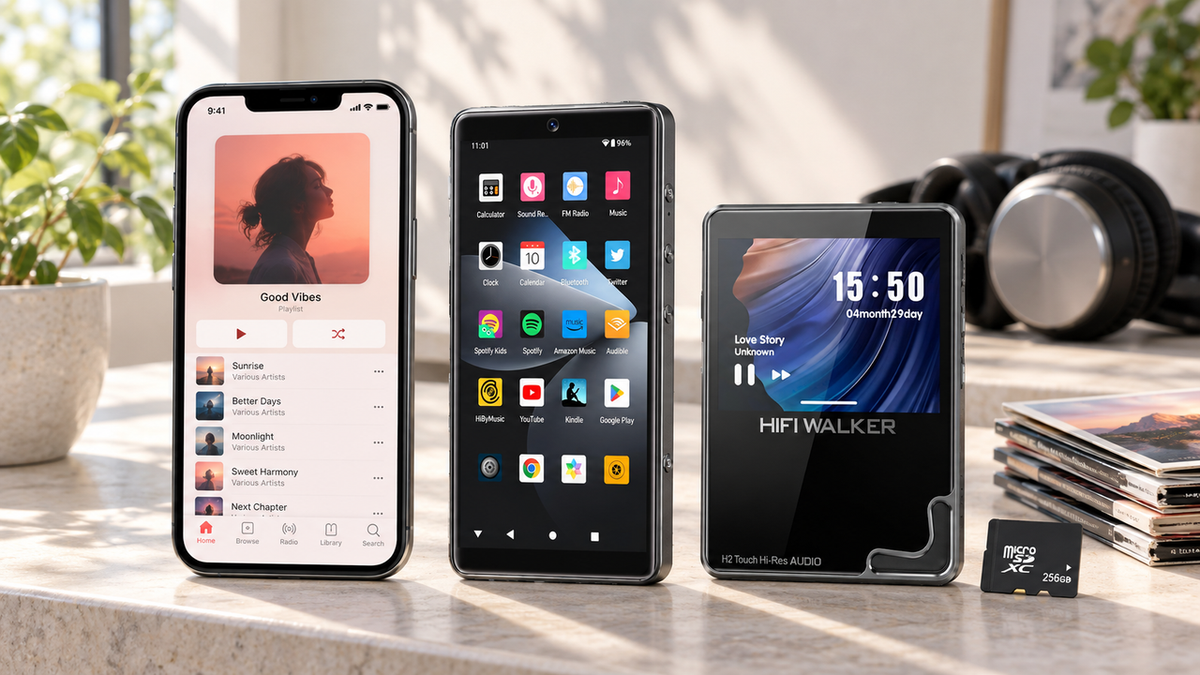
The table below sets the iPhone against two HIFI WALKER Linux players. Read the first row first: it is the one that decides whether a device is an option for you at all.
Neither Linux player runs the Apple Music app. If running the app on the device itself is what you need, that points you to an iPhone or to an Android-based player rather than to these. The next section sets out all three paths.
Three Paths, and What Each One Does
If you are searching for a dap with apple music that runs the streaming app on the player itself, the HIFI WALKER Linux-based models discussed here do not run the native Apple Music app. That is what they are: local-file players.
What they are built for is your own library: FLAC, DSD and other supported Hi-Res files you already have, played through hardware designed for audio. That is a different job from running a subscription app, not a lesser version of the same one.
Path 1 - Use an iPhone for the app
The Apple Music app runs on iPhone, including its in-app downloads for offline listening. For wired headphones you can add an external DAC or adapter that your iPhone supports.
Path 2 - Use an Android-based player for the app
Android players such as the HIFI WALKER G7 line install apps from Google Play. Not every app is compatible with every Android player, so check that model's official product page for the app you want before buying for that purpose.
Path 3 - Use a Linux DAP for files you own
Copy FLAC, DSD or other supported files you are entitled to keep onto a microSD or T Card and play them on an H2 Touch, H20 Ultra or another Linux model. No app store and no subscription downloads are involved.
This page answers the app-compatibility and signal-path question. For the separate question of which external DAC or standalone player suits an iPhone owner, our roundup for Apple Music listeners covers that choice.
Storage and Battery on a Local-File Player
If you take the local-file path, two practical numbers matter more than any sound-quality argument: how much the player holds, and how long it plays.
An iPhone's storage is shared with photos, app data, message attachments and cached streaming content. A player like the HIFI WALKER H2 Mini Hi-Res Music Player takes a microSD card up to 512GB that holds only your music. One limit worth knowing: the HIFI WALKER Hi-Res line recognises up to 14,999 tracks, so a larger card does not by itself mean an unlimited library.

Battery is the other number. HIFI WALKER rates the H2 Mini, H2 and H2 Touch at more than 10 hours of playback, measured with a FLAC 16-bit/44.1kHz file at volume 30, fully charged, screen off, through the 3.5mm output; the H20 Ultra is rated at more than 10 hours with the screen off. Your own runtime will differ with volume, file type and which output you use.
↑ Back to Top
Back to Top ↑Which Path Fits Your Situation
There is no single best answer here — but there is a clear way to sort yourself into the right camp, based on what you actually do with music day to day.
Stay on the App Path If
- Your library lives inside an Apple Music subscription and you own no separate files
- You want one device in your pocket with the app always available
- Earbuds are your main listening gear
Add a Local-File Player If
- You already own FLAC, DSD or other lossless files you are entitled to keep
- You listen with wired over-ear or in-ear headphones
- You want storage and battery that are not shared with anything else
For the widest headroom, the HIFI WALKER H20 Ultra Hi-Res Audio Player is the top pick in the Linux line: a single ESS9038Q2M DAC and a 4.4mm balanced output rated at 380mW into 32 ohms. For a smaller footprint and a lower entry price, the HIFI WALKER H2 Touch Hi-Res Audio Player covers the essentials with a 2.45-inch touchscreen. Neither runs the Apple Music app.


Protecting the Investment
One thing people forget when moving from a phone to a dedicated player: your phone came with a case built in from years of iteration. A new player did not.

A Protective PU Leather Case for H20 Ultra is a small add-on that helps keep the finish and screen tidy in a bag or pocket. Follow the case's own care instructions: a case is not a drop-protection rating, and these players are not rated waterproof or sweatproof, so keep them dry.
If you are still deciding between a phone-only setup and a dedicated player, our guide on modern Hi-Res players that beat what Apple ever offered in the iPod era is a useful next stop, especially if nostalgia for a dedicated device is part of what brought you here.
Making the Final Call
Choosing between these paths does not have to mean choosing one gadget forever. Plenty of listeners keep the phone for streaming and discovery and reach for a local-file player when they sit down with a specific album and a wired pair of headphones.

Our take: if you already have a Hi-Res or FLAC library on a drive somewhere, a local-file player gives it somewhere to live and a dedicated output to play it through. If every track you listen to lives inside a subscription, the app path is the one that fits, and this decision can wait.
For a closer look at exactly how modern devices stack up on compatibility, our device compatibility breakdown for Apple Music players goes deeper on the technical side than we have room for here. And if the iPod comparison is what brought you to this question in the first place, our piece on how modern MP3 players compare to iPods answers that directly.
What Owning a Local Hi-Res Library Actually Opens Up
Streaming solved discovery. It did not solve ownership, and that gap is where a different kind of listening habit starts to form.
None of this requires abandoning Apple Music. It just means the phone is not the only door in the room.
Frequently Asked Questions
Q1: Can any HIFI WALKER player run the Apple Music app directly?
No. The HIFI WALKER Linux-based Hi-Res players (H2 Mini, H2, H2 Touch, H20 Pro, H20 Ultra) do not run native streaming apps, Apple Music included. What an H2 or H20 Pro plays is your own local library - MP3, FLAC, DSD and the other file types listed on that model's spec sheet. The Android-based G7 line installs apps from Google Play, but check that model's official product page for the specific app you want before buying for that purpose.
Q2: Is an apple music player device worth it if I only stream and never own files?
If your entire library lives inside a streaming subscription with no local downloads, a dedicated player has less to offer you right now. The bigger gains show up for listeners who already have a FLAC or Hi-Res collection to load onto a player's expandable storage.
Q3: What is the hardware difference between an iPhone and a dedicated DAP?
The iPhone uses the audio hardware in its system-on-chip. A player like the H20 Ultra uses a separate ESS9038Q2M DAC with its own amplifier stage, and offers a 4.4mm balanced output rated at 380mW into 32 ohms. Whether that is audible to you depends on the recording, the listening level, and the headphones you use.
Q4: Do I need to give up my iPhone to use a dedicated Hi-Res player?
No - most people run both. The phone stays in your pocket for streaming, calls and discovery, while the local-file player handles focused listening from your own library, often with headphones you want more output for.
Q5: Which HIFI WALKER player has the best storage for a large local Apple Music-style library?
The H20 Ultra takes a T Card up to 512GB and the H2 Mini a microSD card up to 512GB. One caveat: the HIFI WALKER Hi-Res line recognises up to 14,999 tracks, so plan the size of the library as well as the size of the card.