


Points clés d'experts : ce qu'il faut retenir
- Le ESS9038Q2M appartient à la même famille de puces DAC que l'on retrouve dans des lecteurs Hi-Res dédiés coûtant plusieurs fois son prix — le loger dans un dongle de 38 g relève d'une remarquable densité d'ingénierie.
- Pour les usagers des transports en commun équipés d'écouteurs intra-auriculaires sensibles, le SNR annoncé du D20 est de 115 dB/1 kHz ; ce bruit de fond plus faible permet aux passages calmes de rester plus nets au quotidien.
- La molette encodeur ALPS d'origine est un atout sous-estimé — un contrôle de volume tactile élimine l'imprécision des curseurs logiciels et rend les ajustements de niveau en temps réel intuitifs pendant l'écoute active.
- La sortie symétrique 4,4 mm n'est pas un simple argument marketing à ce niveau de prix ; la séparation des canaux annoncée du D20 permet une présentation stéréo plus large et plus précisément positionnée.
- Pour les acheteurs de cadeaux : la compatibilité plug-and-play du D20 signifie que le destinataire n'a rien à configurer — c'est le rare cadeau audiophile qui fonctionne instantanément dès le déballage.
Votre téléphone ruine discrètement le son de vos écouteurs
Vous avez dépensé une somme non négligeable pour votre casque. Pourtant, à chaque fois que vous le branchez sur votre téléphone, quelque chose semble... plat. Le détail manque à l'appel. Les basses sont confuses. La scène sonore semble étriquée. Le coupable, ce n'est pas votre casque — c'est la chaîne audio à l'intérieur de votre téléphone. Un ampli DAC portable est la seule mise à niveau qui règle ce problème, et ce guide vous explique précisément pourquoi, sans jargon technique.
En 2026, l'écart entre ce que votre casque peut faire et ce que votre téléphone lui permet de faire n'a jamais été aussi grand. Les fichiers audio haute résolution sont partout — Tidal, Qobuz, bibliothèques FLAC locales — mais la minuscule puce audio de la plupart des smartphones a été conçue pour économiser la batterie et réduire les coûts, pas pour décoder le DSD ou piloter avec autorité un transducteur planar magnétique de 300 Ω.
Ce que fait la puce audio de votre téléphone
- Intégrée au SoC principal — elle partage son alimentation avec le CPU, le GPS et le module radio
- SNR généralement de 90 à 100 dB — un bruit de fond audible sur les écouteurs intra-auriculaires sensibles
- Puissance de sortie souvent inférieure à 30 mW — peine face à tout ce qui dépasse 32 Ω
- De nombreux téléphones n'offrent pas de décodage matériel Hi-Res ou DSD dédié dans leur circuit audio intégré
- Aucune sortie symétrique — seulement une sortie asymétrique 3,5 mm (quand elle existe)
Ce que fait un ampli DAC portable dédié
- Puce DAC ESS ou AKM dédiée — aucune alimentation partagée, aucune interférence RF
- SNR de 115 dB/1 kHz — un bruit de fond plus faible derrière la musique
- Jusqu'à 380 mW de puissance de sortie — compatible avec des casques de 8 à 300 Ω
- Décodage natif PCM 32 bits/768 kHz et DSD512 — pleine résolution Hi-Res
- Double sortie 3,5 mm asymétrique + 4,4 mm symétrique — compatible avec les câbles casque 3,5 mm asymétrique ou 4,4 mm symétrique

- ►1. Votre téléphone ruine discrètement le son de vos écouteurs
- ►2. L'audio Hi-Res expliqué sans jargon
- ►3. Découvrez le HIFI WALKER D20 : le DAC flagship qui tient dans la poche
- ►4. Les chiffres qui comptent vraiment pour vos oreilles
- ►5. Scénarios d'écoute réels : quand le D20 fait toute la différence
- ►6. Comment le D20 s'intègre dans l'écosystème HIFI WALKER
- ►7. Qui devrait acheter un ampli DAC portable en 2026 ?
L'audio Hi-Res expliqué sans jargon
Imaginez un MP3 standard comme une photo JPEG — compressée, pratique, suffisante dans la plupart des cas. Maintenant, imaginez un fichier audio Hi-Res comme une photo RAW. Le fichier est plus volumineux, mais le détail perdu lors de la compression est intégralement préservé : le souffle avant la phrase d'un chanteur, la texture exacte d'une corde de guitare, la traîne de réverbération subtile d'une salle de concert. C'est exactement ce que signifie l'audio Hi-Res.
PCM : la grille numérique
Le PCM (Pulse-Code Modulation, modulation par impulsions codées) est le format audio numérique standard. Un CD est en 16 bits/44,1 kHz. Le PCM Hi-Res commence à 24 bits/96 kHz et va jusqu'à 32 bits/768 kHz — capturant bien davantage de la forme d'onde analogique d'origine.
DSD : le flux à un bit
Le DSD (Direct Stream Digital) adopte une approche différente — au lieu d'une grille de nombres, il utilise un flux à un seul bit fonctionnant à une vitesse extrêmement élevée (de DSD64 jusqu'à DSD512). De nombreux audiophiles décrivent le DSD comme le format numérique le plus proche de la bande analogique.
Pourquoi votre téléphone ne peut pas le gérer
Le décodage DSD natif nécessite une puce DAC dédiée capable de comprendre directement le flux binaire DSD. De nombreux circuits de lecture des téléphones convertissent d'abord le DSD en PCM. Un ampli DAC portable doté d'un décodage matériel DSD512 permet de conserver un circuit de lecture DSD plus propre.
Pourquoi la sortie symétrique compte
Une connexion symétrique fait circuler le signal sur deux chemins séparés, annulant le bruit électrique qui s'accumule dans le câble. Résultat : une diaphonie plus faible entre les canaux gauche et droit, un silence plus noir entre les notes, et davantage de puissance de sortie au niveau de l'étage amplificateur — sans augmenter l'encombrement.
Ce qu'il faut retenir en pratique : pour vraiment entendre la différence entre un flux compressé et un fichier Hi-Res, il faut un matériel capable de décoder et d'amplifier ce signal sans y ajouter son propre bruit. C'est l'unique mission d'un ampli DAC portable — il ne fait rien d'autre, et c'est précisément pour cela qu'il le fait si bien.
Découvrez le HIFI WALKER D20 : le DAC flagship qui tient dans la poche
Le dongle DAC/Ampli USB-C HIFI WALKER D20 — Amplificateur casque symétrique est ce qui se produit quand on arrête de faire des compromis. Il loge une puce DAC ESS9038Q2M de niveau flagship dans un corps en aluminium usiné CNC qui ne pèse que 38 grammes — plus léger que la plupart des porte-clés. Branchez-le sur le port USB-C de votre téléphone et le son de votre casque se transforme instantanément, sans pilote, sans configuration, sans complications.

Qu'est-ce qui distingue le dongle DAC/Ampli USB-C HIFI WALKER D20 de la marée de dongles USB-C bon marché qui inondent le marché ? Trois choses : la puce, la puissance et la qualité de fabrication. Examinons chacune sérieusement.
Les chiffres qui comptent vraiment pour vos oreilles
Les fiches techniques peuvent sembler intimidantes. Voici comment interpréter les chiffres clés du dongle DAC/Ampli USB-C HIFI WALKER D20 en fonction de ce que vous entendez réellement — pas de ce que l'on mesure en laboratoire.
La caractéristique
- SNR ≥115 dB
- Plage dynamique >118 dB
- Séparation des canaux jusqu'à 90 dB annoncés
- 380 mW + 380 mW @ 32 Ω symétrique
- Décodage natif DSD512
- PCM 32 bits / 768 kHz
Ce que vous entendez réellement
- Des passages calmes plus propres, avec moins de souffle sur les écouteurs intra-auriculaires sensibles
- La différence entre un murmure et un orchestre complet, préservée intacte
- Chaque instrument précisément positionné dans son propre espace — une vraie largeur stéréo
- Davantage de marge de puissance pour de nombreux casques circum-auriculaires
- Fichiers DSD décodés via le circuit matériel DSD512 pris en charge
- Chaque harmonique et micro-détail que l'artiste a placé dans le master

La molette encodeur ALPS mérite une mention spéciale. La plupart des dongles DAC contrôlent le volume via un curseur logiciel — imprécis, sujet aux latences et aux sauts. L'encodeur mécanique ALPS d'origine du D20 offre un contrôle du volume tactile, pas à pas, aussi premium au toucher qu'à l'écoute. Un petit détail que vous apprécierez à chaque session d'écoute.
↑ Retour en haut
Retour en haut ↑Scénarios d'écoute réels : quand le D20 fait toute la différence
Un ampli DAC portable n'est pas réservé aux audiophiles penchés sur leur poste d'écoute. Le dongle DAC/Ampli USB-C HIFI WALKER D20 s'intègre naturellement dans deux scénarios où la plupart des gens écoutent le plus de musique : les trajets quotidiens et l'écoute détendue à la maison.
Les trajets quotidiens : la mise à niveau que vous remarquerez chaque matin
Branché sur votre téléphone et accroché à la bandoulière de votre sac, le D20 ne pèse que 38 grammes — vous ne le sentirez pas. Mais vous entendrez immédiatement la différence : le bruit de fond d'un bus ou d'un train est masqué psychoacoustiquement de façon bien plus efficace lorsque votre musique bénéficie d'une plage dynamique plus large et d'un bruit de fond plus noir. Les écouteurs intra-auriculaires sensibles qui sifflaient auparavant peuvent sonner plus proprement.
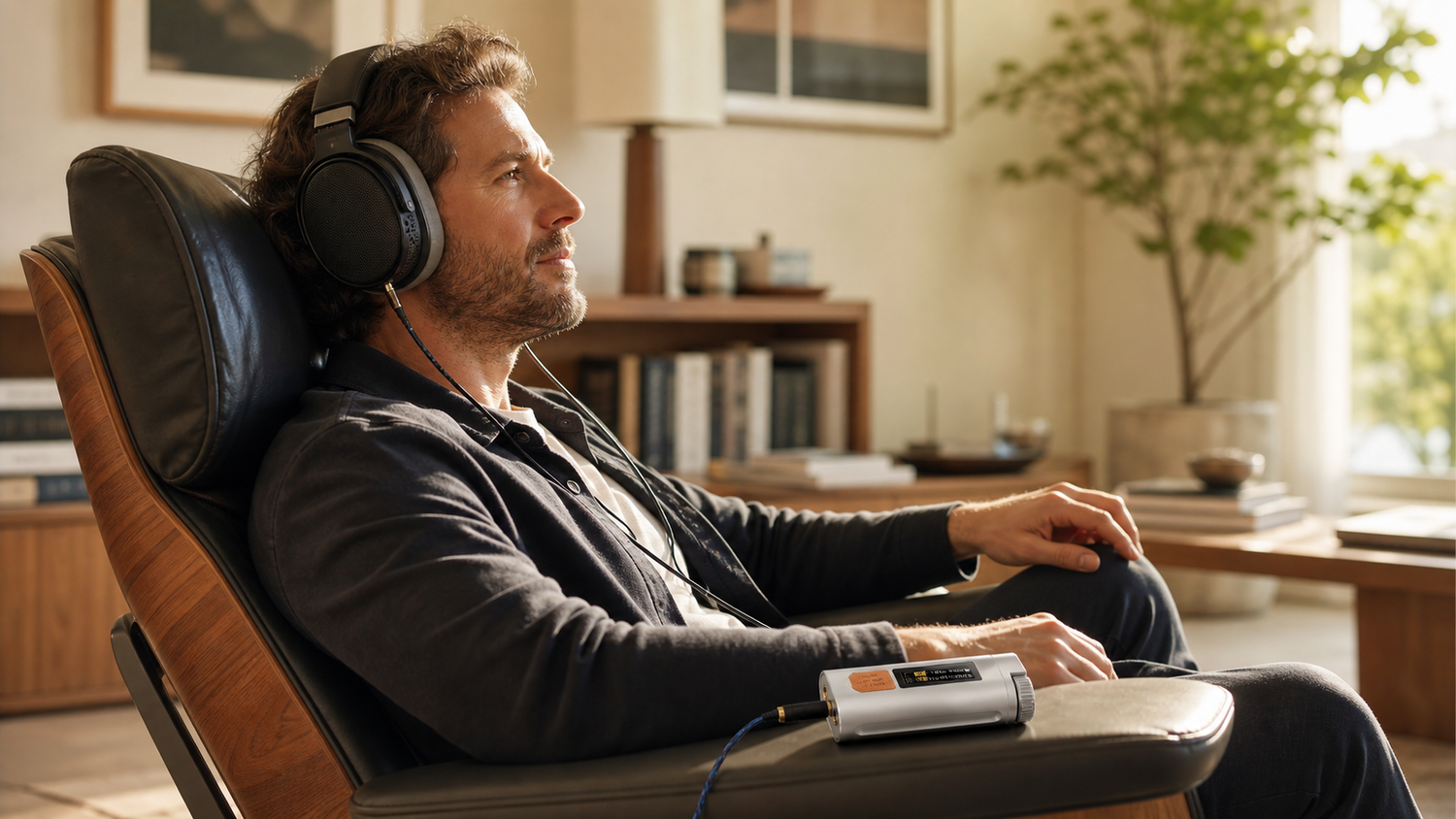
Écoute à la maison : votre salon devient une salle d'écoute
Installé dans votre fauteuil préféré avec un casque circum-auriculaire, la sortie symétrique 380 mW du D20 permet enfin à vos casques de 150 ou 300 Ω de respirer avec toute la marge de puissance nécessaire. Connectez-vous via le port symétrique 4,4 mm pour une séparation des canaux maximale — la scène sonore s'élargit sensiblement à gauche et à droite, plaçant les instruments dans un espace tridimensionnel plutôt que sur une ligne plate entre vos oreilles.
Cadeaux : la mise à niveau audiophile qui ne demande aucune expertise
La connexion USB-C du D20 est annoncée compatible avec Windows XP, Windows 7/8.1/10, et macOS 10 et supérieur. Pour les téléphones USB-C, la compatibilité dépend de la prise en charge audio USB du téléphone. Pour un acheteur de cadeau destiné à un passionné de casques, la configuration reste simple, sans obliger le destinataire à apprendre à utiliser un nouveau lecteur.

Comment le D20 s'intègre dans l'écosystème HIFI WALKER
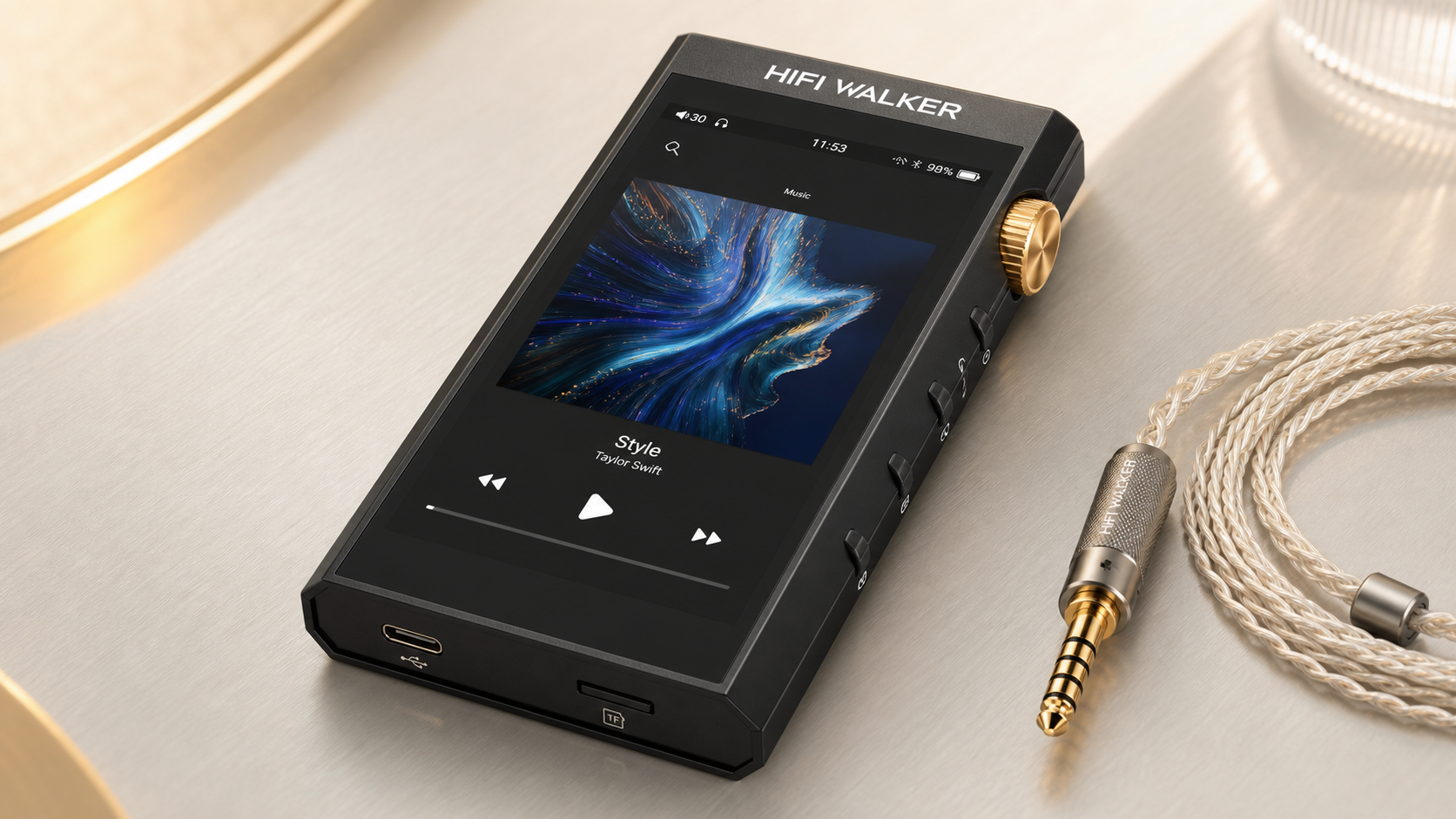
Le D20 est conçu pour être votre première mise à niveau audio sérieuse — mais HIFI WALKER construit tout un écosystème autour de lui. Si vous décidez plus tard de vouloir une expérience d'écoute totalement autonome, la gamme de lecteurs Hi-Res HIFI WALKER offre une progression naturelle. Pour l'instant, le D20 transforme le téléphone que vous possédez déjà en une véritable source Hi-Res.

Associer le dongle DAC/Ampli USB-C HIFI WALKER D20 à un écouteur intra-auriculaire bien calibré comme l'A20Pro crée une chaîne portable complète qui aurait coûté nettement plus cher — et aurait été nettement plus volumineuse — il y a à peine cinq ans. C'est la démocratisation de l'audio Hi-Res : des performances DAC dignes d'un flagship dans un dongle de poche, soutenues par une livraison gratuite, une fenêtre de retour de 30 jours, et une garantie 1 an qui vous permet d'acheter en toute confiance.
Curieux de savoir comment le D20 se compare aux autres options du monde de l'audio portable ? Notre blog Tests et comparatifs de DAP approfondit les associations de sources et la synergie avec les casques — à mettre dans vos favoris si vous construisez votre configuration.
Qui devrait acheter un ampli DAC portable en 2026 ?
Tout le monde n'a pas besoin d'un ampli DAC portable dédié. Mais pour un certain profil d'auditeurs, c'est la mise à niveau au meilleur rapport impact/prix disponible — et le dongle DAC/Ampli USB-C HIFI WALKER D20 se hisse au sommet de cette catégorie en 2026.
Vous remarquerez une différence immédiate si…
- Vous possédez un casque au-dessus de 32 Ω — votre téléphone ne lui fournit probablement pas assez de puissance
- Vous entendez un léger souffle ou du bruit sur des écouteurs intra-auriculaires sensibles à faible volume
- Vous êtes abonné à Tidal HiFi, Qobuz, ou vous écoutez des fichiers FLAC
- Vous avez déjà pensé que votre casque sonnait mieux sur le lecteur de quelqu'un d'autre
- Vous voulez essayer l'audio symétrique sans acheter un nouveau lecteur
Le D20 est particulièrement fait pour vous si…
- Vous voulez une solution compacte et plug-and-play — sans courbe d'apprentissage
- Vous avez des casques de 8 à 300 Ω et voulez un seul dongle pour tous les piloter
- Vous voulez un cadeau vraiment impressionnant et utilisable immédiatement
- Vous faites la navette quotidiennement et voulez un meilleur son sans alourdir votre sac
- Vous voulez la tranquillité d'esprit d'une garantie 1 an et d'un retour sous 30 jours
La barrière à l'entrée de l'audio Hi-Res n'a jamais été aussi basse. Le dongle DAC/Ampli USB-C HIFI WALKER D20 ne demande rien de plus qu'un port USB-C — et en retour, il offre les performances DAC de l'ESS9038Q2M, une puissance symétrique de 380 mW, un décodage natif DSD512, et une qualité de fabrication digne d'un appareil bien plus grand et bien plus cher.
Questions fréquentes
Q1 : Que fait réellement un dongle ampli DAC portable ?
Un dongle ampli DAC portable remplace la puce audio intégrée de votre téléphone par un convertisseur numérique-analogique et un amplificateur casque dédiés, de bien meilleure qualité. Il reçoit le signal audio numérique via USB-C, le décode avec une bien plus grande précision (y compris les formats PCM Hi-Res et DSD), et pilote votre casque avec plus de puissance et moins de bruit qu'aucun smartphone ne peut y parvenir en interne.
Q2 : Dois-je installer des pilotes pour utiliser le dongle DAC/Ampli USB-C HIFI WALKER D20 ?
Pour la plupart des plateformes, aucun pilote n'est nécessaire. Le dongle DAC/Ampli USB-C HIFI WALKER D20 est compatible plug-and-play avec Windows XP, Windows 7, 8.1 et 10, ainsi que macOS 10 et versions ultérieures. Pour les téléphones USB-C, la compatibilité dépend de la prise en charge audio USB du téléphone.
Q3 : Qu'est-ce que le décodage DSD, et pourquoi le dongle D20 prend-il en charge le DSD512 ?
Le DSD (Direct Stream Digital) est un format audio haute résolution utilisé dans le mastering professionnel et les sorties audiophiles. Le dongle DAC/Ampli USB-C HIFI WALKER D20 prend en charge le décodage matériel DSD512 grâce à sa puce ESS9038Q2M, ce qui permet de traiter les fichiers DSD compatibles via le circuit de lecture DSD pris en charge.
Q4 : Quels casques fonctionnent avec le dongle DAC/Ampli USB-C HIFI WALKER D20 ?
Le D20 pilote des casques dont l'impédance va de 8 à 300 Ω, en délivrant jusqu'à 380 mW + 380 mW à 32 Ω via la sortie symétrique 4,4 mm. Cela couvre la grande majorité des écouteurs intra-auriculaires, supra-auriculaires et circum-auriculaires du marché, y compris les transducteurs planar magnétiques exigeants que la plupart des téléphones ne peuvent pas alimenter correctement.
Q5 : Y a-t-il une livraison gratuite et une garantie sur le HIFI WALKER D20 ?
Oui. HIFI WALKER offre la livraison gratuite sur le dongle DAC/Ampli USB-C D20, ainsi qu'une politique de retour et d'échange sous 30 jours et une garantie fabricant de 1 an. Vous pouvez acheter en toute confiance, sachant qu'une assistance est disponible en cas de besoin.