


Good MP3 Players at a Glance
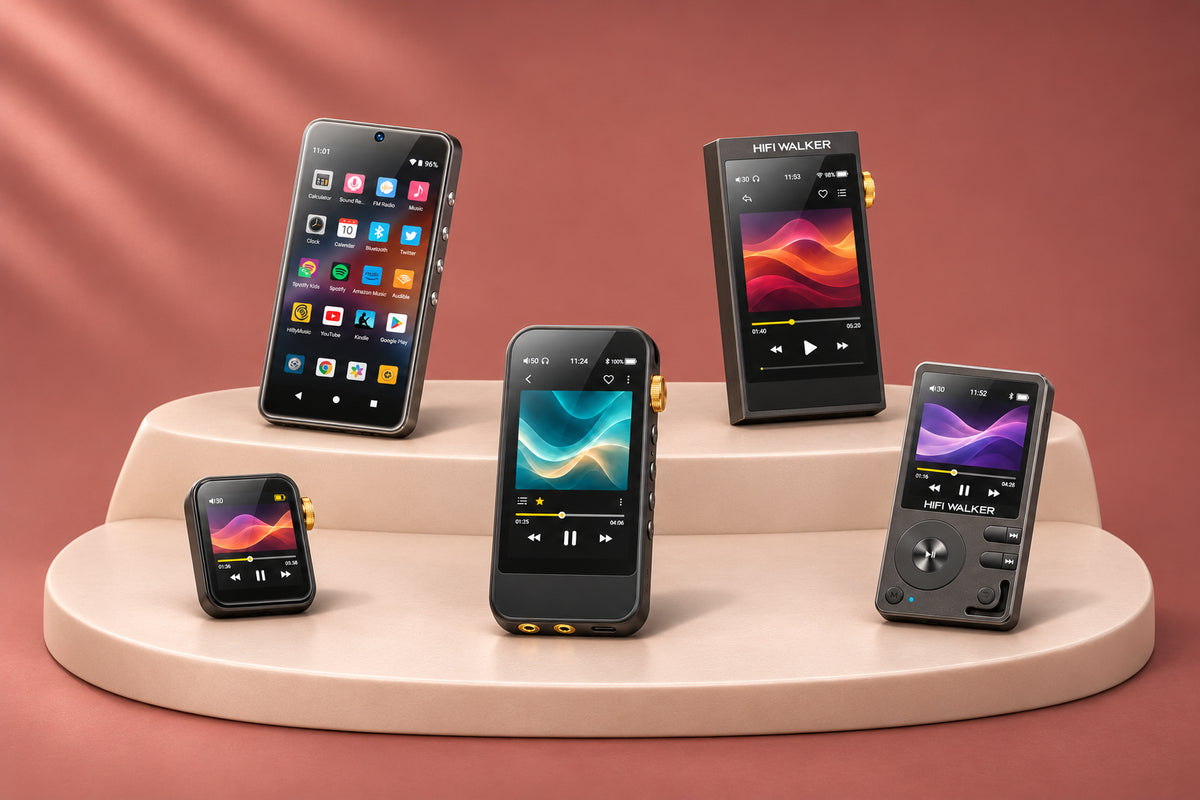
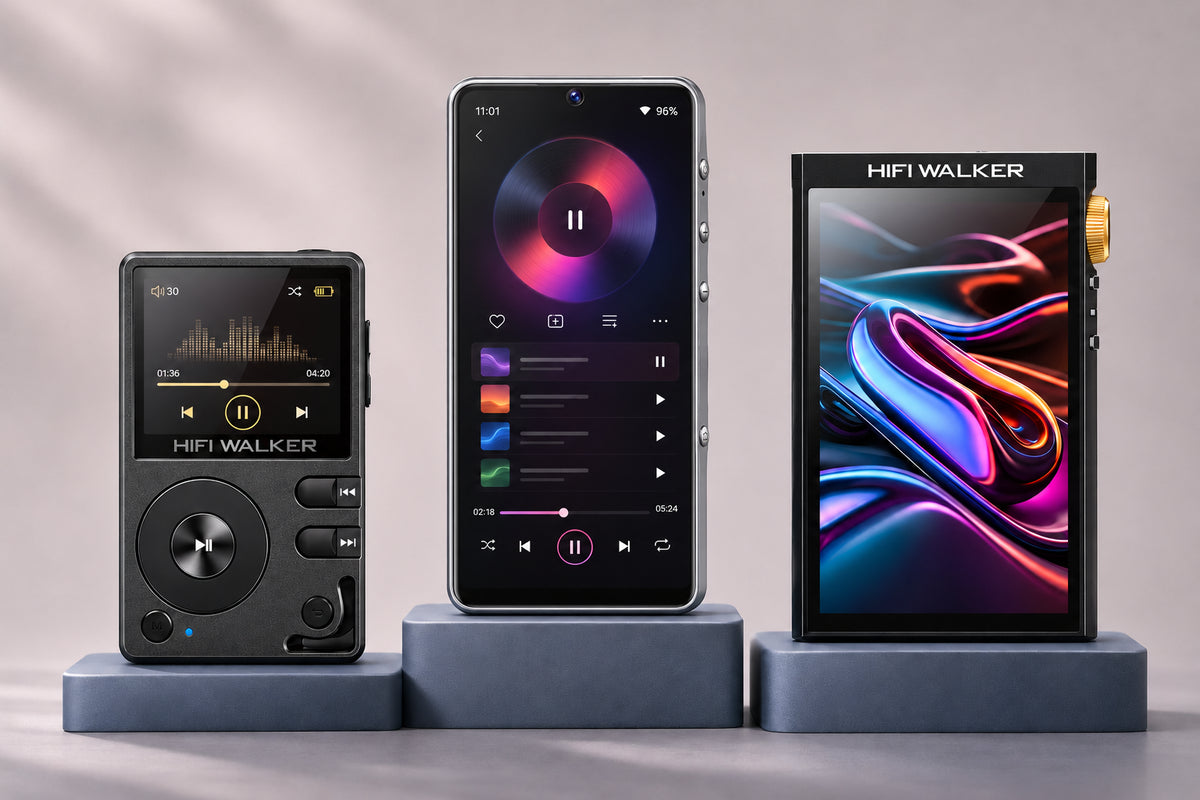
Our compact pick for your own music files is the HIFI WALKER H2 Mini. Choose the G7 Pro if your playlists live in a streaming app. The H2 gives you a larger screen and physical controls for local files. The H20 Pro adds a touchscreen and a 4.4 mm headphone output. The H20 Ultra gives album browsing the most screen space in the local-file range. The G7 is the smaller Android option, and the H2 Touch fits buyers who want touch navigation and Wi-Fi file transfer for their own library.
Do you pick your music from a folder of albums or from a playlist in an app? Use the table to match that habit to a model. Open a model's product page to check the current price, bundle and availability in the U.S. store.

Expert Insights: Key Takeaways
- The H2 Mini is the compact choice for a local library. The G7 Pro is the starting point for listening through supported apps.
- Use the H20 Pro or H20 Ultra if you want a touchscreen with a 4.4 mm balanced headphone connection.
- Check song count, included storage and the current U.S. price for your exact model.
- ►1. Good MP3 Players at a Glance
- ►2. Two Kinds of MP3 Player: Offline Files or Android Apps
- ►3. Offline MP3 Players Compared Side by Side
- ►4. Android MP3 Players: G7 and G7 Pro
- ►5. Three Buying Decisions That Change the Pick
- ►6. Check Your Setup Before You Order
- ►7. Storage, Song Limits and Battery: Read the Fine Print
- ►8. Wired, Bluetooth and USB: Getting the Sound Out
- ►9. What You Need to Play the First Album
- ►10. Choose the Player That Fits Your Library
Two Kinds of MP3 Player: Offline Files or Android Apps
Start by opening one album you listen to regularly. Can you find its songs as files you could copy to another device? A purchased DRM-free download or a track saved from your own CD belongs on the local-file route. If you open an account and pick a playlist inside a service, check the Android route and the specific official app you use. This one check can save you from buying a player that cannot use the collection you planned to bring.
The H2 and H20 families here use Linux and read compatible files from a microSD card. You can load several albums before you leave home and play them without an internet connection. The G7 and G7 Pro run Android 13, with Wi-Fi for compatible apps. Use the Android route if keeping your playlists or audiobooks in their existing app matters more to you than having a player built around a local collection.
Offline Linux players (H2 and H20 series)
- Play your own DRM-free files from a microSD card
- No app store, no notifications, no social feeds
- Physical focus on music: library, playlists, folders
- Several models also work as a computer sound card over USB-C
- Best fit for CD rips, Bandcamp and purchased MP3s
Android players (G7 and G7 Pro)
- Run Android 13 and install apps
- Wi-Fi on both 2.4GHz and 5GHz bands
- G7 Pro comes with streaming and audiobook apps preinstalled
- Pair wireless earbuds over Bluetooth
- Best fit for app-based listening without a phone
Offline MP3 Players Compared Side by Side
The five Linux players share the same basic idea, local files and no apps, but they differ a lot in size, screen, chip and output. The table puts the published figures next to each other. Power figures are into a 32Ω load, the standard reference for headphone output.

H2 Mini: the compact choice
The H2 Mini is the smallest player here at 52x46x15.6mm and 42g without its back clip, so it slips into a jacket pocket or clips to a strap. It runs on an ESS9218PC chip with an integrated headphone amp, rated at 120dB SNR, 118dB dynamic range and 112mW into 32Ω, with 2Vrms from the 3.5mm jack. The 1.54-inch 240x240 screen is small but enough for browsing folders. Battery is 500mAh, rated at over 10 hours playing 16-bit/44.1kHz FLAC at volume 30 with the screen off on the 3.5mm output, and it recharges in about 2 hours. Bluetooth 5.1 handles wireless headphones, and the USB-C port charges it, mounts it as a drive and lets it act as a USB DAC for a computer. It ships with a 64GB card and accepts microSD cards up to 512GB.
H2: a larger player with physical controls
The H2 pairs an ES9018K2M DAC with a MAX97220A headphone amp. The H2 is rated at 107dB SNR, 108dB dynamic range and 70mW+70mW into 32Ω with a 1.5Vrms line level, and it is listed for headphones from 16Ω to 150Ω. The H2 has a 2.0-inch 320x240 screen on a 90x55x15mm body that weighs 152g. The H2 battery is 1500mAh, rated at over 10 hours playing 16-bit/44.1kHz FLAC at volume 30 with the screen off, and a full charge takes about 3 hours. Bluetooth 5.1 works in both directions, so it can send audio to headphones or receive audio from another device. Over USB-C it works as a USB DAC, a USB drive and an OTG host, and it plays DSD files up to DSD128.

H2 Touch: touch navigation for local music
The H2 Touch is the one to pick if you want to tap through your library on a 2.45-inch 480x360 touchscreen. It uses an ESS9219Q chip with an integrated amp, rated at 116dB SNR, 116dB dynamic range, 112mW into 32Ω and 2Vrms from the 3.5mm jack. Its extra functions include e-book reading, recording, Wi-Fi song transfer and network radio. The 3.8V/1500mAh battery is rated at over 10 hours and recharges in about 3 hours, inside an 84.5x61.5x14mm body. Bluetooth 5.1 works both ways, and the USB-C port covers charging, USB DAC, mass storage and SPDIF output, with line out available as well.
H20 Pro: touch controls and balanced output
The H20 Pro moves up to a 3.2-inch 360x640 touchscreen with a volume knob in a 108.5x53x14mm body. Inside are two ES9219PC chips feeding four independent amp channels, rated at 118dB SNR and 115dB dynamic range. The 3.5mm jack delivers 112+112mW into 32Ω at 2Vrms, while the 4.4mm port steps up to 380+380mW at 4Vrms, giving you a second wired option for headphones with a compatible balanced cable. The 1500mAh battery is rated at over 10 hours with a 3-hour charge. USB-C handles charging, USB DAC, mass storage and SPDIF output, and the player can also serve as a digital transport feeding an external DAC.
H20 Ultra: the largest local-library screen
The H20 Ultra has the largest screen of the offline players, a 4-inch 480x800 touchscreen with a knob, set in a CNC aluminum body with a 9H glass back that measures 118x64x21.5mm. It uses a single ESS9038Q2M DAC with two RT6862 I/V stages and two RT6863 amp chips, rated at 119dB SNR and more than 118dB dynamic range. Output is 112mW into 32Ω at 2Vrms from the 3.5mm jack and 380mW at 4Vrms from the 4.4mm port, and the USB-C port can also carry a 1Vpp coaxial digital signal. The 3000mAh battery is rated at over 10 hours with the screen saver on and takes about 3.5 hours to charge. It ships with a 128GB card, supports cards up to 512GB and is listed for headphones from 16Ω to 300Ω.

Android MP3 Players: G7 and G7 Pro
Choose the G7 for a smaller Android device to carry and the G7 Pro for more room to browse inside an app. Size is the difference you will see every time you pick up the player. Screen width matters when you scroll a long playlist, read audiobook titles or use the on-screen controls.
G7: the entry Android player
The G7 is the simplest way to get apps onto a device that is not your phone. It runs Android 13 on an MTK6762 octa-core chip with 3GB of RAM and 16GB of storage on the device, plus a TF card slot; it ships with a 128GB card and supports cards up to 256GB. It has a 4-inch 480x800 screen and a 2000mAh battery, Wi-Fi covers 2.4GHz and 5GHz, and Bluetooth 5.0 connects wireless earbuds. Treat it as an everyday Android music player: choose it for apps and convenience, and check that the specific app you depend on behaves the way you expect before you rely on it for a trip.
Explore the G7 Android Player.
G7 Pro: the app-friendly pick
The G7 Pro is the Android model to choose if apps are the main reason you want a separate player. It runs Android 13 on an MTK6762 octa-core chip with 4GB of RAM and 32GB of storage on the device, has a 5.2-inch 720x1440 screen and a 2500mAh battery, and adds a TF card slot with a 128GB card in the box. Spotify, Tidal and Audible are preinstalled and confirmed usable. It has 3.5mm headphone output rated up to 125mW into 32Ω, USB-C with OTG, Wi-Fi on 2.4GHz and 5GHz, and Bluetooth 5.0 for wireless listening.
If Spotify is the app that decides your purchase, see the G7 and G7 Pro guide for Spotify listeners.

Three Buying Decisions That Change the Pick
Pocket space. Choose the H2 Mini if the player needs to fit beside your keys or clip onto a bag. Choose the H2 when you have room for a larger handheld device and want a physical wheel for browsing. Think through the place you will actually carry it: a narrow pocket on a work bag is a different fit from a coat pocket or a desk.
Touch navigation. For tapping through folders on a compact local player, choose the H2 Touch once it is available. If you want a larger touch display and a dedicated volume knob, choose the H20 Pro. If your player mostly lives beside your listening chair and you want the largest screen in the local range, choose the H20 Ultra.
The way you select music. Pick a player by trying to picture the first three things you will do: find an album, turn down the volume and switch to the next one. If those actions begin in a streaming service or audiobook app, the G7 Pro is the strongest fit here. If you already navigate by albums and folders, use the dedicated guide to MP3 players without Wi-Fi to compare the simpler local options in more detail.
Check Your Setup Before You Order
Pick the first album or playlist
Choose the first thing you would play and identify where it lives. With your own files, check a few tracks for format and copyability. With an app library, identify the official app, the account you plan to use and whether you will have Wi-Fi where you listen.
Look at the plug on the headphones you use
A standard 3.5 mm plug connects to the headphone output on any model here. Choose the H20 Pro or H20 Ultra if your cable already uses 4.4 mm balanced. Check the actual plug and the cable option you want to keep using before you choose a model for its extra output.
Check your music folder size and track count
Both numbers matter for a file-based collection. Check the folder size for card capacity and the track count for indexing. A smaller selection of albums or a card dedicated to a trip can make navigating a large collection easier.
Check the live listing for your variant
Use the model link to confirm the current price, availability and included memory card. Confirm the exact variant before adding an extra card or case to your order.

↑ Back to Top
Back to Top ↑Storage, Song Limits and Battery: Read the Fine Print
Storage is where good MP3 players are most often misdescribed. The offline Linux players all take microSD cards up to 512GB, but there is a second limit that matters more for large collections: each one recognizes at most 14,999 songs. A 512GB card can hold far more files than that, so a card that is physically large enough does not mean every song will appear in the library. If your collection is bigger, split it across cards or keep a curated set on the player.
The memory card in the box is removable. The H2 Mini, H2 and H2 Touch are listed with a 64GB card. The H20 Pro and H20 Ultra are listed with a 128GB card. Check the variant when you order, then keep the original copy of your library on a computer or another backup drive. For the H2, the official USB and microSD transfer guide walks through the first copy.
Battery figures are only comparable when the test conditions match. The H2 Mini and H2 are each rated at over 10 hours playing 16-bit/44.1kHz FLAC at volume 30 with the screen off through the 3.5mm jack. The H2 Touch and H20 Pro are each rated at over 10 hours. The H20 Ultra is rated at over 10 hours with the screen saver on. Volume, screen activity and wired or wireless use can change actual playback time. Keep the stated test conditions in mind when comparing the figures.
Charging times are listed at about 2 hours for the H2 Mini, about 3 hours for the H2, H2 Touch and H20 Pro, and about 3.5 hours for the H20 Ultra. For a longer journey, fully charge the device and try the headphones, card and files you intend to take before leaving.
Wired, Bluetooth and USB: Getting the Sound Out
Every offline player in this guide uses Bluetooth 5.1. On the H2, H2 Touch, H20 Pro and H20 Ultra it works in both directions, so the player can also receive audio from another device. The H2 Mini sends audio to wireless headphones. The G7 and G7 Pro use Bluetooth 5.0 and are best thought of as everyday wireless players for earbuds.
Wired listening is where the offline models separate. Every one has a 3.5mm jack, and the H20 Pro and H20 Ultra add a 4.4mm port for use with a compatible balanced headphone cable. Over USB-C, the H2 Mini, H2, H2 Touch, H20 Pro and H20 Ultra can all act as a USB DAC, which means you can plug the player into a laptop and use it as a sound card for your desk listening. On the Android models, USB-C is for charging and data, with OTG on the G7 Pro.
What You Need to Play the First Album
With a local player, begin with one album already on your computer. Put it on the card, wait for the library to update, and open the album from the player's library or file browser. This small first transfer lets you check how the player displays track names and album order before you spend time copying a large collection. For a weekend trip, a single folder of favourite albums can be easier to browse than your full archive.
With an Android player, connect to Wi-Fi and open the official app you plan to keep using. Sign in to the account where your playlists or books live. Check the app's own rules for using that account and listening away from Wi-Fi. Music you bought as a downloadable file can stay in a separate local collection, ready to copy to a compatible player.
Choose the Player That Fits Your Library
Make the purchase around the music you will play first. For a local collection, pick the controls and headphone connection you will use day to day. For app listening, pick the G7 Pro for more browsing room or the G7 for a smaller device. Open the model link, check the exact offer and included card, and have your first album or playlist ready for setup.
Make the Most of a Dedicated Player
Three ways a good MP3 player pays off beyond simply holding songs.
Match the player to your music source, then check the controls and headphone connection you will use most.
Frequently Asked Questions
Q1: What is a good MP3 player for a local music collection?
Choose the H2 Mini for pocket carry. Choose the H2 for a larger screen and wheel-and-button operation. Either gives your compatible music files a dedicated home on microSD.
Q2: Which MP3 player should I choose for a streaming app?
Start with the G7 Pro for Spotify, Tidal or Audible. Its 5.2-inch screen gives you more room for browsing playlists and book titles. Confirm the official app you rely on before ordering.
Q3: Which HIFI WALKER player has a 4.4 mm balanced headphone output?
The H20 Pro and H20 Ultra both have 4.4 mm balanced and 3.5 mm single-ended headphone connections. Choose the H20 Pro for the smaller body or the Ultra for the larger touchscreen.
Q4: How many songs can these MP3 players recognize?
The five local players in the H2 and H20 families support cards up to 512GB and recognize up to 14,999 songs. The G7 and G7 Pro have no product-level song cap.