


Points clés d'experts : ce qu'il faut retenir
- Le chemin DSD256 natif FPGA du H20 Ultra est un choix d'architecture significatif pour les auditeurs qui conservent des bibliothèques DSD locales et veulent éviter une conversion logicielle inutile avant l'étage DAC.
- Les étages amplificateurs RT6862/RT6863 comptent autant que la puce DAC ESS9038Q2M elle-même. Un étage de sortie en aval solide aide le lecteur à transformer la caractéristique du DAC en performance d'écoute filaire utile à la prise casque.
- Le mode DAC USB transforme la proposition de valeur du H20 Ultra pour les auditeurs à domicile. Plutôt que de budgétiser séparément un DAC/ampli de bureau et un DAP portable, le H20 Ultra consolide les deux rôles — avec le même DAC ESS9038Q2M et la même sortie symétrique 380 mW disponibles que vous soyez à votre bureau ou en déplacement.
- Le châssis en aluminium usiné CNC n'est pas que cosmétique. Il confère au H20 Ultra une sensation dense et rigide, ainsi qu'une finition physique premium qui correspond à son positionnement flagship, tout en restant centré sur des détails de fabrication vérifiés.
- Le Bluetooth 5.1 LDAC bidirectionnel TX/RX rend le H20 Ultra flexible dans les configurations de bureau. Il peut émettre vers des casques sans fil compatibles ou recevoir de sources Bluetooth prises en charge, tandis que la lecture filaire locale et le mode DAC USB restent les principaux usages audiophiles.
Pourquoi le DAP H20 Ultra mérite une véritable analyse technique
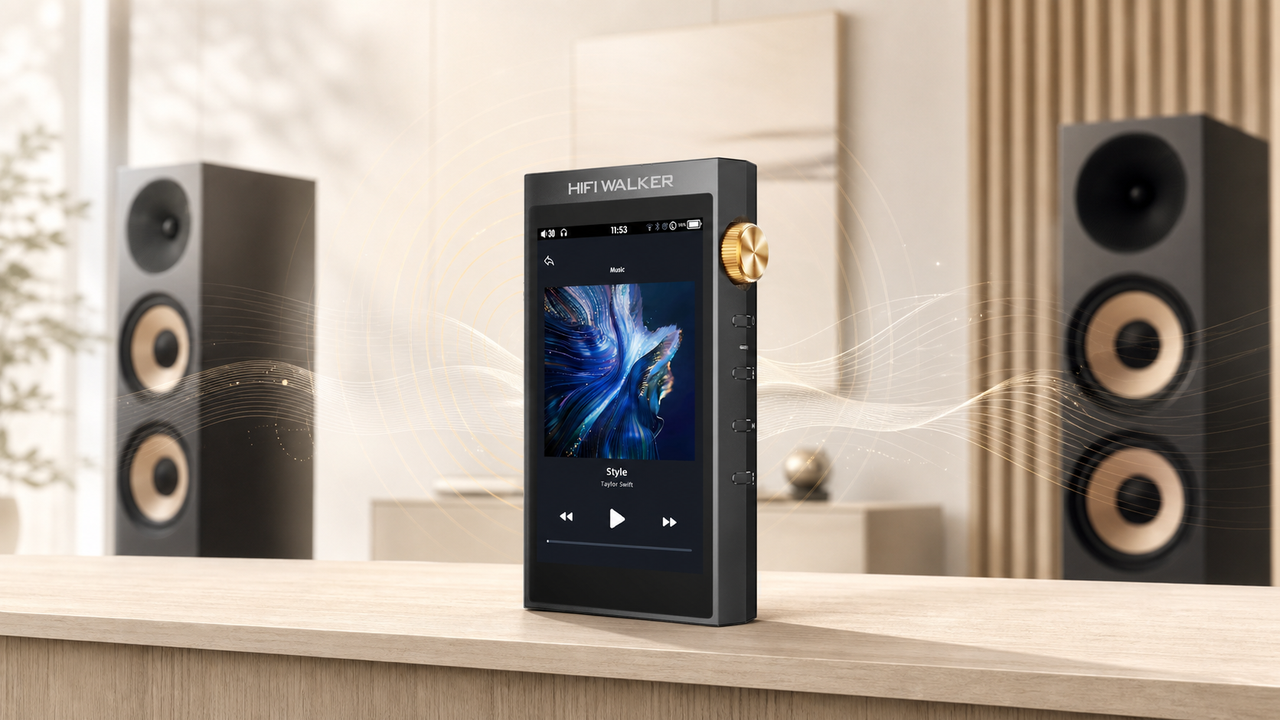
Quand HIFI WALKER a fixé le prix du lecteur audio Hi-Res HIFI WALKER H20 Ultra à $239.99, la marque ne devinait pas ce que le marché tolérerait. Elle visait un plafond de performance précis — défini par la puce DAC ESS9038Q2M, le décodage DSD256 natif, et un double étage amplificateur RT6862/6863 capable de délivrer 380 mW dans une charge de 32 Ω. Cet article décortique exactement ce que cela signifie pour l'écoute réelle, l'usage en DAC USB de bureau, et pourquoi le DAP H20 Ultra se hisse au sommet de la gamme Hi-Res portable.
Si vous avez déjà passé du temps avec des DAP de niveau flagship, vous connaissez déjà la différence entre un lecteur qui cite un nom de puce DAC à des fins marketing et un autre qui extrait réellement toute la performance du silicium. Le H20 Ultra appartient à cette seconde catégorie. Passons en revue couche par couche — architecture de la puce, étage de sortie, prise en charge des formats, implémentation du DAC USB, et ingénierie du châssis.

- ►1. Pourquoi le DAP H20 Ultra mérite une véritable analyse technique
- ►2. ESS9038Q2M : ce que le silicium offre réellement
- ►3. Architecture amplificatrice : le double RT6862/6863 et ce que 380 mW signifie vraiment
- ►4. Mode DAC USB : intégrer le H20 Ultra dans une installation de bureau
- ►5. Châssis en aluminium et fabrication CNC : concevoir un corps à la hauteur de l'électronique
- ►6. Prise en charge des formats et performance de bibliothèque locale : FLAC, DSD et au-delà
- ►7. Comment se compare le H20 Ultra : sa place dans la gamme HIFI WALKER
- ►8. Le verdict : qui devrait acheter le DAP H20 Ultra
ESS9038Q2M : ce que le silicium offre réellement
L'ESS9038Q2M n'est pas un compromis d'entrée de gamme — c'est la variante mobile de la famille flagship 9038 d'ESS, dotée de la même architecture de modulateur HyperStream II 32 bits que l'on retrouve dans les unités DAC de bureau dédiées. Dans le H20 Ultra, HIFI WALKER la déploie dans une configuration à deux canaux entièrement symétrique, permettant à chaque canal de fonctionner indépendamment sans interférence de plan de masse partagé.
Ce que permet l'ESS9038Q2M
- Décodage DSD256 natif sans surcharge DoP
- Lecture PCM jusqu'à 768 kHz / 32 bits
- Modulateur HyperStream II 32 bits par canal
- Bruit de fond intrinsèque ultra-faible pour les écouteurs intra-auriculaires très sensibles
- Traitement synchrone pour une image stéréo précise en phase
Comment HIFI WALKER l'implémente
- Double étage amplificateur discret RT6862 / RT6863 en aval
- Chemin DSD natif contrôlé par FPGA — aucune conversion logicielle
- Sortie symétrique 380 mW @ 32 Ω — suffisant pour les casques planar
- Sorties symétrique 4,4 mm Pentaconn + asymétrique 3,5 mm
- Mode E/S DAC USB pour l'intégration dans une chaîne de signal de bureau
La couche FPGA mérite une attention particulière. Plutôt que d'acheminer les flux binaires DSD à travers un étage de conversion logicielle (qui introduit de la latence et des artefacts potentiels), le H20 Ultra utilise du matériel FPGA pour garder le DSD256 entièrement dans le domaine du flux binaire natif. Pour les auditeurs attentifs aux flux de travail DSD, le bénéfice concret est un chemin de signal plus propre qui évite un flux de travail converti en PCM.
Architecture amplificatrice : le double RT6862/6863 et ce que 380 mW signifie vraiment
Les caractéristiques de puissance de sortie sur les DAP ne sont utiles que lorsque la sortie et la charge sont clairement précisées. Le chiffre de 380 mW du H20 Ultra est spécifié à 32 Ω via la sortie symétrique 4,4 mm, offrant une marge de puissance utile aux casques et écouteurs intra-auriculaires filaires compatibles, tandis que le volume final dépend toujours de l'impédance, de la sensibilité et du niveau d'écoute.
Pour les casques exigeants dans la plage 100-300 Ω — pensez au Sennheiser HD 800 S ou au Beyerdynamic T1 — la marge de puissance de la sortie symétrique se traduit directement par un contrôle dynamique à des niveaux SPL plus élevés sans artefacts d'écrêtage. Le H20 Ultra n'est pas qu'une puissance de fiche technique ; la combinaison RT6862/6863 est choisie pour sa performance à faible distorsion, pas seulement pour son excursion de tension.

Mode DAC USB : intégrer le H20 Ultra dans une installation de bureau
L'une des capacités les plus sous-estimées du H20 Ultra pour les auditeurs à domicile est son mode E/S DAC USB. Connectez-le en USB à un Mac ou un PC, et l'ESS9038Q2M prend le relais comme périphérique de sortie audio du système — contournant l'audio intégré de votre carte mère, quel qu'il soit, et acheminant du PCM ou du DSD bit-perfect directement à travers l'étage amplificateur du H20 Ultra jusqu'à votre casque.
Connectez-vous en USB
Utilisez le port USB du H20 Ultra pour vous connecter à votre Mac ou PC Windows. L'appareil apparaît comme une interface audio de classe USB — aucune installation de pilote propriétaire n'est requise sur la plupart des systèmes.
Définissez-le comme périphérique de sortie par défaut
Dans les paramètres audio de votre système, sélectionnez le H20 Ultra comme périphérique de lecture par défaut. Pour une sortie bit-perfect, réglez la fréquence d'échantillonnage de votre logiciel audio pour qu'elle corresponde au fichier source (par exemple, 96 kHz pour un FLAC en 96 kHz).
Choisissez la sortie symétrique ou asymétrique
Branchez votre casque sur la prise symétrique 4,4 mm pour une capacité de pilotage maximale, ou sur la sortie asymétrique 3,5 mm pour les écouteurs intra-auriculaires et les charges plus légères. La molette de volume rotative gère le volume en mode DAC USB.
Configurez votre logiciel de lecture
Dans Roon, foobar2000, ou JRiver, réglez la sortie sur WASAPI Exclusive (Windows) ou Core Audio Exclusive (Mac) pour garantir que le signal contourne tout ré-échantillonnage du système d'exploitation et atteigne l'ESS9038Q2M intact.
Cela positionne le H20 Ultra comme un appareil à double rôle pour les auditeurs sérieux : un lecteur de musique Hi-Res autonome pour l'écoute loin du bureau, et un DAC/ampli casque de qualité référence au bureau. Pour les audiophiles qui veulent un seul appareil qui remplit les deux rôles sans compromis, c'est une architecture réellement convaincante. Consultez la collection complète de lecteurs Hi-Res HIFI WALKER pour le contexte plus large de la gamme.

Châssis en aluminium et fabrication CNC : concevoir un corps à la hauteur de l'électronique
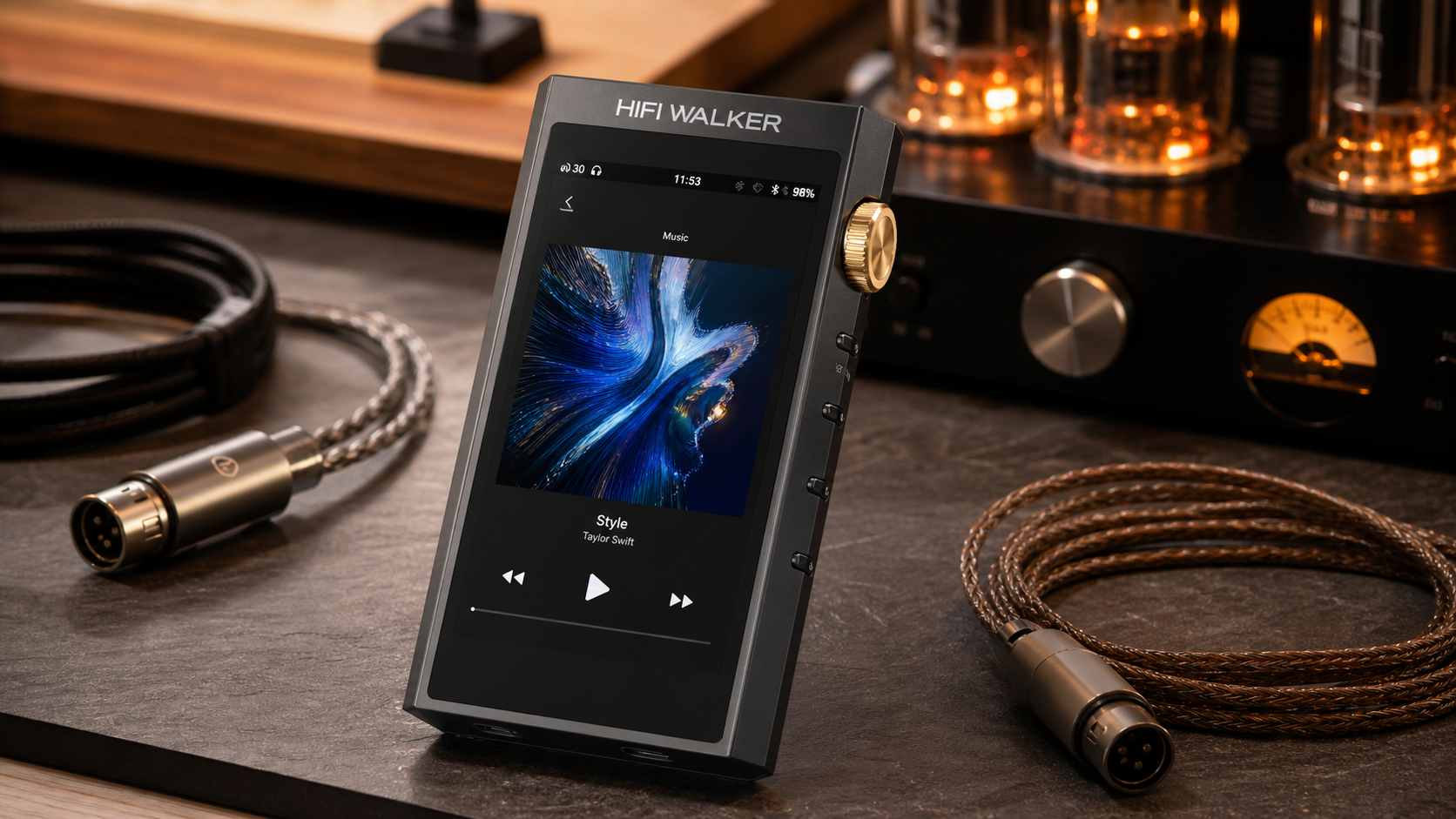
L'électronique interne ne raconte que la moitié de l'histoire technique. Le corps en aluminium usiné CNC du H20 Ultra confère au lecteur une sensation dense et rigide, et une finition premium autour de l'écran tactile, des boutons latéraux, et de la molette de volume rotative. Cette fabrication physique fait partie de l'attrait du H20 Ultra, au même titre que son DAC, son étage de sortie, et ses fonctions de lecture de fichiers locaux.
Points forts de la qualité de fabrication
- Corps en aluminium usiné CNC — blindage RF supérieur à un châssis plastique
- Panneau arrière texturé — finition visuelle premium assortie au châssis métallique
- Molette de volume rotative — réglage du volume tactile et facile
- Écran tactile de 4 pouces pour la navigation dans la bibliothèque et l'accès à l'égaliseur
- Boutons physiques en complément de la saisie tactile
Pourquoi cela compte au niveau de l'écoute
- Un plancher d'interférence induit par le châssis plus bas = un signal plus propre vers le DAC
- La sensation de châssis dense soutient les longues sessions d'écoute à domicile
- La molette de volume rotative facilite les petits ajustements de volume
- L'écran de 4 pouces restitue les pochettes d'albums et les formes d'onde à une résolution lisible
- Les boutons permettent de contrôler les pistes sans réveiller l'écran
Le motif arrière et le corps métallique méritent d'être soulignés, car ils font ressembler le lecteur à un véritable équipement audio sérieux plutôt qu'à un gadget portable générique. Pour l'écoute à domicile, cette qualité de fabrication tactile compte à chaque fois que vous le prenez en main, ajustez le volume, ou changez de sortie.
↑ Retour en haut
Retour en haut ↑Prise en charge des formats et performance de bibliothèque locale : FLAC, DSD et au-delà
La liste des formats pris en charge par le H20 Ultra part du principe que les auditeurs sérieux entretiennent des bibliothèques locales organisées en formats sans perte. La couverture PCM s'étend jusqu'à 768 kHz/32 bits, bien au-delà du plafond de 192 kHz de nombreux lecteurs milieu de gamme. La prise en charge DSD atteint le DSD256 natif via le chemin FPGA évoqué plus haut. Les formats sans perte standard — FLAC, WAV, APE — sont gérés nativement sans surcharge de transcodage.
Le stockage est assuré par la configuration actuelle avec carte de 128 Go, plus une extension T-card jusqu'à 512 Go — suffisant pour une bibliothèque DSD et FLAC haute résolution sérieuse, sans élagage constant. L'autonomie est annoncée à plus de 10 heures en mode veille avec économiseur d'écran, avec une charge d'environ 3,5 heures.
Le Bluetooth 5.1 avec LDAC et aptX-HD ajoute un usage sans fil flexible avec des enceintes ou casques compatibles, tandis que l'architecture bidirectionnelle TX/RX signifie que le H20 Ultra peut aussi recevoir de l'audio depuis des sources Bluetooth prises en charge. Pour en savoir plus sur l'approche de HIFI WALKER en matière de sans-fil Hi-Res, consultez le blog Tests et comparatifs de DAP.
Comment se compare le H20 Ultra : sa place dans la gamme HIFI WALKER
Pour les auditeurs qui évaluent la place du lecteur audio Hi-Res HIFI WALKER H20 Ultra par rapport aux autres options de la gamme, l'axe de décision est principalement la puissance de sortie et l'architecture du DAC. Le H20 Pro occupe le niveau milieu de gamme flagship ; le H2 Touch et le H2 offrent un excellent rapport qualité-prix à des tarifs plus bas. Mais le H20 Ultra combine la conversion DAC ESS9038Q2M, la prise en charge du DSD256, le mode DAC USB, et une sortie symétrique 4,4 mm de 380 mW dans un seul lecteur local flagship.

Si votre collection de casques penche vers des écouteurs intra-auriculaires très sensibles ou des dynamiques faciles à piloter sous 100 Ω, l'écart de performance entre le H20 Pro et le H20 Ultra se réduit. Mais si vous utilisez des planar magnétiques ou des dynamiques à haute impédance et voulez une capacité DAC USB de classe bureau dans le même appareil, l'architecture du H20 Ultra est conçue précisément pour cet usage.

Le verdict : qui devrait acheter le DAP H20 Ultra
Le lecteur audio Hi-Res HIFI WALKER H20 Ultra est conçu pour un auditeur précis : quelqu'un qui entretient une bibliothèque organisée sans perte et DSD, possède des casques exigeants qui bénéficient d'une puissance de sortie symétrique élevée, et veut un seul appareil qui serve à la fois de source Hi-Res portable et de DAC USB de bureau. À $239.99, c'est une mise à niveau ciblée pour les auditeurs qui veulent la lecture Hi-Res locale, le mode DAC USB, et une sortie filaire symétrique en un seul appareil.
Achetez le H20 Ultra si vous...
- Possédez des casques planar ou à haute impédance nécessitant plus de 200 mW en pilotage symétrique
- Avez une bibliothèque DSD256 / FLAC Hi-Res que vous prenez au sérieux
- Voulez remplacer un DAC/ampli de bureau séparé par un appareil à double usage
- Privilégiez le DSD natif FPGA à la conversion logicielle DoP
- Donnez la priorité à la qualité de fabrication en aluminium, au contrôle de volume rotatif et aux boutons physiques
Envisagez le H20 Pro / H2 Touch si...
- Vos casques sont principalement des écouteurs intra-auriculaires très sensibles sous 32 Ω
- L'intégration DAC USB de bureau n'est pas un usage prioritaire
- Votre flexibilité budgétaire vous oriente vers la gamme $1,505 ou $1,123
- Préférez un format plus compact à une marge de puissance de sortie maximale
Chaque achat du H20 Ultra inclut la livraison gratuite, une fenêtre de retour de 30 jours, et une garantie 1 an — l'engagement standard de HIFI WALKER au niveau flagship. Pour un regard approfondi sur le paysage plus large des lecteurs Hi-Res, consultez le blog Actualités Audio HIFI WALKER.
Questions fréquentes
Q1 : Quelle puce DAC utilise le H20 Ultra, et pourquoi est-ce important ?
Le H20 Ultra utilise l'ESS9038Q2M — la variante mobile de la famille de DAC flagship 9038 d'ESS. Elle dispose d'une architecture de modulateur HyperStream II 32 bits et prend en charge le DSD256 natif et le PCM jusqu'à 768 kHz/32 bits. Dans le H20 Ultra, elle est associée à un double étage amplificateur RT6862/6863, qui garde la section de gain séparée de la sortie analogique du DAC pour une diaphonie plus faible et une séparation du signal plus propre.
Q2 : Le H20 Ultra peut-il être utilisé comme DAC USB de bureau ?
Oui. Le H20 Ultra prend en charge le mode E/S DAC USB, vous permettant de le connecter à un Mac ou un PC via USB et de l'utiliser comme périphérique de sortie audio du système. L'ESS9038Q2M et l'étage amplificateur RT6862/6863 gèrent le décodage et l'amplification, contournant l'audio intégré de votre ordinateur. Réglez votre logiciel de lecture sur WASAPI Exclusive (Windows) ou Core Audio Exclusive (Mac) pour une sortie bit-perfect.
Q3 : Le H20 Ultra prend-il en charge le DSD256 natif, ou seulement le DoP ?
Le H20 Ultra prend en charge la lecture DSD256 native basée FPGA — pas le DoP (DSD over PCM). Le matériel FPGA achemine le flux binaire DSD directement vers l'ESS9038Q2M sans conversion logicielle, préservant le chemin de signal DSD natif et évitant la latence et les artefacts potentiels introduits par l'encapsulation DoP.
Q4 : Quelle puissance de sortie le H20 Ultra délivre-t-il sur la sortie symétrique ?
Le H20 Ultra délivre jusqu'à 380 mW à 32 Ω via la sortie symétrique 4,4 mm. Cela offre une marge de puissance utile à de nombreux casques filaires et écouteurs intra-auriculaires compatibles, tandis que le résultat final dépend toujours de la sensibilité du casque, de son impédance et du niveau d'écoute. La sortie asymétrique 3,5 mm est également disponible pour les écouteurs intra-auriculaires et les charges plus légères.
Q5 : Quelle est la capacité de stockage du H20 Ultra ?
La configuration commerciale actuelle du H20 Ultra inclut une carte de 128 Go et prend en charge une T-card jusqu'à 512 Go. Cela offre une capacité substantielle pour de grandes bibliothèques DSD256 et FLAC haute résolution, selon la taille des albums et les formats de fichiers.