


Expertinzichten: de belangrijkste conclusies
- Het FPGA-native DSD256-pad in de H20 Ultra is een betekenisvolle architectuurkeuze voor luisteraars die lokale DSD-bibliotheken bijhouden en onnodige softwareconversie vóór de DAC-trap willen vermijden.
- De RT6862/RT6863-versterkertrappen zijn net zo belangrijk als de ESS9038Q2M-DAC-chip zelf. Een sterke uitgangstrap stroomafwaarts helpt de speler om de DAC-specificatie om te zetten in nuttige bekabelde luisterprestaties bij de koptelefoonaansluiting.
- USB-DAC-modus verandert de waardepropositie van de H20 Ultra voor thuisluisteraars volledig. In plaats van apart te budgetteren voor een desktop-DAC/versterker en een draagbare DAP, combineert de H20 Ultra beide rollen — met dezelfde ESS9038Q2M-DAC en 380 mW gebalanceerde uitgang beschikbaar, of je nu aan je bureau zit of onderweg bent.
- De CNC-behuizing van aluminium is niet alleen cosmetisch. Ze geeft de H20 Ultra een dicht, stevig gevoel en een premium fysieke afwerking die past bij de vlaggenschippositionering, met de focus op geverifieerde bouwdetails.
- LDAC-tweerichtings-TX/RX-Bluetooth 5.1 maakt de H20 Ultra flexibel in desktopconfiguraties. Hij kan zenden naar compatibele draadloze koptelefoons of ontvangen van ondersteunde Bluetooth-bronnen, terwijl bekabeld lokaal afspelen en USB-DAC-modus de belangrijkste audiofiele toepassingen blijven.
Waarom de H20 Ultra DAP een grondige technische analyse verdient
Toen HIFI WALKER de HIFI WALKER H20 Ultra Hi-Res Audio Player prijsde op $239.99, gokten ze niet zomaar naar wat de markt zou accepteren. Ze werkten toe naar een specifiek prestatieplafond — bepaald door de ESS9038Q2M-DAC-chip, native DSD256-decodering en een dubbele RT6862/6863-versterkertrap die 380 mW in een belasting van 32 Ω kan leveren. Dit artikel ontleedt precies wat dat betekent voor praktijkluisteren, desktop-USB-DAC-gebruik en waarom de H20 Ultra DAP bovenaan staat in de stapel draagbare Hi-Res-spelers.
Als je al ervaring hebt met DAP's van vlaggenschipniveau, ken je het verschil tussen een speler die een DAC-chipnaam voor marketingdoeleinden noemt en een die daadwerkelijk de volledige prestatie uit de chip haalt. De H20 Ultra is gebouwd voor dat laatste kamp. Laten we laag voor laag doorgaan — chiparchitectuur, uitgangstrap, formaatondersteuning, USB-DAC-implementatie en behuizingstechniek.

- ►1. Waarom de H20 Ultra DAP een grondige technische analyse verdient
- ►2. ESS9038Q2M: wat de chip werkelijk levert
- ►3. Versterkerarchitectuur: dubbele RT6862/6863 en wat 380 mW werkelijk betekent
- ►4. USB-DAC-modus: de H20 Ultra integreren in een desktopopstelling
- ►5. Behuizing van aluminium en CNC-bouw: de body afstemmen op de elektronica
- ►6. Formaatondersteuning en prestaties van je lokale bibliotheek: FLAC, DSD en meer
- ►7. Hoe de H20 Ultra zich verhoudt: waar hij past in het HIFI WALKER-assortiment
- ►8. Het oordeel: wie moet de H20 Ultra DAP kopen
ESS9038Q2M: wat de chip werkelijk levert
De ESS9038Q2M is geen budgetcompromis — het is de mobiele variant van ESS's vlaggenschip 9038-familie, met dezelfde 32-bit HyperStream II-modulatorarchitectuur die je terugvindt in dedicated desktop-DAC-units. In de H20 Ultra zet HIFI WALKER hem in in een volledig symmetrische tweekanaals-configuratie, waardoor elk kanaal onafhankelijk kan draaien zonder gedeelde grondvlak-interferentie.
Wat de ESS9038Q2M mogelijk maakt
- Native DSD256-decodering zonder DoP-overhead
- PCM-weergave tot 768 kHz / 32-bit
- 32-bit HyperStream II-modulator per kanaal
- Ultralage inherente ruisvloer voor zeer gevoelige oordopjes
- Synchrone verwerking voor faseaccuraat stereobeeld
Hoe HIFI WALKER het implementeert
- Dubbele discrete RT6862/RT6863-versterkertrap stroomafwaarts
- FPGA-gestuurd native DSD-pad — geen softwareconversie
- 380 mW @ 32 Ω gebalanceerde uitgang — genoeg voor planaire koptelefoons
- 4,4 mm Pentaconn gebalanceerd + 3,5 mm SE-uitgangen
- USB-DAC-I/O-modus voor integratie in de desktop-signaalketen
De FPGA-laag verdient bijzondere aandacht. In plaats van DSD-bitstreams door een softwareconversietrap te leiden (wat latentie en mogelijke artefacten introduceert), gebruikt de H20 Ultra FPGA-hardware om DSD256 volledig in het native bitstream-domein te houden. Voor luisteraars die zich bekommeren om DSD-workflows is het praktische voordeel een schoner signaalpad dat een geconverteerde PCM-workflow vermijdt.
Versterkerarchitectuur: dubbele RT6862/6863 en wat 380 mW werkelijk betekent
Specificaties van uitgangsvermogen op DAP's zijn alleen nuttig wanneer de uitgang en belasting duidelijk zijn. Het cijfer van 380 mW van de H20 Ultra is opgegeven bij 32 Ω via de 4,4 mm gebalanceerde uitgang, wat compatibele bekabelde koptelefoons en oordopjes nuttige headroom geeft, terwijl het uiteindelijke volume nog steeds afhangt van impedantie, gevoeligheid en luisterniveau.
Voor veeleisende koptelefoons in het bereik van 100–300 Ω — denk aan Sennheiser HD 800 S of Beyerdynamic T1 — vertaalt de headroom van de gebalanceerde uitgang zich rechtstreeks naar dynamische controle bij hogere SPL zonder clipping-artefacten. De H20 Ultra is niet zomaar vermogen op papier; de combinatie RT6862/6863 is gekozen voor prestaties met lage vervorming, niet alleen voor spanningszwaai.

USB-DAC-modus: de H20 Ultra integreren in een desktopopstelling
Een van de meest ondergewaardeerde mogelijkheden van de H20 Ultra voor thuisluisteraars is de USB-DAC-I/O-modus. Sluit hem via USB aan op een Mac of pc en de ESS9038Q2M neemt het over als audio-uitgangsapparaat van het systeem — waarbij de geïntegreerde audio van je moederbord wordt omzeild en bit-perfecte PCM of DSD rechtstreeks via de versterkertrap van de H20 Ultra naar je koptelefoon wordt geleid.
Sluit aan via USB
Gebruik de USB-poort van de H20 Ultra om verbinding te maken met je Mac of Windows-pc. Het apparaat verschijnt als USB-audio-class-interface — op de meeste systemen is geen installatie van een eigen driver nodig.
Stel in als standaard uitgangsapparaat
Selecteer in je OS-audio-instellingen de H20 Ultra als standaard afspeelapparaat. Voor bit-perfecte uitvoer stel je de samplerate in je audiosoftware in op die van het bronbestand (bijvoorbeeld 96 kHz voor 96 kHz FLAC).
Kies gebalanceerde of SE-uitgang
Sluit je koptelefoon aan op de 4,4 mm gebalanceerde aansluiting voor maximaal aandrijfvermogen, of op de 3,5 mm SE-uitgang voor oordopjes en lichtere belastingen. De draaiknop regelt het volume in USB-DAC-modus.
Configureer je afspeelsoftware
Stel in Roon, foobar2000 of JRiver de uitvoer in op WASAPI Exclusive (Windows) of Core Audio Exclusive (Mac), zodat het signaal alle OS-resampling omzeilt en intact bij de ESS9038Q2M aankomt.
Dit positioneert de H20 Ultra als een apparaat met een dubbele rol voor serieuze luisteraars: een standalone Hi-Res-muziekspeler voor luisteren onderweg, en een koptelefoon-DAC/versterker van referentiekwaliteit aan het bureau. Voor audiofielen die één stuk hardware willen dat beide zonder compromissen doet, is dit een echt overtuigende architectuur. Bekijk de volledige HIFI WALKER Hi-Res-spelerscollectie voor de bredere assortimentscontext.

Behuizing van aluminium en CNC-bouw: de body afstemmen op de elektronica
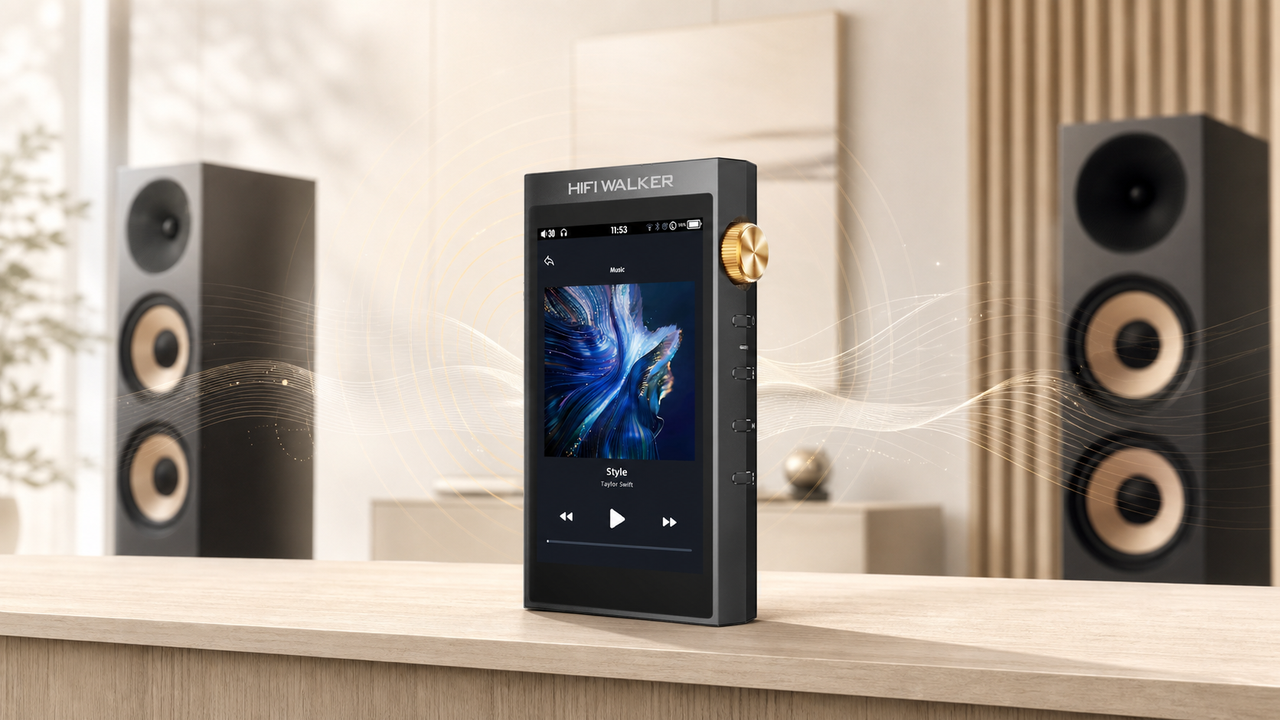
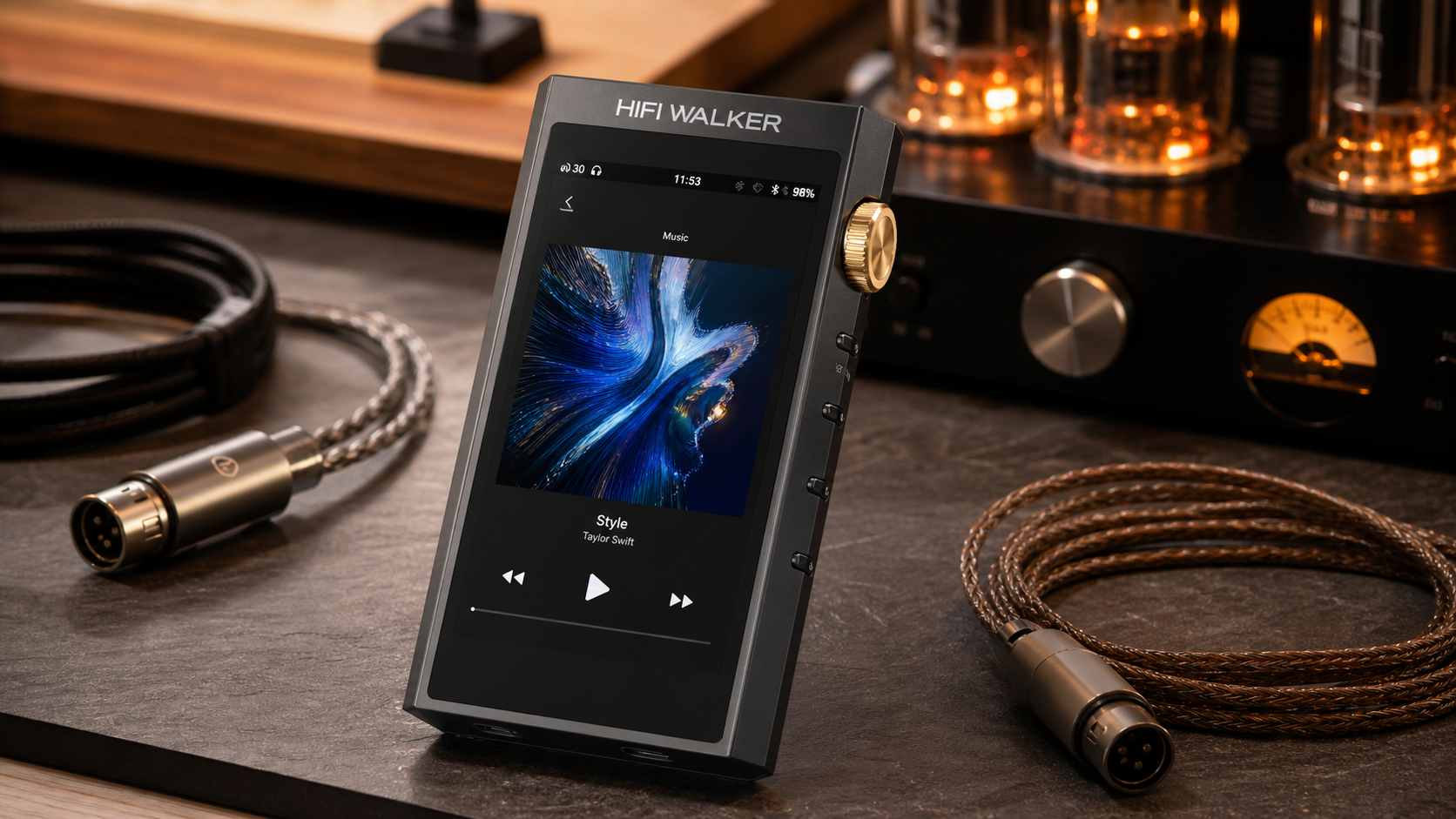
Interne elektronica is maar de helft van het technische verhaal. De CNC-bewerkte behuizing van aluminium geeft de H20 Ultra een dicht, stevig gevoel en een premium afwerking rond het touchscreen, de zijknoppen en de draaiknop voor het volume. Die fysieke bouwkwaliteit maakt deel uit van de aantrekkingskracht van de H20 Ultra, naast de DAC, de uitgangstrap en de functies voor het afspelen van lokale bestanden.
Hoogtepunten van de bouwkwaliteit
- CNC-behuizing van aluminium — superieure RF-afscherming vergeleken met kunststof behuizingen
- Gestructureerd achterpaneel — premium visuele afwerking die past bij de metalen behuizing
- Draaiknop voor het volume — tactiele, eenvoudige volumeaanpassing
- 4-inch touchscreen voor navigatie door de bibliotheek en toegang tot EQ
- Fysieke knopbediening naast touch-invoer
Waarom dit ertoe doet op luisterniveau
- Lagere door de behuizing veroorzaakte interferentievloer = schoner signaal naar de DAC
- Het dichte gevoel van de behuizing ondersteunt lange luistersessies thuis
- Draaiknop voor het volume maakt kleine volumeaanpassingen eenvoudig
- 4-inch scherm toont albumhoezen en golfvormen op leesbare resolutie
- Knoppen maken tracksturing mogelijk zonder het scherm te activeren
Het patroon op de achterkant en de metalen behuizing zijn het vermelden waard omdat ze de speler meer laten aanvoelen als een serieus stuk audiohardware dan als een generiek draagbaar gadget. Voor thuis luisteren doet die tactiele bouwkwaliteit ertoe, elke keer dat je hem oppakt, het volume aanpast of van uitgang wisselt.
↑ Terug naar boven
Terug naar boven ↑Formaatondersteuning en prestaties van je lokale bibliotheek: FLAC, DSD en meer
De lijst met ondersteunde formaten van de H20 Ultra is opgebouwd rond de aanname dat serieuze luisteraars zorgvuldig samengestelde lokale bibliotheken in lossless-formaten bijhouden. PCM-dekking reikt tot 768 kHz/32-bit, ver voorbij het plafond van 192 kHz van veel middenklasse-spelers. DSD-ondersteuning reikt tot native DSD256 via het hierboven besproken FPGA-pad. Standaard lossless-formaten — FLAC, WAV, APE — worden native verwerkt zonder transcodering-overhead.
Opslag wordt geregeld door de huidige 128 GB-kaartconfiguratie plus T-card-uitbreiding tot 512 GB — genoeg voor een serieuze DSD- en high-resolution FLAC-bibliotheek zonder constant te hoeven opschonen. De batterijduur wordt opgegeven als meer dan 10 uur in de schermbeveiliging-standbymodus, met een oplaadtijd van ongeveer 3,5 uur.
Bluetooth 5.1 met LDAC en aptX-HD voegt flexibel draadloos gebruik toe met compatibele speakers of koptelefoons, terwijl de tweerichtings-TX/RX-architectuur betekent dat de H20 Ultra ook audio kan ontvangen van ondersteunde Bluetooth-bronnen. Lees meer over de aanpak van HIFI WALKER voor Hi-Res draadloos in de blog met DAP-reviews en vergelijkingen.
Hoe de H20 Ultra zich verhoudt: waar hij past in het HIFI WALKER-assortiment
Voor luisteraars die willen weten waar de HIFI WALKER H20 Ultra Hi-Res Audio Player staat ten opzichte van andere opties in het assortiment, draait de beslissing vooral om uitgangsvermogen en DAC-architectuur. De H20 Pro bezet het mid-vlaggenschipniveau; de H2 Touch en H2 bieden sterke waarde tegen lagere prijzen. Maar de H20 Ultra combineert ESS9038Q2M-DAC-conversie, DSD256-ondersteuning, USB-DAC-modus en 380 mW 4,4 mm gebalanceerde uitgang in één vlaggenschip lokale speler.

Als je koptelefooncollectie meer neigt naar zeer gevoelige oordopjes of makkelijker aan te sturen dynamische drivers onder 100 Ω, wordt het prestatieverschil tussen de H20 Pro en H20 Ultra kleiner. Maar als je planaire drivers of dynamische drivers met hoge impedantie gebruikt en desktop-klasse USB-DAC-vermogen in hetzelfde apparaat wilt, is de architectuur van de H20 Ultra speciaal gebouwd voor precies dat gebruik.

Het oordeel: wie moet de H20 Ultra DAP kopen
De HIFI WALKER H20 Ultra Hi-Res Audio Player is ontworpen voor een specifieke luisteraar: iemand die een zorgvuldig samengestelde lossless- en DSD-bibliotheek bijhoudt, veeleisende koptelefoons bezit die baat hebben bij hoog gebalanceerd uitgangsvermogen, en één apparaat wil dat zowel als draagbare Hi-Res-bron als desktop-USB-DAC dient. Voor $239.99 is het een gerichte upgrade voor luisteraars die lokale Hi-Res-weergave, USB-DAC-modus en gebalanceerde bekabelde uitgang in één apparaat willen.
Koop de H20 Ultra als je…
- Planaire of hoge-impedantie koptelefoons hebt die 200 mW+ gebalanceerde aandrijving nodig hebben
- Een DSD256-/Hi-Res-FLAC-bibliotheek hebt die je serieus neemt
- Een apart desktop-DAC/versterker wilt vervangen door een apparaat met dubbel doel
- FPGA-native DSD verkiest boven software-DoP-conversie
- Prioriteit geeft aan bouwkwaliteit van aluminium, draaiknopvolumeregeling en fysieke knoppen
Overweeg H20 Pro / H2 Touch als…
- Je koptelefoons voornamelijk zeer gevoelige oordopjes onder 32 Ω zijn
- USB-DAC-desktopintegratie geen prioritaire toepassing is
- Budgetflexibiliteit wijst richting het bereik van $1,505 of $1,123
- Je een kleiner formaat verkiest boven maximale uitgangsheadroom
Elke aankoop van de H20 Ultra wordt geleverd met gratis verzending, een retourtermijn van 30 dagen en 1 jaar garantie — de standaardbelofte van HIFI WALKER op vlaggenschipniveau. Voor een diepgaande blik op het bredere landschap van Hi-Res-spelers, bekijk de HIFI WALKER Audio-nieuwsblog.
Veelgestelde vragen
Vraag 1: Welke DAC-chip gebruikt de H20 Ultra, en waarom is dat belangrijk?
De H20 Ultra gebruikt de ESS9038Q2M — de mobiele variant van ESS's vlaggenschip 9038-DAC-familie. Hij beschikt over een 32-bit HyperStream II-modulatorarchitectuur en ondersteunt native DSD256 en PCM tot 768 kHz/32-bit. In de H20 Ultra wordt hij gecombineerd met een dubbele RT6862/6863-versterkertrap, die de versterkingssectie gescheiden houdt van de analoge uitgang van de DAC voor minder overspraak en een schonere signaalscheiding.
Vraag 2: Kan de H20 Ultra gebruikt worden als desktop-USB-DAC?
Ja. De H20 Ultra ondersteunt USB-DAC-I/O-modus, waarmee je hem via USB kunt aansluiten op een Mac of pc en als audio-uitgangsapparaat van het systeem kunt gebruiken. De ESS9038Q2M en de RT6862/6863-versterkertrap verzorgen decodering en versterking, waarbij de geïntegreerde audio van je computer wordt omzeild. Stel je afspeelsoftware in op WASAPI Exclusive (Windows) of Core Audio Exclusive (Mac) voor bit-perfecte uitvoer.
Vraag 3: Ondersteunt de H20 Ultra native DSD256, of alleen DoP?
De H20 Ultra ondersteunt FPGA-gebaseerde native DSD256-weergave — geen DoP (DSD over PCM). De FPGA-hardware leidt de DSD-bitstream rechtstreeks naar de ESS9038Q2M zonder softwareconversie, waardoor het native DSD-signaalpad behouden blijft en de latentie en mogelijke artefacten van DoP-inkapseling worden vermeden.
Vraag 4: Welk uitgangsvermogen levert de H20 Ultra op de gebalanceerde uitgang?
De H20 Ultra levert tot 380 mW bij 32 Ω via de 4,4 mm gebalanceerde uitgang. Dat geeft veel compatibele bekabelde koptelefoons en oordopjes nuttige headroom, terwijl het uiteindelijke resultaat nog steeds afhangt van de gevoeligheid, impedantie en het luisterniveau van de koptelefoon. De 3,5 mm single-ended uitgang is ook beschikbaar voor oordopjes en lichtere belastingen.
Vraag 5: Wat is de opslagcapaciteit van de H20 Ultra?
De huidige verkoopconfiguratie van de H20 Ultra bevat een 128 GB-kaart en ondersteunt een T-card tot 512 GB. Dat biedt aanzienlijke capaciteit voor grote DSD256- en high-resolution FLAC-bibliotheken, afhankelijk van albumformaten en bestandsformaten.