

Last updated: June 17, 2026
Expert Insights: Audio Amplifier Essentials 2026
- Output impedance matters more than output power for IEM users. A 0.5Ω output impedance DAP will sound more accurate with multi-driver IEMs than a 500mW amp with 10Ω output impedance.
- Class D amplifiers in 2026 measure below 0.001% THD+N at listening levels — identical to Class A in controlled blind tests, with 3× better battery efficiency for portable use.
- The weakest link in most portable audio chains isn't the headphones or DAC — it's the amplifier stage in the smartphone. A $99 DAC/amp dongle or entry-level DAP makes a larger measurable improvement than headphone upgrades alone.
- Solid-state amplifier 'break-in' is not supported by measurement data. Any perceived change over days of use is listener adaptation (brain accommodation), not component change. Trust measurements taken immediately after power-up.
What Is an Audio Amplifier and Why It Still Matters in 2026
An audio amplifier is the critical link between your music source and your headphones or speakers. It takes low-level electrical signals—often just millivolts from a DAC or streaming player—and boosts them to drive transducers at proper volume and dynamics. In 2026, as lossless FLAC, DSD256, and hi-res streaming become mainstream, your amplifier chain is more important than ever for getting every detail out of your recordings.
This guide covers how audio amplifiers work, the key differences between amplifier classes (Class A, AB, D, and tube), what specs like THD and SNR actually mean, how impedance matching affects your headphones, and how modern hi-res DAP players integrate professional-grade amplification in a pocket-sized form factor.
Built-In Amp Problems
- Weak output — often under 10mW
- High noise floor from digital interference
- Poor impedance matching for most headphones
- Compressed dynamic range on peaks
Dedicated Amplifier Benefits
- Clean, powerful output — 100mW+ balanced
- Ultra-low distortion (<0.001% THD+N)
- Correct impedance control for any headphone
- Full dynamic range preserved at all volumes

Professional rack-mounted amplifier systems — the reference point for portable DAP amplification design.
- ►1. What Is an Audio Amplifier and Why It Still Matters in 2026
- ►2. How Audio Amplifiers Work: Signal Path Explained
- ►3. Amplifier Classes Explained: Class A, AB, D, and Tube
- ►4. Key Amplifier Specifications: What the Numbers Actually Mean
- ►5. Impedance Matching: The Spec That Makes or Breaks Your Sound
- ►6. Digital vs Analog Amplification in 2026: Which Is Right for You?
- ►7. How to Choose the Right Amplifier for Your Setup in 2026
- ►8. Common Amplifier Myths Debunked: Engineering vs. Audiophile Folklore
- ►9. DAP vs Dedicated Amp: Which Amplifier Path Is Right for Portable Listening?
How Audio Amplifiers Work: Signal Path Explained
Every audio amplifier — whether a $50,000 studio rack unit or the amplifier stage inside a portable DAP — follows the same fundamental signal path. Transistors or vacuum tubes control a larger power supply current using a smaller input signal, effectively multiplying signal power while preserving waveform shape. Understanding this chain helps you diagnose sound quality issues at every stage.
Signal Input Stage
Low-level audio signals (typically 0.1–2V RMS) enter through high-impedance input buffers. The buffer prevents loading of the source — whether a DAC chip outputting 2Vrms or an LDAC Bluetooth receiver — ensuring the full signal voltage reaches the amp stage intact.
Voltage Amplification Stage
Op-amps or discrete transistor circuits boost signal voltage by the amplifier's gain factor. Premium designs use matched component pairs, low-noise op-amps (like OPA1612 or LME49720), or dual-differential topologies to minimize added noise and harmonic distortion during this stage.
Current Amplification (Output Stage)
The output stage transistors supply the current demanded by the load — your headphones. A 300Ω headphone at 100mW needs only ~5.5mA, while a 16Ω IEM at the same power requires ~79mA. The output stage must source this current cleanly without clipping or crossover distortion.
Negative Feedback Loop
A portion of the output signal is fed back to the input, inverted. This corrects gain errors, reduces THD, and flattens frequency response. The amount of feedback is a key design choice — more feedback lowers distortion but can cause instability with reactive headphone loads.

Typical op-amp based headphone amplifier circuit showing input buffer, gain stage, and output stage.
Amplifier Classes Explained: Class A, AB, D, and Tube
Amplifier operating class describes how the output transistors conduct current relative to the audio waveform. This single design decision determines efficiency, heat generation, distortion character, and sonic signature. In 2026, Class D has matured dramatically — but each class still has a legitimate place depending on your listening context and headphone choice.
Solid-State Advantages
- Consistent performance regardless of temperature
- No component replacement cycles
- Compact enough for portable devices
- Precise, low-distortion, analytical sound
- Ideal for revealing hi-res recording detail
Tube Amplifier Character
- Natural even-order harmonic enhancement
- Forgiving of harsh or compressed recordings
- Vintage aesthetic with genuine sonic warmth
- Euphonic midrange — vocals sound organic
- Soft clipping behavior vs solid-state hard clip
Key insight for 2026: Class D amplifiers — once dismissed as too harsh for headphones — now power some of the best portable DAPs on the market. Modern implementations like those in the H20Ultra achieve THD+N below 0.001% with 90%+ battery efficiency, delivering desktop-class sound from a player that fits in your jacket pocket.

HIFI WALKER H20Ultra — ESS9038Q2M DAC, balanced 4.4mm output, and Class D amplification in a portable form factor.
Key Amplifier Specifications: What the Numbers Actually Mean
Amplifier marketing is full of impressive-sounding numbers. Knowing which specs genuinely predict sound quality — and which are marketing noise — saves you money and frustration. Here are the measurements that matter most when evaluating any headphone amplifier or DAP in 2026.
The output impedance rule of eighths is the most overlooked specification: your amplifier's output impedance should be 1/8th or less of your headphone's impedance. A 0.5Ω output impedance pairs with anything from 4Ω IEMs to 600Ω vintage headphones without altering frequency response. Violate this rule and you get bass-light or artificially warm sound — depending on the headphone's impedance curve.

Professional APx585 measurement rig — how amplifier THD, SNR, and dynamic range are objectively measured.
Impedance Matching: The Spec That Makes or Breaks Your Sound
Impedance matching is the single most important — and most ignored — factor in headphone amplifier selection. Get it wrong and even an expensive amplifier will sound tonally incorrect with your headphones. The interaction between amplifier output impedance and headphone impedance directly shapes the frequency response curve you actually hear.
For IEM users: a high output impedance amplifier — say, 10Ω — paired with a multi-armature IEM that has impedance swings from 4Ω to 40Ω across frequencies will produce significant tonal coloration. Always check the output impedance spec before pairing sensitive IEMs with any source device, including DAPs and DAC/amp dongles.
Low-Impedance Headphones (≤32Ω)
- Need current-capable amplifier output stages
- Very sensitive to output impedance mismatches
- Higher dB/mW sensitivity — easier to overdrive
- Dominant in portable/consumer headphone market
High-Impedance Headphones (250Ω+)
- Require high-voltage amplifier swing
- More forgiving of output impedance variations
- Traditional studio and audiophile reference choice
- Better electrical noise immunity in studio environments

↑ Back to Top
Back to Top ↑Digital vs Analog Amplification in 2026: Which Is Right for You?
The digital vs analog amplification debate has shifted dramatically by 2026. Advanced DSP processing, GaN transistors, and improved Class D topologies have closed the measurable performance gap to near zero. Yet the two approaches offer different practical advantages — and understanding the tradeoffs helps you choose the right tool for your listening habits.

Internal layout comparison: analog Class A circuitry (left) vs. modern Class D digital amplifier board (right).
Traditional Analog Amplification
- Continuous signal — no sampling or conversion
- Natural harmonic structure with some even-order character
- Proven 50-year track record of reliability
- Warmer tonal presentation preferred by many audiophiles
- Simpler repair — passive components, easy to service
Modern Digital/Class D Amplification
- PWM switching at 300kHz+ for high efficiency
- Advanced DSP: parametric EQ, crossfeed, filters
- 85–95% efficiency — critical for portable battery life
- Precise digital volume control without channel imbalance
- Software-updateable — features improve over time
The best modern DAPs — like the H2 Touch — take a hybrid approach: digital processing for convenience features (Android apps, LDAC, parametric EQ) feeding into a precision analog output stage. This gives you Spotify, Tidal, and local-file playback through a separate player setup, keeping music use separate from your phone.

HIFI WALKER H2 Touch — Android music player combining digital streaming convenience with a dedicated analog amplifier stage.
How to Choose the Right Amplifier for Your Setup in 2026
Choosing an audio amplifier in 2026 means matching the technology to your specific headphones, use case, and budget — not chasing marketing claims. Follow this structured decision process to avoid common mistakes and ensure your amplifier actually improves your listening experience.
Audit Your Headphone's Electrical Requirements
Check your headphones' impedance (Ω) and sensitivity (dB/mW). Low-sensitivity planar magnetics (like HiFiMAN at 83dB/mW, 35Ω) demand far more power than efficient IEMs (115dB/mW, 16Ω). Calculate minimum power: P = (desired SPL − sensitivity) dB × conversion factor. For most headphones, 50–200mW clean power provides adequate headroom.
Define Your Primary Use Case
Desktop home listening: prioritize output power, Class A or AB for warmth, large power supply. Daily commute: prioritize battery life, Class D efficiency, compact form — a portable DAP with built-in amp is ideal. Studio monitoring: prioritize flat frequency response, low output impedance, accurate reproduction over coloration.
Decide: Dedicated Amp vs DAP with Built-In Amp
A dedicated amp requires a separate DAC source. A modern DAP like the H20 Pro or H20Ultra combines ESS Sabre DAC + balanced amplifier in one unit — eliminating the interconnect between DAC and amp (often a source of noise pickup). For portable use, an all-in-one DAP is almost always the better technical choice in 2026.
Prioritize Balanced Output for Maximum Performance
Balanced (4.4mm Pentaconn or 2.5mm TRRS) amplifier outputs deliver up to 4× the power of single-ended outputs and reject common-mode noise through differential signaling. If your headphones support balanced cables, ensure your amplifier has a true balanced output stage — not just a balanced connector wired to a single-ended circuit.
Set a Realistic Budget with Diminishing Returns in Mind
Measurable performance (THD, SNR, dynamic range) improves rapidly up to $150–200 in 2026. Beyond that, improvements become increasingly marginal. Focus budget on the DAC/amp combination that matches your headphone impedance correctly, not on premium aesthetics or exotic components.

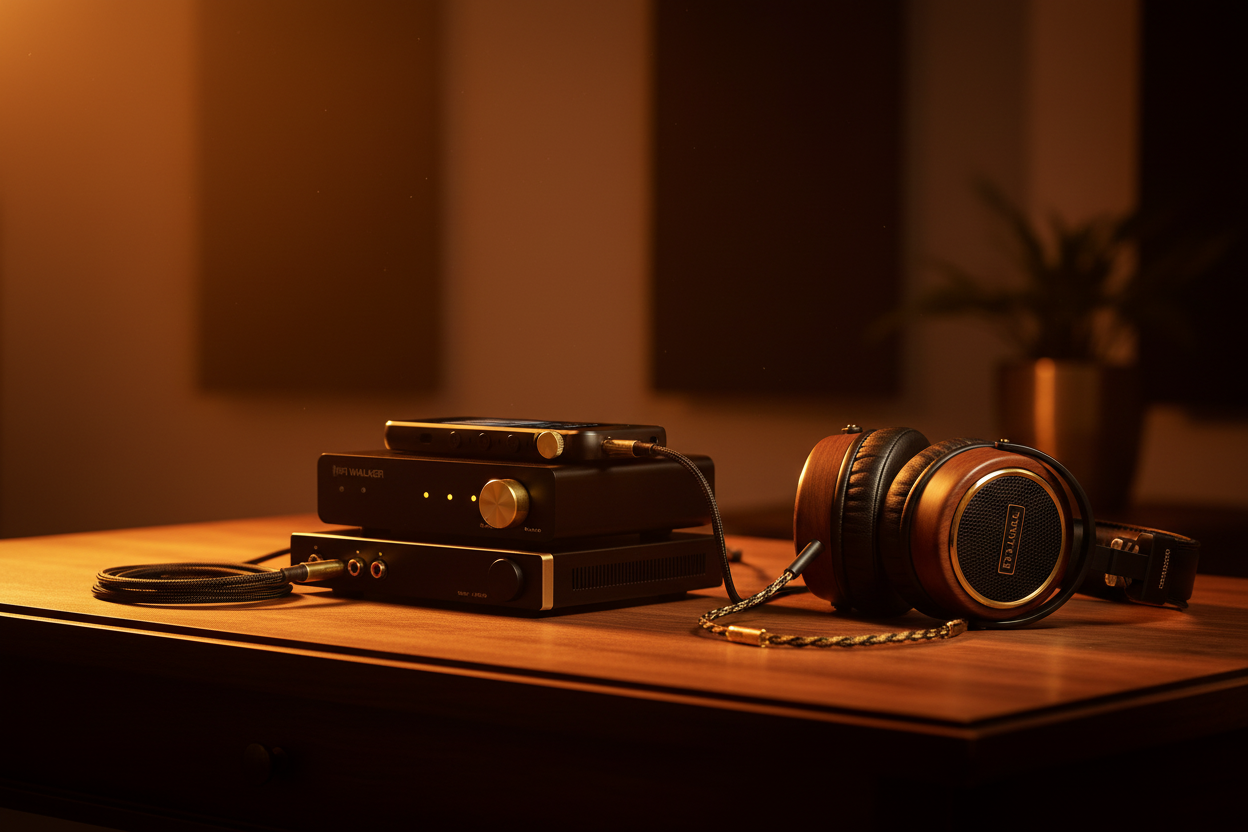
A complete desktop audiophile setup: DAC source, dedicated headphone amplifier, and high-impedance open-back headphones.

Common Amplifier Myths Debunked: Engineering vs. Audiophile Folklore
The audio world is unusually prone to mythology — partly because sound quality is subjective, and partly because expensive gear creates confirmation bias. Here's what measurement science and blind testing actually tell us about audio amplifier performance in 2026.
The Myth
- "More expensive always sounds better"
- "Tube amps are always superior"
- "Higher wattage equals higher quality"
- "Gold-plated cables improve the signal"
- "Burn-in improves solid-state amps over time"
- "Class D sounds harsh and digital"
The Engineering Reality
- THD and SNR specs predict performance better than price
- Solid-state measures lower distortion — tubes add euphonic coloration
- Clean power at your specific impedance matters, not peak wattage
- Copper conducts audio signals perfectly — gold prevents corrosion only
- Solid-state circuits are fully broken in within minutes, not weeks
- Modern GaN Class D amps measure below 0.001% THD — indistinguishable from Class A in blind tests
The most consequential myth is the "more power is better" fallacy. An amplifier with 1000mW output but 0.1% THD sounds worse than one with 200mW output and 0.001% THD — assuming both have enough headroom for your headphones. Always check distortion at your actual listening level, not just peak specification power.
Similarly, amplifier "break-in" for solid-state designs is not supported by engineering evidence. Transistor operating points stabilize within the first few minutes of operation. Any perceived improvement over days or weeks is listener adaptation — your ears and brain adjusting to a new sound signature. This is well-documented in controlled blind test literature. Tube amp components do change over their lifetime, but that's wear, not improvement.
DAP vs Dedicated Amp: Which Amplifier Path Is Right for Portable Listening?
For portable listeners in 2026, the classic "separate DAC + separate amp" chain has largely been superseded by high-performance all-in-one digital audio players (DAPs). Modern DAPs integrate ESS Sabre or AKM DAC chips alongside discrete amplifier circuits — eliminating the interconnect cable between DAC and amp that traditionally introduced noise and impedance complications.
The D20 USB-C DAC/Amp Dongle offers a compelling middle path: plug it into any USB-C Android phone or laptop and instantly gain a balanced 4.4mm amplifier output with THD well below 0.01%. For listeners not ready to commit to a full DAP, it's the highest-leverage amplifier upgrade available at $99.
Frequently Asked Questions
Q1: Do I need a separate audio amplifier if my phone or DAP already has one built in?
Built-in smartphone amplifiers typically output under 10mW with high noise floors from nearby digital circuits — fine for efficient IEMs but inadequate for demanding headphones. A dedicated amplifier or a quality DAP like the HIFI WALKER H20 Pro (380mW balanced) provides clean power, proper impedance matching, and dynamic range to unlock your headphones' full potential. If you own 32Ω+ sensitivity headphones, a dedicated amp makes a measurable, audible difference.
Q2: How much amplifier power do I need for my headphones?
Most headphones need 1–10mW for comfortable listening, but having 10× headroom (10–100mW) ensures clean reproduction of dynamic peaks without clipping. High-impedance headphones (250–300Ω, like Sennheiser HD600) may need 100–200mW for optimal performance. Planar magnetics with low sensitivity (83–88dB/mW) often require 500mW+. Check your headphones' impedance and sensitivity specs, then target an amplifier delivering at least 5× your minimum power requirement.
Q3: What is balanced output on a headphone amplifier and does it actually help?
Balanced amplifier outputs (4.4mm Pentaconn or 2.5mm TRRS) use separate positive/negative signal paths for each channel with no shared ground. This delivers up to 4× the power of single-ended outputs, rejects common-mode noise, and eliminates crosstalk between channels. On quality DAPs like the H20Ultra, balanced output measures noticeably lower THD than single-ended at the same volume. For home listening or noisy environments, balanced output is worth using if your headphones support it.
Q4: Is a tube amplifier or solid-state amplifier better for headphones in 2026?
Neither is objectively better — they offer different sonic presentations. Solid-state amplifiers measure lower distortion (<0.001% THD) and more accurate frequency response; they reveal exactly what's in your recording. Tube amplifiers add even-order harmonic character (pleasant, musical warmth) that many listeners prefer, especially with bright or harsh recordings. In 2026, the best portable DAPs use solid-state with optional EQ tuning to approximate tube warmth without the maintenance overhead of actual valves.
Q5: What does output impedance mean and why does it matter for IEMs?
Output impedance is the amplifier's internal source resistance. The 1/8 rule states your amplifier's output impedance should be ≤1/8 of your headphone's impedance for a flat frequency response. For a 16Ω IEM, you need <2Ω output impedance. A high-impedance source (10Ω) paired with a multi-armature IEM whose impedance swings from 4–40Ω across frequencies will produce significant tonal coloration — typically sounding bass-light or overly bright. Always check this spec before pairing sensitive IEMs with any amplifier.
Q6: Can a better amplifier improve compressed MP3 audio quality?
A better amplifier cannot restore information lost in MP3 compression, but it will reveal more detail in the frequency content that remains — including, unfortunately, compression artifacts that become more audible through a transparent amp. The practical effect: a clean amplifier makes the difference between 128kbps and 320kbps MP3 clearly audible, which often motivates switching to lossless FLAC or streaming hi-res audio for the most satisfying long-term experience.