

Expert Insights: Key Takeaways
- DSD256 native decoding at sub-$110 was impossible to find before 2023 — the H2 Mini's ESS Sabre DAC inclusion represents genuine democratization of audiophile format support.
- PCM 32bit/384kHz's main advantage in portable players isn't the 384kHz ceiling itself — it's that a 384kHz-capable DAC typically uses gentler, more phase-accurate anti-aliasing filters on lower-rate content like standard 44.1kHz FLAC.
- The physical-button interface on the H2 Mini is a deliberate engineering choice for audiophile portability: no touchscreen means no digitizer layer between your ear and the music, and gloved/pocket operation works reliably where touchscreens fail.
Why Your Audio Format Choice Matters More Than Ever in 2026
If you're shopping for a dedicated audio player in 2026, the spec sheet will hit you fast: DSD64, DSD256, PCM 24/96, PCM 32bit/384kHz, MQA, FLAC — it reads like a decoder ring challenge. But here's the truth: understanding these formats is the single fastest way to decide whether a player actually delivers on its hi-res promise. This guide is built around the HIFI WALKER H2 Mini Hi-Res Music Player, a compact, sub-$110 hifi music player that punches well above its price by supporting the full format spectrum. By the end of this article you'll know exactly what DSD256 and PCM 32bit/384kHz mean, which one sounds better on the H2 Mini, and whether this player deserves a slot in your pocket.

The H2 Mini sits in a unique sweet spot: it's a true hifi mp3 player in form factor, yet its ESS Sabre DAC and native DSD decoding place it in audiophile territory that most sub-$150 devices simply can't reach. Format support isn't marketing fluff here — it's the whole story.
- ►1. Why Your Audio Format Choice Matters More Than Ever in 2026
- ►2. DSD Explained: What DSD64, DSD128, and DSD256 Actually Mean
- ►3. PCM Deep Dive: Why 32bit/384kHz Is Not Just Marketing
- ►4. DSD256 vs PCM 32bit/384kHz: The Real Listening Comparison
- ►5. H2 Mini Format Support: Full Spec Breakdown for the Informed Buyer
- ►6. H2 Mini vs Other HIFI WALKER Players: Which Format Tier Do You Need?
- ►7. Practical Setup: Getting the Best Out of DSD and FLAC on the H2 Mini
- ►8. Verdict: Is the H2 Mini the Right Format-Capable Audio Player for You?

DSD Explained: What DSD64, DSD128, and DSD256 Actually Mean
DSD stands for Direct Stream Digital — the same encoding format that gave SACD its legendary sound in the early 2000s. Instead of storing audio as multi-bit PCM samples, DSD uses a single-bit bitstream at a very high sample rate. The number after "DSD" is a multiplier of the base 2.8224 MHz rate used on SACD discs.
DSD Tier Breakdown
- DSD64 (2.8224 MHz) — base SACD quality, widely available
- DSD128 (5.6448 MHz) — studio download standard, noticeably richer texture
- DSD256 (11.2896 MHz) — audiophile peak, requires capable DAC hardware
- DSD512 (22.5792 MHz) — niche mastering tier, heavy CPU/DAC load
H2 Mini DSD Support
- Native DSD64 playback — no conversion, bit-perfect
- Native DSD128 playback — full hardware decoding
- Native DSD256 playback — confirmed on H2 Mini's ESS DAC
- File formats: .dsf and .dff both recognized
What makes DSD special is its noise-shaping design. The quantization noise is pushed far above the audible band (roughly 20 kHz), leaving the music signal remarkably clean between 20 Hz and 20 kHz. Many veteran listeners describe DSD as having a more analogue, less "digital edge" compared to equivalent-resolution PCM — though this is a genuine debate we'll address in the comparison section below.
PCM Deep Dive: Why 32bit/384kHz Is Not Just Marketing
PCM (Pulse-Code Modulation) is the format behind every CD (16bit/44.1kHz), every standard FLAC file, and most streaming services. The two numbers — bit depth and sample rate — tell you its ceiling for dynamic range and frequency response respectively. As a flac player the H2 Mini handles the full PCM stack.
Bit Depth → Dynamic Range
Each additional bit adds ~6 dB of dynamic range. 16bit = 96 dB (CD). 24bit = 144 dB. 32bit = 192 dB — exceeding the noise floor of any known recording environment. So 32bit is mostly headroom for DSP processing chains, not a perceptible ceiling in pure playback.
Sample Rate → Frequency Ceiling
Nyquist theorem: max reproducible frequency = sample rate ÷ 2. At 44.1kHz you get 22.05kHz (above human hearing). At 384kHz you get 192kHz. The practical benefit is in the steep anti-aliasing filter design — higher rates allow gentler, more phase-neutral filters in the audible band.
FLAC Compression — Lossless Always
FLAC encodes PCM data losslessly at 40–60% the original size. The H2 Mini decodes every FLAC bit depth and sample rate natively. Your 24bit/96kHz FLAC album arrives at the DAC chip pixel-perfect.
WAV vs FLAC on the H2 Mini
Both are lossless PCM containers. FLAC saves storage; WAV marginally reduces CPU overhead. On the H2 Mini's dedicated processor the difference is inaudible — use FLAC for the library space savings.

DSD256 vs PCM 32bit/384kHz: The Real Listening Comparison
This is the question every audiophile eventually asks: if my audio player supports both DSD256 and PCM 32bit/384kHz natively, which should I prioritize? Spoiler: it depends on your music library, not on one format being universally "better." Here's the honest breakdown.
The H2 Mini's ESS DAC handles both paths without software conversion — that's the critical differentiator at this price point. Budget players that claim "DSD support" are often silently converting DSD to PCM inside the firmware before hitting the DAC. The H2 Mini keeps each format on its native decode path, which is why the sonic character difference between DSD and PCM is actually audible on this device.

H2 Mini Format Support: Full Spec Breakdown for the Informed Buyer
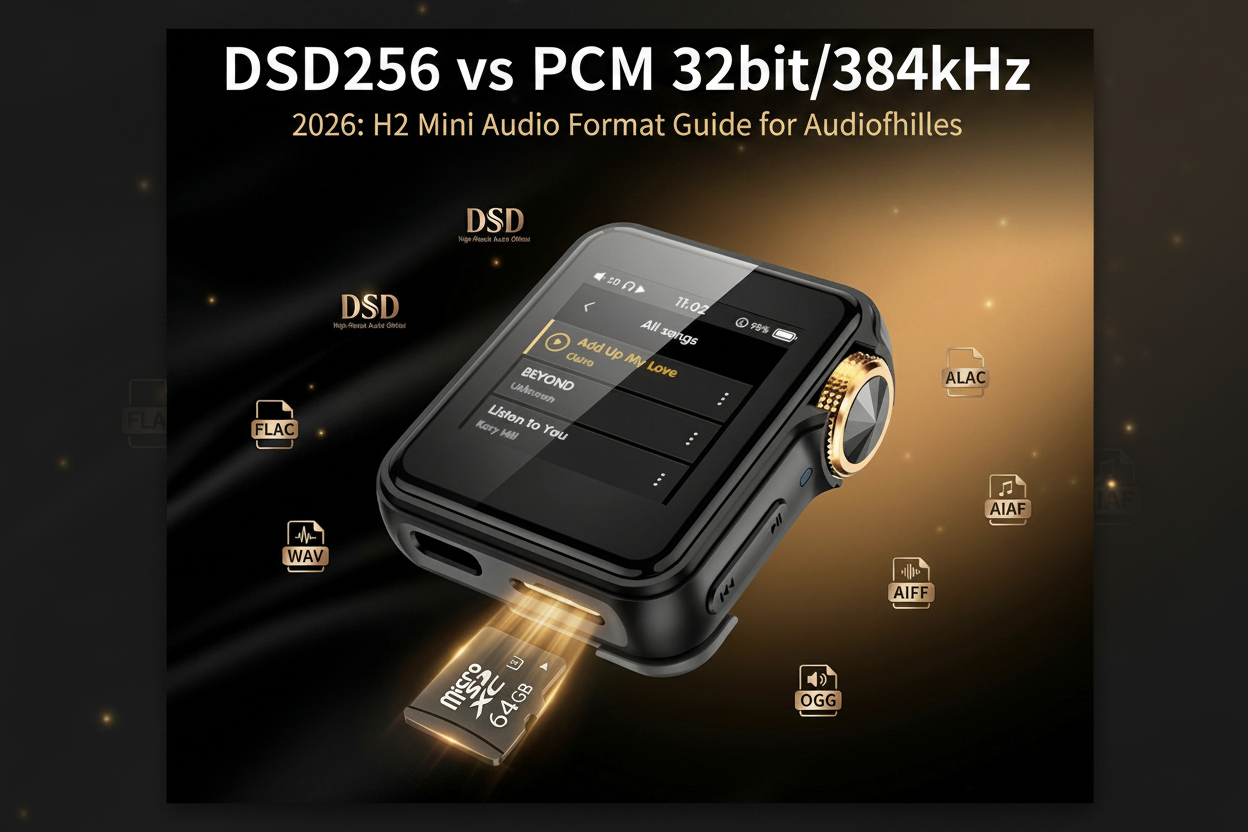
The HIFI WALKER H2 Mini Hi-Res Music Player was designed to be the most format-complete mp3 music player in its class. "mp3 music player" barely scratches the surface — the format list reads more like a flagship DAP than a sub-$110 device.
Lossless Formats Supported
- FLAC (up to 32bit/384kHz)
- WAV (up to 32bit/384kHz)
- APE (Monkey's Audio, all compression levels)
- AIFF (Apple lossless container, PCM encoded)
- DSD (.dsf, .dff) — DSD64 / DSD128 / DSD256
- DST-compressed DSD files
Lossy & Other Formats
- MP3 (up to 320kbps CBR/VBR)
- AAC / M4A (iTunes library compatible)
- OGG Vorbis
- WMA / WMA Lossless
- Opus codec support
- CUE sheet support for large FLAC albums
CUE sheet support deserves a special mention for serious collectors: if you've ripped vinyl or CD box sets into single-file FLAC + CUE, the H2 Mini will split chapters correctly on playback. That's a feature missing from most competing players at twice the price. Explore the full HIFI WALKER player lineup if you want to compare format support across models.
↑ Back to Top
Back to Top ↑H2 Mini vs Other HIFI WALKER Players: Which Format Tier Do You Need?
The H2 Mini doesn't exist in a vacuum. HIFI WALKER's 2026 lineup covers $90 to $240, and format support scales meaningfully with price. Here's how the H2 Mini positions against key siblings so you can calibrate your budget against your format ambitions.
For most listeners building a lossless offline library, the H2 Mini covers 95% of commercially available hi-res content — DSD512 and PCM 768kHz files are genuinely rare in real-world libraries. The jump to the H20Ultra Hi-Res Audio Player makes sense if you want balanced output, Android streaming apps, or dual-DAC architecture for measurably lower noise floors.

Practical Setup: Getting the Best Out of DSD and FLAC on the H2 Mini
Owning a capable flac player is only half the equation — the other half is your library workflow. Here's how to get bit-perfect playback on the HIFI WALKER H2 Mini Hi-Res Music Player from day one.
Choose Your MicroSD Card Wisely
The H2 Mini supports MicroSD up to 512GB. DSD256 files run ~5 GB/hour, so a 256GB card gives you ~50 hours of DSD256. Use a UHS-I U3 card to avoid read bottlenecks during DSD256 decode.
Organize Folders by Format
Create top-level folders: /FLAC, /DSD64, /DSD128, /DSD256. The H2 Mini scans by folder — keeping formats separated lets you instantly filter by quality tier from the navigation menu.
Disable Resampling in Settings
Navigate to Settings → Audio Output and confirm 'Direct Mode' or 'Bit-Perfect' is enabled. This bypasses any software sample-rate conversion and sends the native bitstream to the ESS DAC hardware decoder.
Set Gain Appropriately
DSD256 files are typically mastered at lower levels than PCM. If switching between formats mid-session, use the H2 Mini's gain control (+Low, Medium, High) — Medium gain covers most IEMs and portable headphones without noise floor bleed.
Protect Your Investment
The H2 Mini's aluminum chassis handles drops better than plastic rivals, but pairing it with the Protective PU Leather Case for H2 ($23.99) adds belt-clip portability and scratch protection for commutes and outdoor listening sessions.

Verdict: Is the H2 Mini the Right Format-Capable Audio Player for You?
After mapping every format tier from DSD64 to PCM 32bit/384kHz, one conclusion holds: the HIFI WALKER H2 Mini Hi-Res Music Player is the most format-complete audio player under $110 available in 2026. It doesn't just list DSD256 in marketing copy — it decodes it natively through a dedicated ESS Sabre DAC path, which is the difference you actually hear.
Buy the H2 Mini If…
- You have an offline FLAC/DSD library ready to go
- You want sub-$110 native DSD256 decoding
- Ultra-compact form factor matters (hiking, gym, commute)
- You prefer physical buttons over touchscreens
- 15-hour battery life is a priority
- You don't need Android streaming apps
Consider Stepping Up If…
- You need balanced 4.4mm or 2.5mm output
- Spotify / Tidal / Qobuz streaming is a must-have
- You want DSD512 or PCM 768kHz headroom
- Touchscreen navigation is non-negotiable
- You're driving high-impedance full-size headphones
- Budget allows $180–$240 range
For the price-conscious audiophile who's done their format homework — and that's exactly who this guide was written for — the H2 Mini is the easy answer. Check the HIFI WALKER DAP reviews and comparisons blog for deeper head-to-head breakdowns across the full lineup.
Frequently Asked Questions
Q1: Does the HIFI WALKER H2 Mini support native DSD256 playback or does it convert to PCM?
The H2 Mini supports true native DSD256 playback via its ESS Sabre DAC hardware decoder. The firmware keeps DSD on its own decoding path rather than converting it to PCM, which preserves the characteristic DSD sound signature. Files in both .dsf and .dff containers are recognized.
Q2: What's the highest PCM sample rate the H2 Mini can play?
The H2 Mini decodes PCM up to 32bit/384kHz natively. This covers virtually all commercially available hi-res PCM content from stores like Qobuz, HDtracks, and Bandcamp. FLAC, WAV, AIFF, and APE containers are all supported up to this ceiling.
Q3: Is there an audible difference between DSD256 and 24bit/96kHz FLAC on the H2 Mini?
Yes — in controlled listening the difference is subtle but real on the H2 Mini due to native decoding. DSD256 tends to sound slightly smoother and more analogue in character, particularly on acoustic instruments and vocals. 24bit/96kHz FLAC offers a slightly more precise stereo image. Neither is objectively better; the right choice depends on your music genre and personal preference.
Q4: Can the H2 Mini play MQA files?
The H2 Mini does not natively unfold MQA. It will play MQA-encoded FLAC files as standard FLAC (first unfold only, at the original 44.1kHz or 48kHz rate). For full MQA decoding up to 384kHz, you would need the H20 Pro or H20Ultra which have hardware MQA support.
Q5: How does the H2 Mini compare to a smartphone as an audio player for hi-res files?
Smartphones use integrated SoC audio codecs shared with other system tasks, limiting output quality and creating noise floor interference from cellular radios and processor activity. The H2 Mini's dedicated ESS Sabre DAC, single-function processor, and 15-hour battery make it dramatically more capable as a hi-res audio player — not just on paper but in measurable THD+N and output impedance specs.