

Expert Insights: Key Takeaways
- The H20 Ultra supports DSD256 through its ESS9038Q2M DAC, so travellers can bring local hi-res files into the cabin instead of relying on in-flight Wi-Fi or compressed streams.
- The 4.4mm balanced output is rated at 380mW/32R, giving compatible balanced headphones and IEMs more headroom than the 3.5mm output without promising that every difficult full-size headphone will be an ideal match.
- Bluetooth 5.1 supports two-way RX/TX operation with LDAC and aptX-HD, which is useful when you want wireless convenience or want the H20 Ultra to receive audio from another source.
- The current selling configuration includes a 128GB card, and the T Card slot supports cards up to 512GB. Keep HIFI WALKER's 14,999-song recognition limit in mind when planning very large libraries.
- The CNC aluminium body and 9H glass back give the player a sturdy travel feel, but a protective case is still the sensible choice for bags, trays, and overhead-bin life.
The Moment the Cabin Door Closes
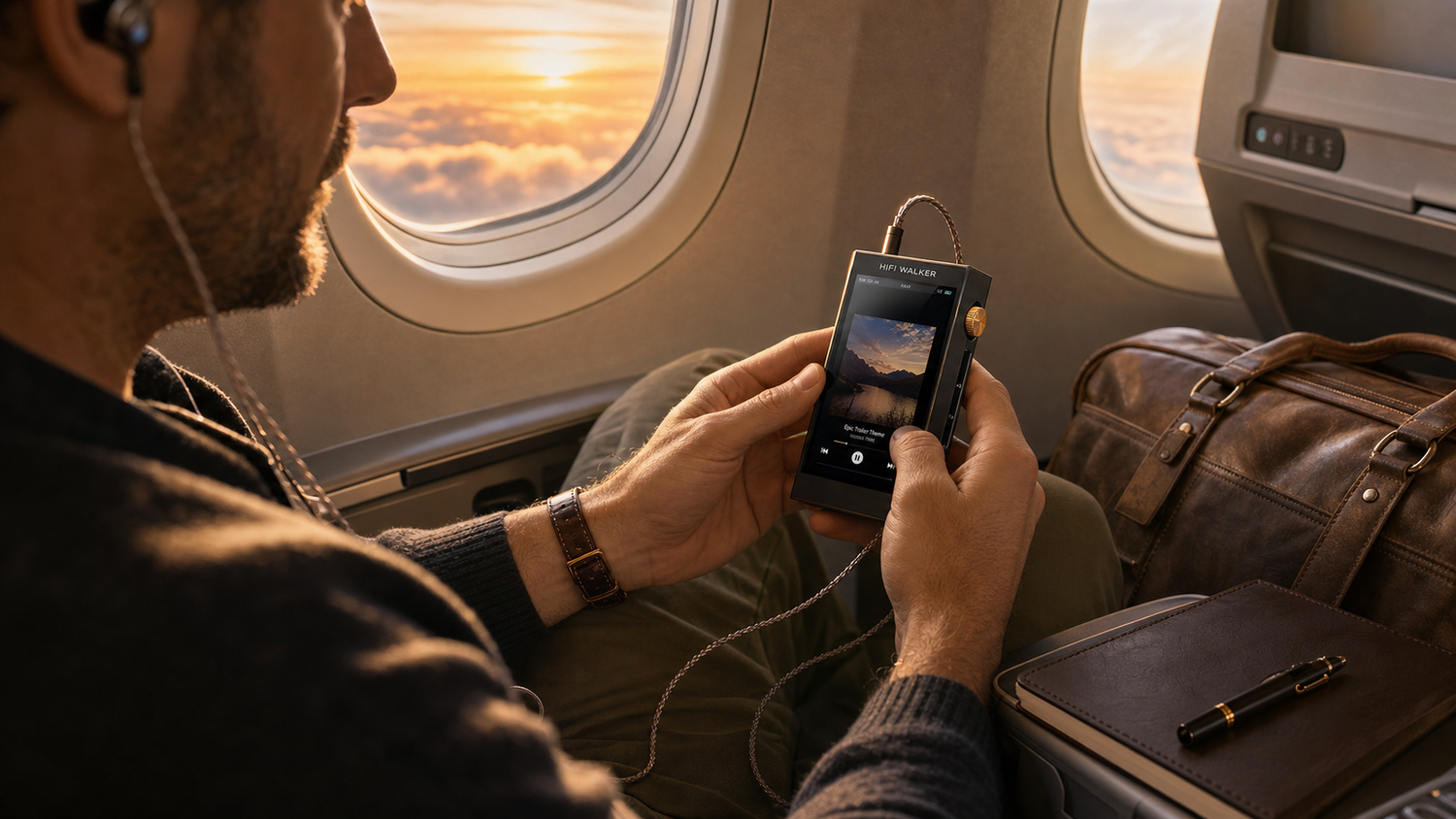
There is a specific kind of quiet that settles over a long-haul cabin once the seat-belt sign switches off — engines droning, cabin crew retreating, the person next to you already asleep under a blanket. This is exactly the moment a serious lossless DAP for travel earns every cent you paid for it. No buffering wheel, no signal bar anxiety, no compressed codec mangling your favourite recording. Just your local library, available even when the cabin has no usable signal.
In 2026, portable hi-res audio has become much more practical in a pocket-friendly form factor. This article walks through why the HIFI WALKER H20 Ultra Hi-Res Audio Player is a strong travel companion for listeners who prefer local files, wired output, and fewer signal-related compromises at altitude — and how to get the absolute most from it before, during, and after your flight.

- ►1. The Moment the Cabin Door Closes
- ►2. Why the Cabin Is Actually the Perfect Listening Room
- ►3. Inside the H20 Ultra: The Hardware That Makes It Sound This Good
- ►4. Building Your Offline Library Before You Fly
- ►5. What DSD256 Actually Sounds Like at Altitude
- ►6. The Complete Travel Bundle: H20 Ultra + A20Pro
- ►7. Bluetooth at Altitude: Two-Way LDAC Without the Compromise
- ►8. Why Serious Listeners Are Choosing Dedicated DAPs Over Everything Else
Why the Cabin Is Actually the Perfect Listening Room
Counterintuitive as it sounds, a pressurised aircraft cabin — once you seal it off with a good pair of IEMs or over-ears — creates listening conditions that most home setups never achieve: zero interruptions, no social obligation to pause the music, and a psychological state of enforced stillness that makes you genuinely listen rather than have audio playing in the background.
What Ruins In-Flight Audio
- Heavily compressed files exposing every flaw at volume
- Battery dying mid-ocean with no USB port available
- Relying on cabin entertainment systems with poor DAC quality
- No offline library — no signal means no music
- Underpowered output struggling with planar or high-impedance headphones
What the H20 Ultra Solves
- Local file support includes DSD256 and PCM up to 768kHz/32-bit
- 3.7V / 3000mA battery; rated for more than 10 hours in HIFI WALKER's screen-saver standby playback test
- ESS ES9038Q2M DAC with dual RT6862/6863 amp architecture
- 128GB card included in the current selling configuration; T Card support up to 512GB
- 4.4mm balanced output rated at 380mW/32R
For battery life, use the rated condition correctly: HIFI WALKER lists more than 10 hours of playback in screen-saver standby playback mode. That is enough for many long routes, but volume, file type, screen use, Bluetooth use, and headphone load can change real-world runtime.
Inside the H20 Ultra: The Hardware That Makes It Sound This Good
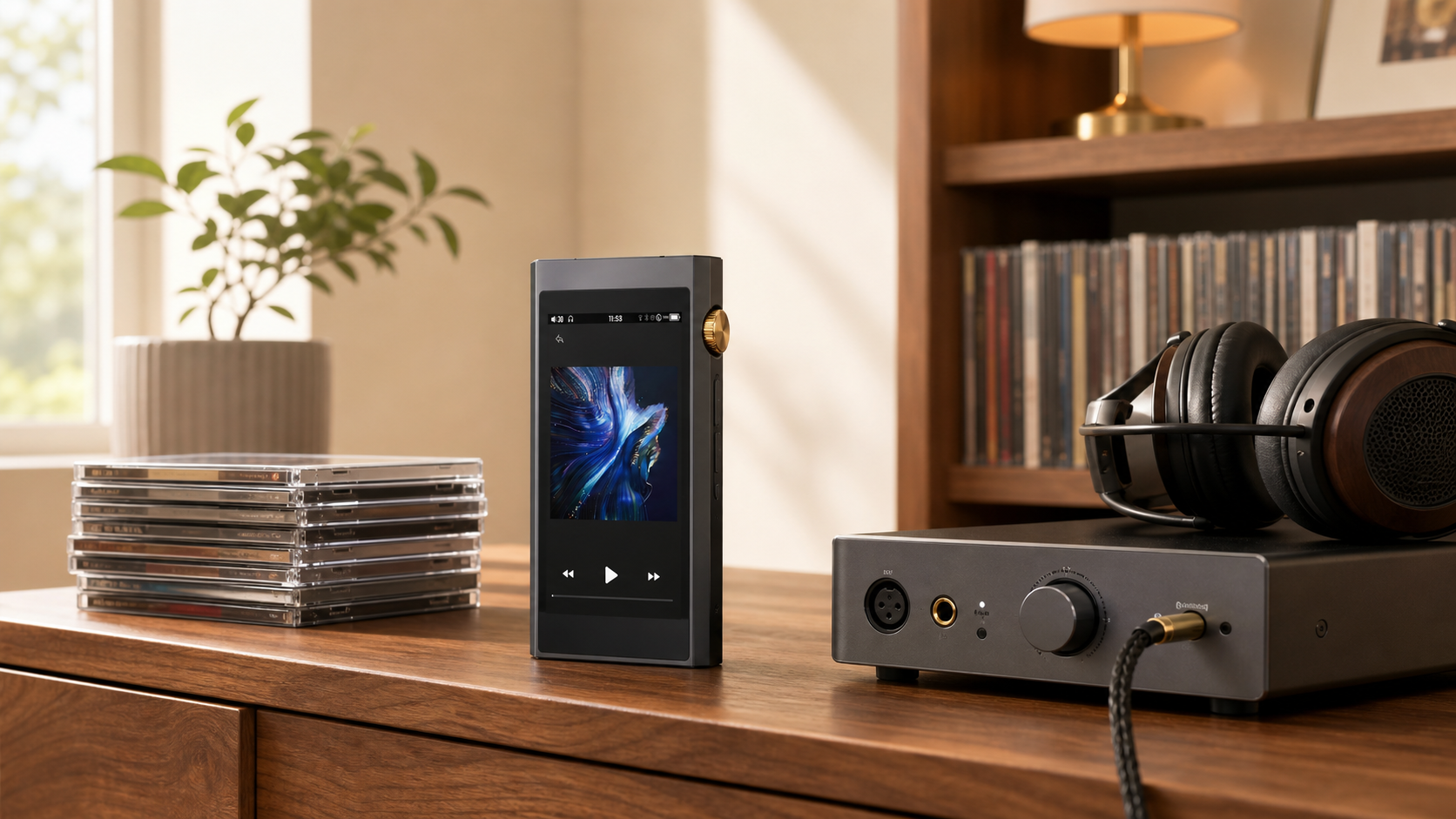
The HIFI WALKER H20 Ultra Hi-Res Audio Player is built around the ESS ES9038Q2M DAC — a well-regarded mobile DAC used in serious portable audio designs. It pairs that DAC with RT6862 and RT6863 amp stages, plus separate 3.5mm and 4.4mm outputs for different listening setups.

The 4.4mm balanced output is useful when your IEMs or headphones support a balanced cable and you want more output headroom. The 4-inch touchscreen and ALPS crown volume knob also make quick volume changes easier in a darkened cabin.
Building Your Offline Library Before You Fly
The magic of a dedicated offline hi-res audio player is that your entire listening universe lives on the device. No signal required, no subscription gate, no buffering at 30,000 feet. Here is how to set up the H20 Ultra before a long trip.
Consolidate your FLAC and DSD library
Gather your ripped CDs, Bandcamp purchases, and hi-res downloads into a single folder structure. FLAC, WAV, DSD (.dsf/.dff), APE, and MP3 are all natively supported — no conversion needed.
Start with the included 128GB card
Drag your highest-priority albums — orchestral recordings, audiophile-quality jazz, reference DSD titles — onto the included 128GB card so your must-have music is ready before departure.
Expand with a microSD card
Slot in a card up to 512GB for your full library. The T Card slot supports cards up to 512GB; for very large collections, remember the 14,999-song recognition limit. Format the card appropriately before loading.
Configure balanced vs single-ended output
If you are bringing IEMs with a 4.4mm cable, use the balanced output for extra headroom. For standard 3.5mm headphones, the single-ended output remains the correct path.
Charge the night before — not at the airport
HIFI WALKER lists about 3.5 hours for charging. Charge the night before departure so you start from full, and avoid depending on a cabin USB port that may be weak, unavailable, or already occupied.

What DSD256 Actually Sounds Like at Altitude
Numbers and chip names are only meaningful if they translate to a felt experience. So what does a portable DSD256 player actually do to a recording you know intimately, listened to at 38,000 feet with a great pair of IEMs sealed against cabin noise?
The H20 Ultra supports DSD256 files, but the audible result depends on the recording, mastering, earphones, fit, and listening volume. The practical win is simple: you can carry high-resolution local files and play them without converting your travel listening around a streaming connection.
Through the 4.4mm balanced output on the HIFI WALKER H20 Ultra Hi-Res Audio Player, the 4.4mm balanced output can offer more headroom for compatible cables and headphones. On a long flight, that stable wired setup often matters more than chasing a dramatic spec-sheet promise.

Load your local library before boarding, then listen without relying on in-flight Wi-Fi or mobile signal.
↑ Back to Top
Back to Top ↑The Complete Travel Bundle: H20 Ultra + A20Pro
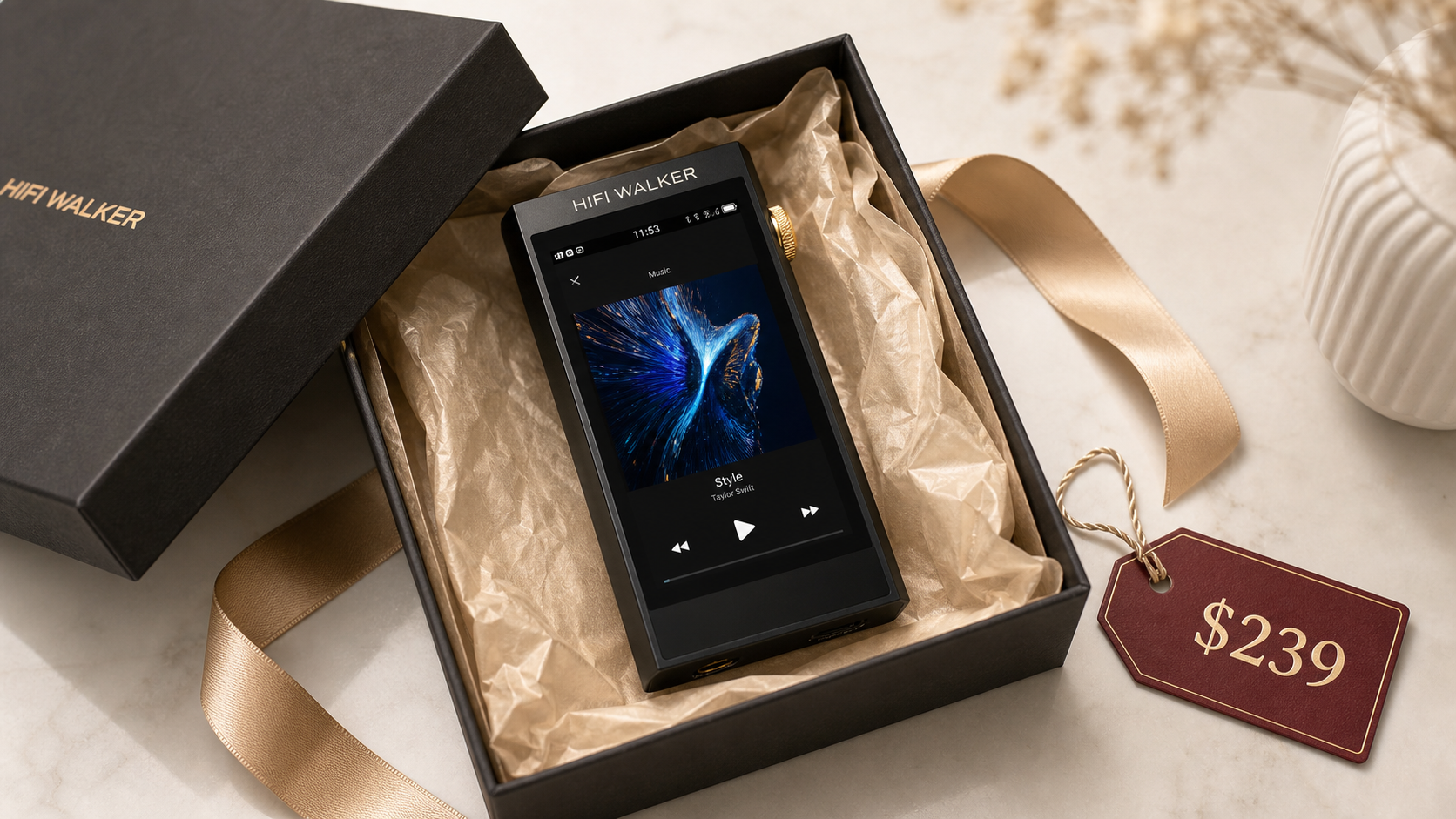
Bringing your own reference headphones is ideal, but for travellers who want a single optimised carry-on audio package, the H20Ultra +A20Pro earphone bundle is the most coherent pairing HIFI WALKER offers. The A20Pro Hi-Fi Earphone is a convenient pairing for travellers who want the player and earphones in one purchase, and the bundle price can save money versus buying separately.

The Protective PU Leather Case for H20 Ultra ($25.99) helps protect the finish from everyday travel scuffs and scratches without adding much bulk. Explore the full HIFI WALKER portable audio player range for pairings at every budget.
Bluetooth at Altitude: Two-Way LDAC Without the Compromise
Some audiophiles treat Bluetooth as the enemy of hi-res audio. The H20 Ultra takes a more nuanced position: its Bluetooth 5.1 implementation supports LDAC and aptX HD in both transmit and receive modes. That means you can use LDAC or aptX-HD in transmit or receive mode when both devices support the codec. Actual wireless quality still depends on the headphones, codec mode, and cabin conditions.
On a long flight, this is specifically useful when you want to share audio with a travel companion or switch between wired IEMs and wireless over-ears without re-routing cables. The wired balanced output remains the cleanest path for critical listening, while Bluetooth is the practical option when cables are inconvenient.
The USB DAC mode also means the H20 Ultra doubles as a high-quality DAC for your laptop on hotel stopovers — one device serving multiple roles throughout the trip. For a deeper look at how the H20 Ultra compares to other players in the HIFI WALKER lineup, see our DAP Reviews and Comparisons.
Why Serious Listeners Are Choosing Dedicated DAPs Over Everything Else
The argument for a dedicated balanced DAP for long flights is simple once you have experienced it: a device built around local music playback can be easier to trust on a flight than a general-purpose phone juggling calls, apps, storage, and battery. The H20 Ultra keeps the music library, DAC, amp stage, storage card, and headphone outputs in one dedicated player instead of tying the whole trip to a phone.
General-Purpose Device Compromises
- Phone battery and storage are shared with many apps
- Notifications and app switching can interrupt focus
- Battery-saving settings can change listening habits
- Many phones need adapters for wired listening
- Music storage competes with photos, videos, and downloads
Dedicated DAP Advantages
- Dedicated player for local files and headphone output
- Simple interface focused on browsing and playing music
- 3.7V / 3000mA battery; >10h rated screen-saver standby playback
- 4.4mm balanced output rated at 380mW/32R
- 128GB card included; T Card support up to 512GB, with 14,999-song recognition limit
The HIFI WALKER H20 Ultra Hi-Res Audio Player is built on this philosophy from the ground up. It is trying to be a focused portable music player, and that focus is exactly why it makes sense for long flights. For listeners with a local library and wired headphones, that focus can be more useful than another app on a phone.
Every purchase comes with free shipping, a 30-day return window, and a 1-year manufacturer warranty — so the return window lowers the pressure of trying the H20 Ultra on your next long-haul trip.
Frequently Asked Questions
Q1: How long does the HIFI WALKER H20 Ultra battery last on a long-haul flight?
HIFI WALKER rates the H20 Ultra for more than 10 hours of playback in screen-saver standby playback mode, with about 3.5 hours listed for charging. Real-world runtime can vary with volume, screen use, Bluetooth use, file type, and headphone load, so charge before departure rather than relying on a cabin USB port.
Q2: Does the H20 Ultra need Wi-Fi or a signal to play music in flight?
No — the H20 Ultra is a fully offline hi-res audio player. Your music library lives on local storage: the current selling configuration includes a 128GB card, and the T Card slot supports cards up to 512GB. There is no reliance on any network connection at any point. This is one of its core advantages for air travel: your music is always available, at any altitude, with zero buffering.
Q3: What audio formats does the H20 Ultra support for hi-res playback?
The H20 Ultra supports DSD256, PCM up to 768kHz/32-bit, FLAC, WAV, APE, and MP3, among other local file formats. Sound quality still depends on the recording, mastering, headphones, fit, and listening conditions.
Q4: Is the 4.4mm balanced output worth using with travel IEMs?
Absolutely. The balanced output on the H20 Ultra is rated at 380mW/32R, giving compatible 4.4mm setups more output headroom than the 3.5mm path.
Q5: What is the return and warranty policy for the HIFI WALKER H20 Ultra?
HIFI WALKER offers free shipping, a 30-day return and exchange window, and a 1-year manufacturer warranty on the H20 Ultra. If you are not satisfied after your first long-haul test, you can return it within 30 days for a full exchange or refund — lowering the pressure of trying it.