


Expert Insights: Key Takeaways
- The ESS9038Q2M DAC chip in the HIFI WALKER D20 is the same silicon found in dedicated desktop units costing $200–$400 — its presence in a $99 dongle represents genuine trickle-down audiophile engineering.
- For commuters specifically, the 4.4mm balanced output's >90dB channel separation is not just a spec — it translates to a wider, more defined stereo image that helps musical detail cut through ambient environmental noise.
- At 38g, the D20's CNC-machined aerospace aluminum body is lighter than most smartphones yet rigid enough for daily commute pocket carry — material choice matters as much as circuit design in a portable device.
- DSD512 hardware decoding and PCM 32bit/768kHz support mean the D20 can handle demanding hi-res formats through its USB DAC chain without overstating what every recording or app will deliver.
- The ALPS encoder knob is a tactile detail that sounds minor until you try to adjust volume on a cold morning with gloves — precision hardware controls for audio devices are an underrated quality-of-life feature for commuters.
So… What Exactly Is a USB DAC Dongle?
You've probably noticed that your phone's audio jack disappeared a few years ago — and the cheap adapter that came in the box doesn't exactly inspire confidence. That's where a USB DAC dongle comes in. It's a small plug-and-play device that connects to your phone or laptop via USB-C and converts digital audio signals into the rich, detailed analog sound your headphones actually need to perform at their best.
Think of your phone's built-in audio circuitry like a budget kitchen knife — it gets the job done, but a professional chef wouldn't cook with it. A hi-res audio dongle is the equivalent of a high-carbon steel blade: same basic function, dramatically better results. If you've ever wondered why your expensive headphones don't sound as impressive as the reviews promised, this is almost certainly why.
Without a USB DAC Dongle
- Phone's integrated chip handles conversion — designed for calls, not audiophile listening
- Electrical interference from other phone components bleeds into your audio signal
- Limited output power struggles to drive quality headphones properly
- High-resolution audio files get downsampled or compressed during playback
With a Dedicated USB DAC Dongle
- Dedicated audiophile-grade DAC chip handles every conversion with precision
- Isolated circuitry eliminates electrical noise from your phone's internals
- Sufficient output power makes headphones 8–300Ω sing at their full potential
- Native PCM and DSD decoding preserves every detail the artist recorded
- ►1. So… What Exactly Is a USB DAC Dongle?
- ►2. Why Your Commute Is the Perfect Place to Upgrade Your Sound
- ►3. Meet the HIFI WALKER D20: A Flagship DAC in Your Pocket
- ►4. Breaking Down the Tech: What the Specs Actually Mean for Your Ears
- ►5. 3.5mm vs 4.4mm Balanced: Which Output Should You Use?
- ►6. Setting Up Your D20 in Under 60 Seconds (No Driver Install Needed)
- ►7. How the D20 Compares: Is $99 the Right Investment?
- ►8. Ready to Hear More? Browse the Full HIFI WALKER Lineup
Why Your Commute Is the Perfect Place to Upgrade Your Sound
Commuting — whether that's a 45-minute train ride or a brisk walk through a busy city — is actually one of the best auditory environments to appreciate better audio gear. When you're moving through noise and chaos, a higher-resolution signal with better channel separation lets you hear details that cut through the ambient din. Vocals become clearer. Instrument separation improves noticeably. Your playlist stops feeling like background noise and starts feeling like a private concert.

The beautiful thing about a portable DAC for headphones in the dongle form factor is that it adds zero bulk to your commute bag. We're talking about a device the size of a USB thumb drive. You plug it in, put your phone in your pocket, and within seconds you're hearing music the way the mixing engineer intended — not the compromised version your phone's circuitry has been serving you.
Meet the HIFI WALKER D20: A Flagship DAC in Your Pocket
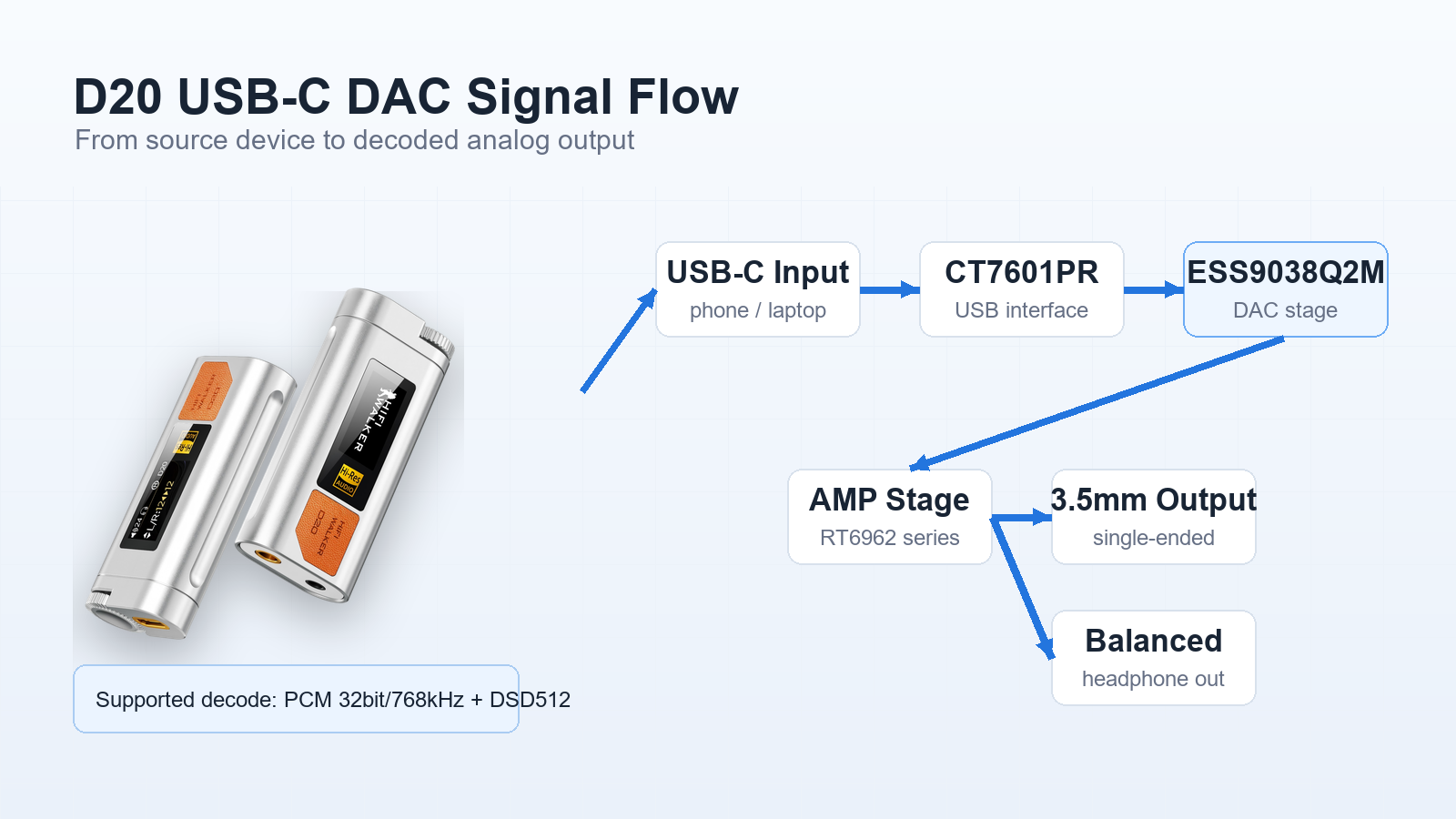
The HIFI WALKER D20 USB-C DAC/Amp Dongle — Balanced Headphone Amplifier is built around the same ESS9038Q2M chip you'd find in dedicated desktop DACs costing several times its price. At just 38 grams, it delivers up to 380mW of balanced output power — enough to properly drive headphones across the full 8–300Ω impedance range. This isn't a convenience accessory. It's a serious audio tool that happens to fit on a keychain.

What makes the HIFI WALKER D20 USB-C DAC/Amp Dongle genuinely different from the crowded sub-$100 dongle market is the combination of a genuine ALPS encoder knob for tactile volume control, an OLED display showing sample rate and signal chain status, and full balanced output via 4.4mm Pentaconn — a feature usually reserved for devices that cost twice as much.
Breaking Down the Tech: What the Specs Actually Mean for Your Ears
Spec sheets can feel intimidating if you're new to hi-res audio. Let's decode what the D20's numbers actually mean in everyday listening terms — no engineering degree required.

To put the SNR figure in perspective: a standard phone audio circuit typically measures around 90–100dB SNR. The D20's ≥115dB means the noise floor is so low that in quiet passages — think a solo piano recording at midnight — you'll hear the room, the breath, the sustain pedal, instead of an underlying electronic hiss. That's the difference a dedicated balanced headphone amplifier dongle makes.
3.5mm vs 4.4mm Balanced: Which Output Should You Use?
The D20 gives you two output options, and understanding which to use will immediately improve your listening experience. Most commuters will start with the 3.5mm single-ended output — it works with every standard headphone cable you already own. But if your headphones support a 4.4mm balanced cable (or you pick one up), the jump in performance is immediately audible.
3.5mm Single-Ended
- Works with all standard headphone cables — no upgrades needed
- Great starting point for new hi-res audio listeners
- Still dramatically better than your phone's built-in output
- Ideal when you're traveling light and want plug-and-play simplicity
4.4mm Balanced (Pentaconn)
- 380mW output power drives demanding headphones with authority
- Separate ground paths eliminate crosstalk for cleaner stereo imaging
- >90dB channel separation — the soundstage opens up noticeably
- The audiophile choice for serious commute listening sessions
Balanced output essentially doubles the headphone's effective drive capability and creates a fully separate electrical path for each channel. In practical commuting terms: vocals sound more centered, instruments spread wider across the stereo field, and the overall sound feels less congested — even in a noisy environment. If your headphones support 4.4mm, use it.
↑ Back to Top
Back to Top ↑Setting Up Your D20 in Under 60 Seconds (No Driver Install Needed)
One of the most common concerns new users have is whether a hi-res audio dongle requires complicated setup. With the HIFI WALKER D20 USB-C DAC/Amp Dongle, the answer is a firm no — this is genuinely plug-and-play on most platforms.
Plug into Your USB-C Port
Connect the D20 directly to your phone, tablet, or laptop's USB-C port. The OLED display lights up immediately — no button press required.
Select Audio Output on Your Device
On Android and most modern devices, your phone automatically routes audio to the D20. On Windows XP / 7 / 8.1 / 10 and macOS 10+, no drivers needed — the OS detects it as a standard USB audio device.
Choose Your Output: 3.5mm or 4.4mm
Plug your headphones into whichever port matches your cable. The OLED display confirms which output is active and shows the current sample rate of whatever's playing.
Dial In Your Volume
Use the precision ALPS encoder knob to set your listening level. The tactile click-and-rotate feel is a genuine upgrade over swipe-to-adjust volume on a touchscreen — especially with gloves on in winter.
Hit Play and Hear the Difference
Play a high-resolution audio file or a lossless streaming track. The ESS9038Q2M handles up to PCM 32bit/768kHz and DSD512 hardware decoding — what you hear is the closest possible reproduction of the original studio recording.
How the D20 Compares: Is $99 the Right Investment?
The usb c dac amp market ranges from $15 budget sticks to $400+ boutique devices. The D20 sits in a particularly interesting sweet spot: it uses a DAC chip (ESS9038Q2M) that appears in products costing $200–$300+, while keeping the price at $99. The CNC-machined aluminum body, ALPS encoder, and OLED display are amenities you'd normally only find at higher price points.

For commuters specifically, the 38g weight and the durability of CNC aerospace-grade aluminum matter as much as the audio specs. Dongles get jostled in pockets, pulled in and out of bags daily, and the D20 is built to handle that without the flimsy plastic feel of cheaper alternatives. Every HIFI WALKER D20 also ships with free shipping, a 30-day return guarantee, and a 1-year warranty.

Ready to Hear More? Browse the Full HIFI WALKER Lineup
The HIFI WALKER D20 USB-C DAC/Amp Dongle is the fastest, most affordable way to transform how you hear music — especially on a daily commute. But if your audio journey goes further, HIFI WALKER's full range of hi-res audio gear is worth exploring. From entry-level players to advanced balanced-output devices, there's a clear upgrade path as your ears grow more discerning.
Explore the complete HIFI WALKER Hi-Res Audio Player collection to see how the D20 fits into a broader ecosystem — or read our in-depth DAC and player reviews for more buying guidance from our editorial team.
Every order comes with free shipping, a 30-day return guarantee, and a 1-year manufacturer warranty. Try the D20 with your own phone, laptop, headphones, and music library so you can judge the upgrade in your real commute setup.
Frequently Asked Questions
Q1: What does a USB DAC dongle actually do?
A USB DAC dongle is a small device that takes the digital audio signal from your phone or laptop's USB-C port and converts it into an analog signal your headphones can use. Your device's built-in audio circuitry is designed for general use — a dedicated dongle uses higher-quality chips and isolated circuits to produce a cleaner, more detailed sound, especially with high-resolution audio files.
Q2: Do I need any special cables or adapters to use the HIFI WALKER D20?
No. The HIFI WALKER D20 USB-C DAC/Amp Dongle connects directly to any USB-C port on your phone, tablet, or laptop. Your standard 3.5mm headphone cable works immediately with the 3.5mm output. If you want to use the 4.4mm balanced output for even better performance, you'll need a headphone with a 4.4mm cable or a compatible aftermarket cable — but it's not required to start.
Q3: Will the D20 work with my iPhone?
The HIFI WALKER D20 is designed for USB-C connections and works natively with USB-C iPhones (iPhone 15 and later), Android phones, Windows laptops (XP / 7 / 8.1 / 10), and macOS 10+. For older Lightning iPhones, a USB-C to Lightning adapter would be needed — compatibility may vary depending on Apple's driver support.
Q4: What headphones work best with a USB DAC dongle like the D20?
The HIFI WALKER D20 drives headphones across the 8–300Ω impedance range, which covers the vast majority of consumer and audiophile headphones. Lower-impedance IEMs (8–32Ω) work great with the 3.5mm output. Higher-impedance over-ears benefit most from the 4.4mm balanced output's 380mW power delivery. If you want a matching pair, the HIFI WALKER A20Pro Hi-Fi Earphone is tuned to complement the D20's output characteristics.
Q5: Is the HIFI WALKER D20 worth it for casual listeners, or is it only for audiophiles?
The D20 is genuinely designed for people who are just starting to explore better audio — not exclusively for seasoned audiophiles. Its plug-and-play setup means zero technical knowledge is required. The ALPS volume knob is intuitive, the OLED display shows you what's playing and at what quality, and the difference in sound quality versus a phone's built-in output is audible within the first few minutes of listening. Plus, free shipping, a 30-day return guarantee, and a 1-year warranty are included.