


Expert Insights
- Tape's frequency ceiling (~15kHz) means you lose the 'air' frequencies (16–20kHz) that give cymbals and strings their sense of space — frequencies that hi-res audio preserves completely.
- The cassette player revival is primarily a cultural and collectible phenomenon, not an audiophile one. Sales data shows most buyers play their tapes fewer than 10 times before display-only use.
- The H20 Ultra's ESS9038Q2M DAC implementation and 4.4mm balanced output give modern portable players a level of channel control and noise performance that analog tape cannot match.
- Balanced output on supported modern DAPs, such as 4.4mm balanced on models that include it, can reduce common-mode noise compared with single-ended output — a real-world improvement no cassette mechanism can replicate.
- For listeners who genuinely love the 'tape sound,' modern digital audio workstations offer high-quality tape saturation plugins. You can apply that character selectively to hi-res files without committing to the full degradation package of physical tape.
Introduction: The Tape Deck That Refused to Die
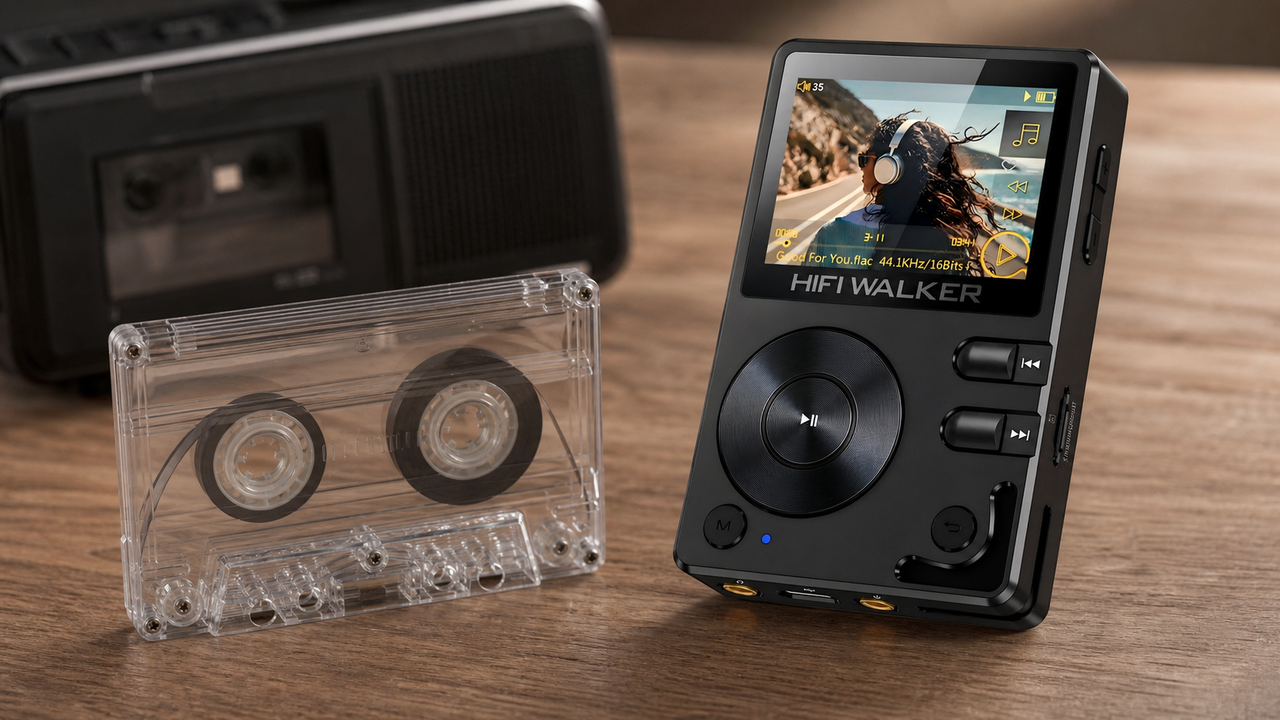
The cassette player is one of audio history's great survivors. Written off in the early 2000s when CDs and MP3 players swept the market, it has staged a remarkable comeback — cassette sales in the US hit a 35-year high in 2022. But nostalgia is one thing; sound quality is another. If you're choosing between a vintage cassette deck and a modern Digital Audio Player (DAP), which one actually serves your ears better?
This article breaks down the cassette player versus the modern DAP across every dimension that matters: sound quality, format support, convenience, durability, and value. Whether you're a returning vinyl-era audiophile or a curious newcomer, by the end you'll know exactly where each technology shines — and where it falls flat.

- ►1. Introduction: The Tape Deck That Refused to Die
- ►2. A Brief History: From Compact Cassette to Hi-Res DAP
- ►3. Sound Quality Face-Off: Analog Warmth vs Digital Precision
- ►4. Format Flexibility: What Can Each Device Actually Play?
- ►5. Portability, Build, and Everyday Use
- ►6. The Nostalgia Factor: Why Cassettes Still Have a Place
- ►7. Our DAP Recommendations: From Entry to Audiophile Grade
- ►8. Verdict: Should You Buy a Cassette Player or a Modern DAP?
A Brief History: From Compact Cassette to Hi-Res DAP
Philips introduced the Compact Cassette in 1963 as a dictation tool. By the 1980s, Sony's Walkman had transformed it into the world's first truly personal listening experience — millions of people walking city streets with orange foam headphones pressed to their ears. The cassette player democratized portable music.
The Cassette Era (1963–2000)
- Philips Compact Cassette launched 1963
- Sony Walkman debuts 1979 — personal audio revolution
- Peak global sales: ~3 billion tapes per year in the mid-1980s
- Dolby NR and chrome/metal tapes push fidelity limits
- Analog tape hiss, azimuth drift, and wow/flutter are inherent
- Format fades commercially as CDs and MP3 players dominate
The DAP Era (2001–Present)
- iPod (2001) puts 1,000 songs in your pocket
- FLAC and lossless formats replace lossy MP3 as bandwidth grows
- Dedicated DAC/amp chips deliver measurable audiophile performance
- Hi-Res Audio standard (96kHz/24-bit and beyond) established
- DSD and high-rate PCM now supported on selected modern devices
- Modern DAPs may offer Bluetooth, local hi-res playback, or balanced output depending on the model
The arc from cassette to DAP is not simply about convenience — it's a story of measurable acoustic engineering catching up with what human ears can actually appreciate. Each generation pushed the boundaries of portable fidelity in its own way.
Sound Quality Face-Off: Analog Warmth vs Digital Precision
This is the heart of the debate. Cassette advocates cite a certain warmth and organic texture — the slight saturation and gentle high-frequency roll-off that tape imparts. Critics counter that this warmth is simply colored distortion. Let's look at the actual numbers.
The numbers tell a clear story: in every objective metric, a modern hi-res DAP outperforms even the finest cassette deck by a significant margin. The cassette's frequency ceiling of roughly 15kHz means you're already losing air and sparkle that hi-res formats preserve faithfully.
That said, "measurements aren't music" is a real argument. Tape saturation at high volumes introduces even-order harmonics that some listeners find pleasing — similar to why many people prefer the sound of tubes over solid state. The key is knowing whether you want accurate reproduction or a pleasing coloration.

Format Flexibility: What Can Each Device Actually Play?
A cassette player plays cassette tapes — full stop. That's not a criticism; it's simply physics. The playback head is calibrated for oxide tape at specific bias frequencies. Your entire library must exist on physical media that degrades with every play and is sensitive to heat, humidity, and magnetic fields.
Cassette Format Ecosystem
Standard Type I (ferric oxide), Type II (chrome), and Type IV (metal) tapes. Dolby B, C, or S noise reduction adds complexity. Recording quality varies wildly by tape age and condition.
Basic DAP Format Support (Entry Level)
FLAC, MP3, AAC, WAV, OGG. Even budget players handle lossless files that blow away cassette fidelity at 16-bit/44.1kHz — identical to CD quality.
Mid-Range DAP Format Support
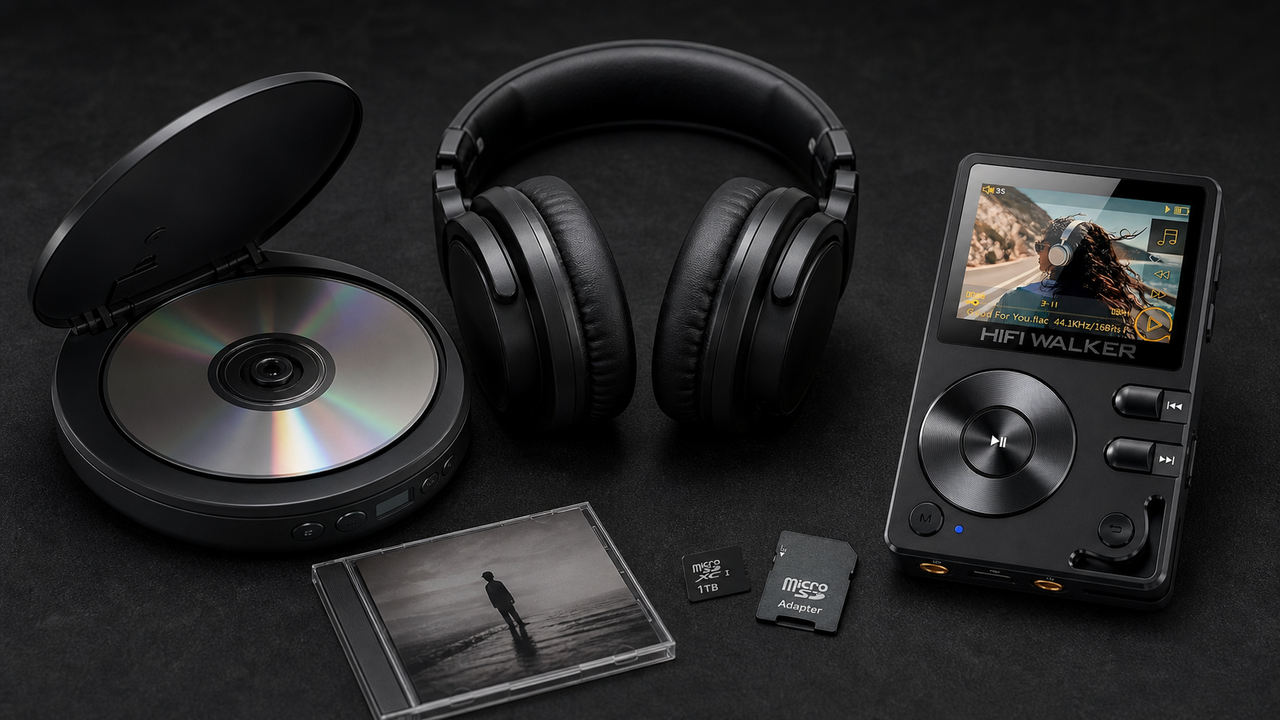
Adds DSD64/128, AIFF, APE, WV. The HIFI WALKER H2 Hi-Res Audio Player handles all of these natively with its dedicated DAC chip.
Flagship DAP Format Support
DSD256, PCM up to 32-bit/384kHz, and MQA rendering. The H20Ultra Hi-Res Audio Player handles all current hi-res standards — including formats that don't even have a commercial release yet.
Cassette tapes physically deteriorate. FLAC files stored on a quality microSD card can last decades without any signal degradation. For anyone with a large library, format flexibility alone makes the DAP the practical choice. Explore the full range of HIFI WALKER hi-res audio players to find the right format support level for your collection.
Portability, Build, and Everyday Use
The original cassette Walkman weighed around 400g with batteries — not exactly featherweight. Tape mechanisms are mechanically complex: capstans, pinch rollers, take-up spools, and magnetic heads all need alignment and periodic maintenance. Drop it on concrete and you may need a technician.
Cassette Player Realities
- Mechanical moving parts — higher failure rate
- AA/AAA batteries drain quickly under motor load
- Tape heads require periodic demagnetizing and cleaning
- Physical media takes up bag space
- Rewind/fast-forward is slow and wears the tape
- No gapless playback, no shuffle by song
- Susceptible to magnetic fields and temperature extremes
Modern DAP Advantages
- Solid-state storage — no moving parts to wear out
- Internal Li-Po battery: 15–20+ hours playback
- Entire library on a 512GB microSD card
- Instant track access, gapless playback, smart playlists
- Balanced 3.5mm/4.4mm outputs for audiophile-grade IEM pairings
- Bluetooth 5.0 with aptX HD and LDAC codec support
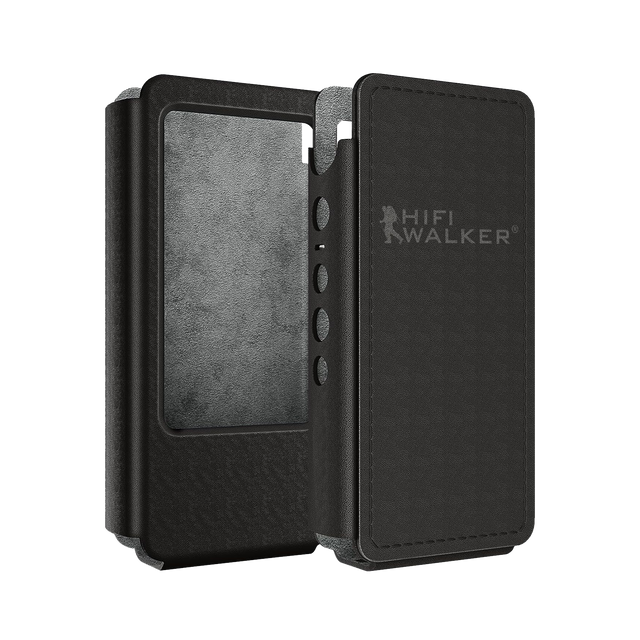
- Rugged designs with protective case options

↑ Back to Top
Back to Top ↑The Nostalgia Factor: Why Cassettes Still Have a Place
Here's an honest take: the cassette player's revival isn't really about fidelity — and that's completely fine. It's about tactile culture. Holding a tape, reading the handwritten track list on a J-card, pressing Play and hearing the subtle hiss before the music starts — these are experiences that a FLAC file on a DAP simply doesn't replicate.
Artists like Arctic Monkeys, Billie Eilish, and Taylor Swift have all released albums on cassette in recent years. Limited-edition tapes sell out instantly — they function more as collectible artifacts than listening formats. If that cultural dimension resonates with you, a cassette player is absolutely worth owning alongside a modern DAP. They serve different emotional purposes.
Think of it this way: you might own a beautiful vintage typewriter and still write your articles on a laptop. The cassette player occupies a similar space — a meaningful object that connects you to a moment in audio history, not your primary high-fidelity listening tool.

Our DAP Recommendations: From Entry to Audiophile Grade
If this comparison has convinced you to explore (or upgrade to) a modern DAP, HIFI WALKER offers a clear ladder of options — each step up delivering meaningfully better DAC hardware, output options, and format support. Here are the standouts across the range.

For listeners on a tighter budget who still want to leave the cassette's limitations behind, the HIFI WALKER H2 Mini Hi-Res Music Player ($109.99) packs hi-res playback into an ultra-compact body — roughly the size of a large matchbox. It's the modern answer to what the original Walkman tried to be.
If you want a larger touchscreen interface while staying with a 3.5mm SE output and 3.5mm Line Out, step up to the HIFI WALKER H2 Touch Hi-Res Audio Player ($134.25). If balanced output is the priority, choose H20 Pro or H20 Ultra instead. You can also read our in-depth player reviews on the DAP Reviews & Comparisons blog before deciding.
Verdict: Should You Buy a Cassette Player or a Modern DAP?
The honest answer: it depends entirely on what you're looking for. If sound quality, format flexibility, battery life, and everyday practicality are your priorities — a modern DAP wins comprehensively. There is no metric by which a cassette player outperforms a dedicated hi-res audio player in pure acoustic terms.
Choose a Cassette Player If…
You love the ritual of physical media, collect limited-edition releases, enjoy the tactile experience of tape, or want a retro conversation piece that genuinely sounds 'warm' to your ears. Pair it with a DAP for serious listening sessions.
Choose an Entry DAP If…
You want to step up from lossy streaming or MP3s and experience what FLAC actually sounds like. The HIFI WALKER H2 Mini or H2 will transform how you hear your existing music library.
Choose a Mid-Range DAP If…
You have a growing hi-res library, own quality IEMs, and want more than an entry-level player. Choose H2 Touch for touchscreen control with 3.5mm SE / Line Out, or choose H20 Pro if balanced output is required.
Choose a Flagship DAP If…
You demand DSD256, an ESS9038Q2M DAC implementation, 4.4mm balanced output, and reference-class portable playback. The H20Ultra Hi-Res Audio Player is your endgame portable — no cassette player, however vintage or prestigious, comes close.

The cassette player had its moment — and what a moment it was. But today's hi-res DAPs carry that spirit of personal portable listening forward with technology that would have seemed like science fiction to a 1985 Walkman owner. The best news? You don't have to choose just one. Own both, and let each serve its rightful purpose.
Frequently Asked Questions
Q1: Does a cassette player actually sound warm, or is that just distortion?
Both, technically. Tape saturation introduces even-order harmonic distortion — mathematically similar to what tube amplifiers add. Many listeners find this pleasing because it smooths transients and adds a gentle 'glow' to the sound. However, it's a coloration, not accuracy. If you want your recordings reproduced as the artist intended, a hi-res DAP with a quality DAC chip is far more faithful.
Q2: Can a modern DAP play my old cassette tapes?
Not directly — DAPs don't have tape heads. However, you can transfer your cassette recordings to digital using a USB cassette converter or a cassette player with a line output connected to an audio interface. Once digitized as WAV or FLAC files, your DAP can play them in full lossless quality.
Q3: What is the best modern alternative to a cassette player for portable listening?
A dedicated Digital Audio Player (DAP) is the direct spiritual successor to the Walkman-era cassette player. For entry-level hi-res listening, the HIFI WALKER H2 Mini is an excellent start. For serious audiophiles, the H20Ultra Hi-Res Audio Player offers flagship DAC performance in a portable body.
Q4: Are cassette tapes still being manufactured in 2024?
Yes — a small number of manufacturers in the US, Japan, and Europe still produce blank cassette tape, and labels continue to press limited-edition releases on cassette. However, the available tape types and quality-tier variety are far more limited than the 1980s heyday. For new music acquisition, digital hi-res downloads and streaming offer vastly greater selection.
Q5: How does the sound quality of a good cassette Walkman compare to a budget DAP?
Even a budget hi-res DAP like the HIFI WALKER H2 Mini ($109.99) objectively outperforms a top-tier vintage cassette Walkman in every measurable metric: lower noise floor, wider frequency response, lower distortion, and higher dynamic range. The cassette player may have subjective character, but the DAP has superior accuracy and transparency.