

What Actually Counts as a Streaming Music Player in 2026
Most people typing 'streaming music player' into a search bar already have a phone with Spotify on it. What they're really asking is whether something else — a dedicated device — does the job better. The honest answer: it depends on what 'streaming' means to you.
If it means Wi-Fi apps and subscription services, you want an Android-based player. If it means playing your own lossless library, audiobooks, or downloaded tracks without your phone's battery taking the hit, a dedicated Hi-Res player is the better tool. Both categories show up in this list, and we'll be clear about which is which.
This distinction matters more than spec sheets. A lot of buyer's remorse in this category comes from crossing that line by accident. Android decides which apps you can install, not sound quality on its own, so compare the documented audio hardware, supported outputs, and app requirements of the exact model before you decide.
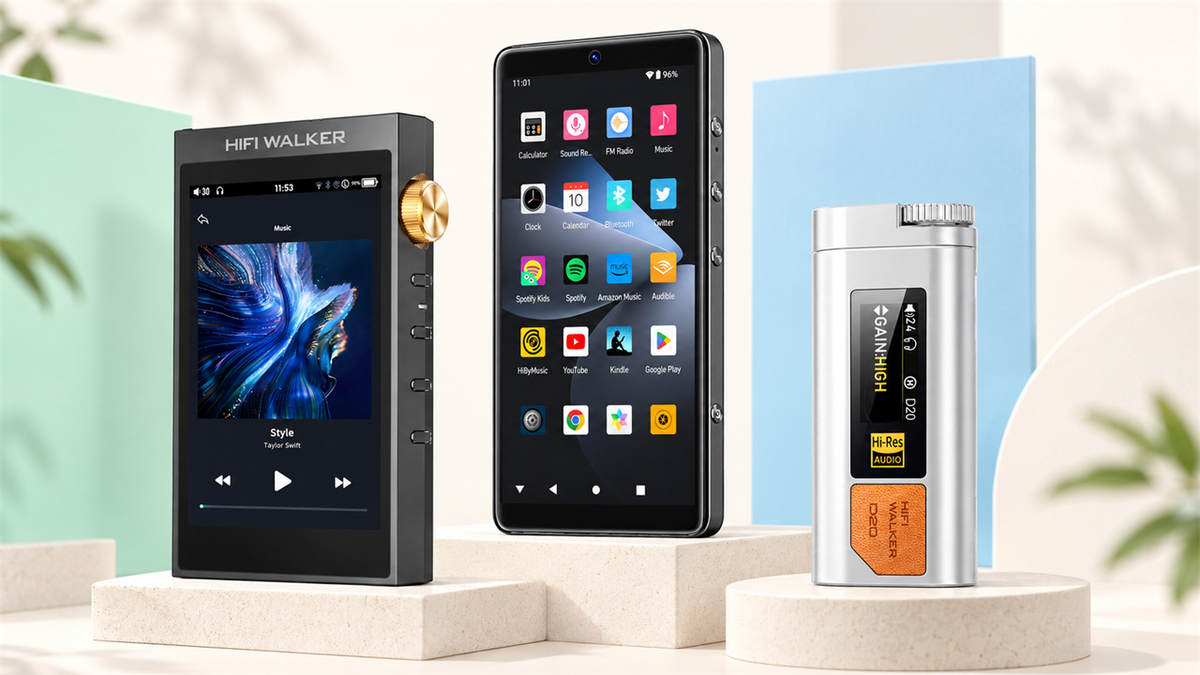
That makes the scope of this comparison deliberately narrow. For app-based streaming, the two devices worth comparing here are the Android G7 Pro and G7. The Linux-based H2 and H20 models are local-file alternatives rather than streaming-app devices, and the D20 is a USB DAC/amp that needs a separate source device, so it is covered as an accessory rather than a player.
Expert Insights: Key Takeaways
- The term 'streaming music player' covers two genuinely different devices — Android players for app-based streaming, and Hi-Res players for local lossless libraries — and confusing the two is the most common shopping mistake in this category.
- None of the Hi-Res players run the Audible app natively; they handle audiobook files as standard local audio, with basic resume rather than chapter bookmarking.
- A local FLAC library removes two dependencies of phone streaming: a live connection and a battery shared with everything else the phone is doing. Whether it also sounds better depends on the service, plan, title, and playback chain you're comparing against.
- ►1. What Actually Counts as a Streaming Music Player in 2026
- ►2. Dedicated Player vs. Streaming on Your Phone
- ►3. The Audible and Audiobook Angle
- ►4. For Android-App Streaming: G7 Pro vs G7
- ►5. What the Linux Models Do Instead: Local Lossless Libraries
- ►6. Budget Picks and Kids' Music Players
- ►7. Bandcamp, FLAC Downloads, and Getting Music Onto a Player
- ►8. So Which One Actually Fits You
Dedicated Player vs. Streaming on Your Phone
A dedicated music player compared to streaming on a phone comes down to one thing: what else that phone is doing while it plays music. Notifications, background apps, and calls all compete for the same battery and processor.
Streaming on Your Phone
- Battery shared with calls, apps, notifications
- Audio quality depends on the app, plan, and codec in use
- One more thing pulling your attention mid-track
- Convenient if you already carry it everywhere
A Dedicated Streaming Music Player
- Battery and storage built around one job: music
- Local lossless playback on the Hi-Res models, straight from your own files
- Nothing else competing for your attention
- One more thing to charge and carry
Neither side wins outright. If your listening is casual — a podcast on the bus, background music at your desk — your phone is fine. If you have a real library of FLAC files, or you're handing a device to a kid who doesn't need a phone yet, a dedicated player starts making more sense.

What changes when the music comes off the phone
A lot of the decision here isn't about sound quality on paper — it's about what your phone gets to stop doing.
A dedicated player doesn't make your library bigger — it just stops your phone from being the bottleneck between you and it.
The Audible and Audiobook Angle
Searches for an audible player device or mp3 player with audible usually come from people tired of their phone dying mid-chapter, or wanting something simpler than a smartphone for long listens. Here's the honest picture: none of the Linux-based H2 or H20 players runs the Audible app. The Android-based G7 Pro is the exception, with Google Play, Spotify, Tidal, and Audible preinstalled and confirmed usable.
What our Linux-based players like the H2 Hi-Res Audio Player and H20 Pro Hi-Res Audio Player do support is playing local audiobook audio files, the same way they'd play any other song — including resuming the current track after you power off and back on. If your audiobooks are downloaded as standard audio files, that's a workable path. These players cannot install the Audible app itself, so its bookmarks and chapter navigation are not part of what the official spec sheet lists — worth confirming before you buy.
For readers who want the deeper breakdown of which player handles audiobook-style files best, our guide on choosing an MP3 audiobook player that works with your apps goes further into the app-compatibility question.
Check the file format
Confirm your audiobook files are standard formats like MP3 or FLAC, not DRM-locked Audible AAX files.
Load them like music
Drop the files onto a microSD card and the player will treat them as a standard playlist.
Use basic resume
If you lose power or switch the player off, playback picks back up where the current track left off — standard song resume, not chapter-specific bookmarking.
For Android-App Streaming: G7 Pro vs G7
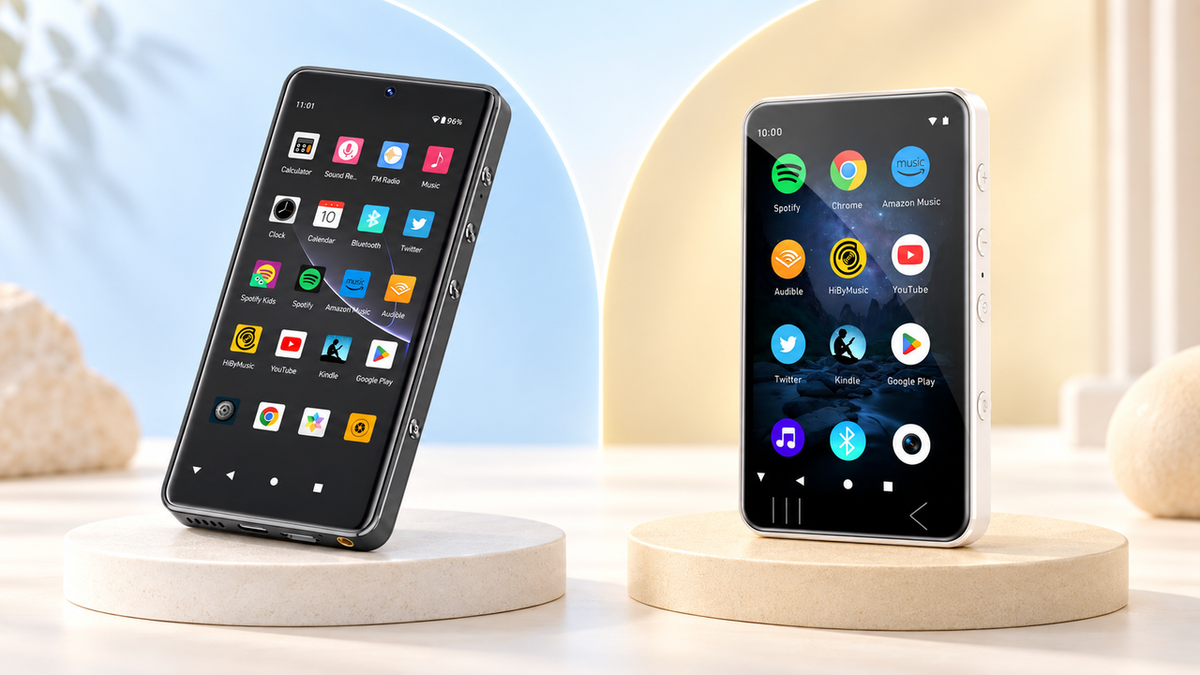
If what you actually want is a phone-like device that runs Spotify, Tidal, and the Audible app but skips calls and texts, that's a different category — an Android player, not a Hi-Res DAP.

The G7 Pro isn't a Hi-Res audiophile player — it doesn't carry an ESS DAC or balanced output, and we won't pretend otherwise. What it is: a dedicated Android device that keeps streaming apps off your phone, with Wi-Fi and a 5.2-inch display for actually navigating an app library.
Its sibling, the G7 Android Player, runs the same Android 13 foundation with a 4-inch 480x800 screen, 3GB of RAM plus 16GB of storage and a 2000mAh battery, against the G7 Pro's 5.2-inch 720x1440 screen, 4GB plus 32GB and 2500mAh. One caveat before you buy: the preinstalled app list is confirmed for the G7 Pro, while app availability on the G7 is not listed on its spec sheet and should be checked for the exact unit you order.
What the Linux Models Do Instead: Local Lossless Libraries
This is where the portable streaming music player search usually leads people who already know what FLAC is. These aren't streaming devices at all: the Linux-based H2 and H20 models don't run Spotify, Tidal, or any other Android app. They're built around playing your own high-resolution files without a phone's compromises.


Both support DSD256 playback and up to 512GB of expandable storage via microSD, with a practical ceiling of 14,999 recognizable tracks — plenty for even a large collection, though it's worth knowing that number exists.


↑ Back to Top
Back to Top ↑Budget Picks and Kids' Music Players
Searches for a streaming music player for kids or a music streaming device for kids usually aren't looking for Wi-Fi streaming at all — they're looking for something that plays a loaded library of songs without handing a child a phone or an internet connection.
The H2 Hi-Res Audio Player steps up from the smallest players in the range, with a larger 2.0-inch display and stronger 70mW+70mW output per channel for headphones that need a bit more drive. It does not connect to app stores or streaming services — it is a local-library player, which for a kid's device is arguably the point.
Bandcamp, FLAC Downloads, and Getting Music Onto a Player
The 'bandcamp to mp3' search usually comes from people who bought or downloaded music from Bandcamp and want to know how to get it playing on a dedicated device rather than a streaming app. The good news: this is the easiest part of the process.
Bandcamp purchases typically download as MP3 or FLAC files directly to your computer. From there, it's a drag-and-drop job onto a microSD card, which any of our Hi-Res players will read. No conversion, no app, no subscription — this is exactly the local-library use case these players are built for.
What Streaming Apps Give You
- Massive catalog on demand
- Requires a live internet connection
- Audio quality varies by service, plan, title, and settings
- Subscription fee, ongoing
What a Local Hi-Res Library Gives You
- Your exact files, at their original quality
- Works with no signal at all
- FLAC and DSD supported on Hi-Res models
- One-time file cost, no ongoing fee
For a deeper comparison of dedicated players against phone-based streaming, our guide to streaming music players versus phones walks through the tradeoffs in more detail.
So Which One Actually Fits You
Here's the shortcut: if you need Spotify, Tidal, or the Audible app itself, the G7 Pro Android Player is your pick, because it's the model confirmed with those apps preinstalled and usable, with the G7 as the lower-cost Android option to check availability on. If you have a local FLAC or DSD library and demanding headphones, the H20 Ultra Hi-Res Audio Player is the reference point.
If price matters more than balanced output, the H20 Pro Hi-Res Audio Player gets you most of the sound quality for less. And if you're buying for a child, or you just want the smallest, simplest thing that plays a loaded library, the H2 Mini Hi-Res Music Player is the honest starting point.
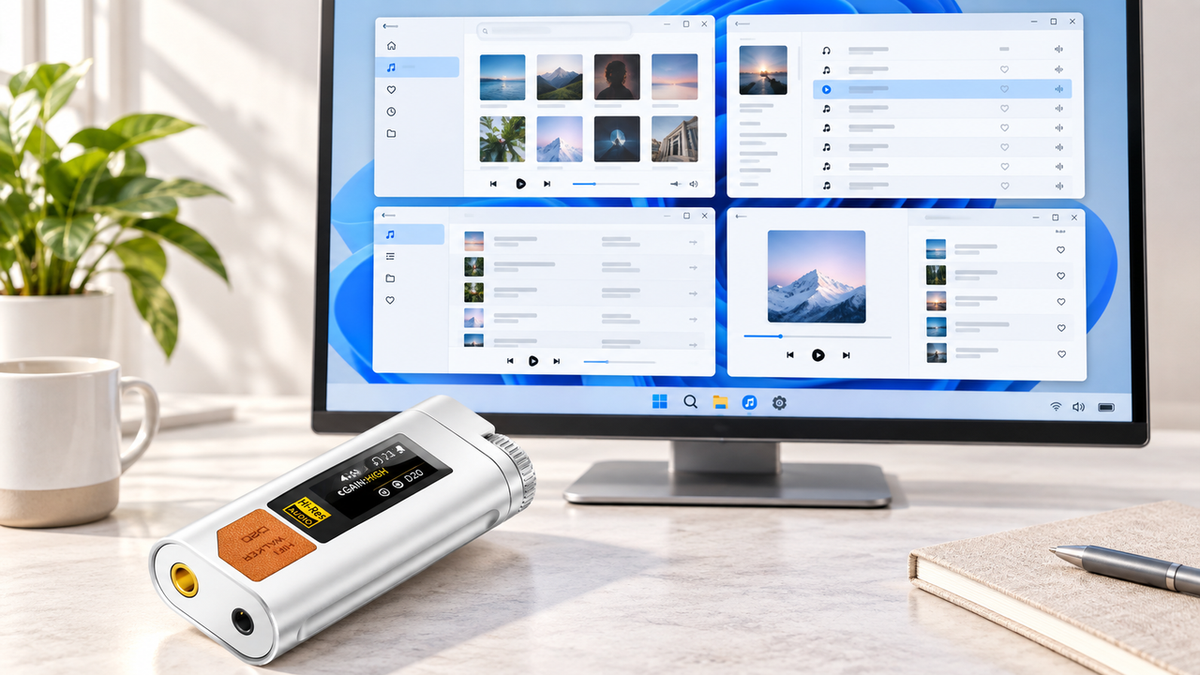
Already have decent headphones and just want better sound from your existing phone or laptop without carrying a second device? The D20 USB-C DAC/Amp Dongle is worth a look — it's not a standalone player, but it upgrades what you already carry.
Browse the full lineup in our HIFI WALKER music player collection to compare specs and pricing side by side before deciding.

There's a whole layer of music that never shows up in a streaming app
Once you start thinking in local files instead of subscriptions, a few other doors tend to open.
None of this requires giving up streaming — it just means streaming stops being the only option in the room.
Frequently Asked Questions
Q1: Is there a HIFI WALKER player that runs the Audible app directly?
The G7 Pro Android Player runs Android 13 with Google Play, Spotify, Tidal, and Audible preinstalled and usable. Our Linux-based Hi-Res players do not run the Audible app itself — they play local audiobook audio files the same way they play music.
Q2: Can I use a streaming music player without Wi-Fi?
Yes. The Hi-Res players in this lineup — H2 Mini, H2, H2 Touch, H20 Pro, and H20 Ultra — are built around local file playback from a microSD card and don't require an internet connection to play your library.
Q3: How do I get Bandcamp downloads onto a dedicated music player?
Bandcamp purchases typically download as MP3 or FLAC files. Copy them onto a microSD card and insert it into any HIFI WALKER Hi-Res player — no conversion or app needed.
Q4: What's the best streaming music player for a kid?
The H2 Mini Hi-Res Music Player is a simple, lightweight option that plays a loaded local library without app stores, streaming subscriptions, or internet access.
Q5: Is there a limit to how many songs a Hi-Res player can hold?
Yes — the Hi-Res lineup (H2 Mini through H20 Ultra) can recognize up to 14,999 tracks, even though storage can go up to 512GB via microSD. That's a generous ceiling for most personal libraries.