

Expert Insights
- The SNR gap between a portable cassette player (~60 dB) and a modern DAP (120+ dB) represents a 1,000-fold improvement in dynamic range — audible on any quality headphone in a quiet listening environment.
- Cassette 'warmth' is technically second-harmonic distortion and high-frequency rolloff. It's a form of signal coloration, not enhanced fidelity. Whether you enjoy it is subjective; calling it superior is not accurate.
- The strongest argument for cassettes in 2024 is cultural and tactile — the ritual of physical media. But that argument belongs in the realm of personal preference, not audio engineering.
- Budget DAPs under $150 now include dedicated ESS or AKM DAC chips that produce genuinely professional-grade measurements. The price barrier to serious hi-res audio has never been lower.
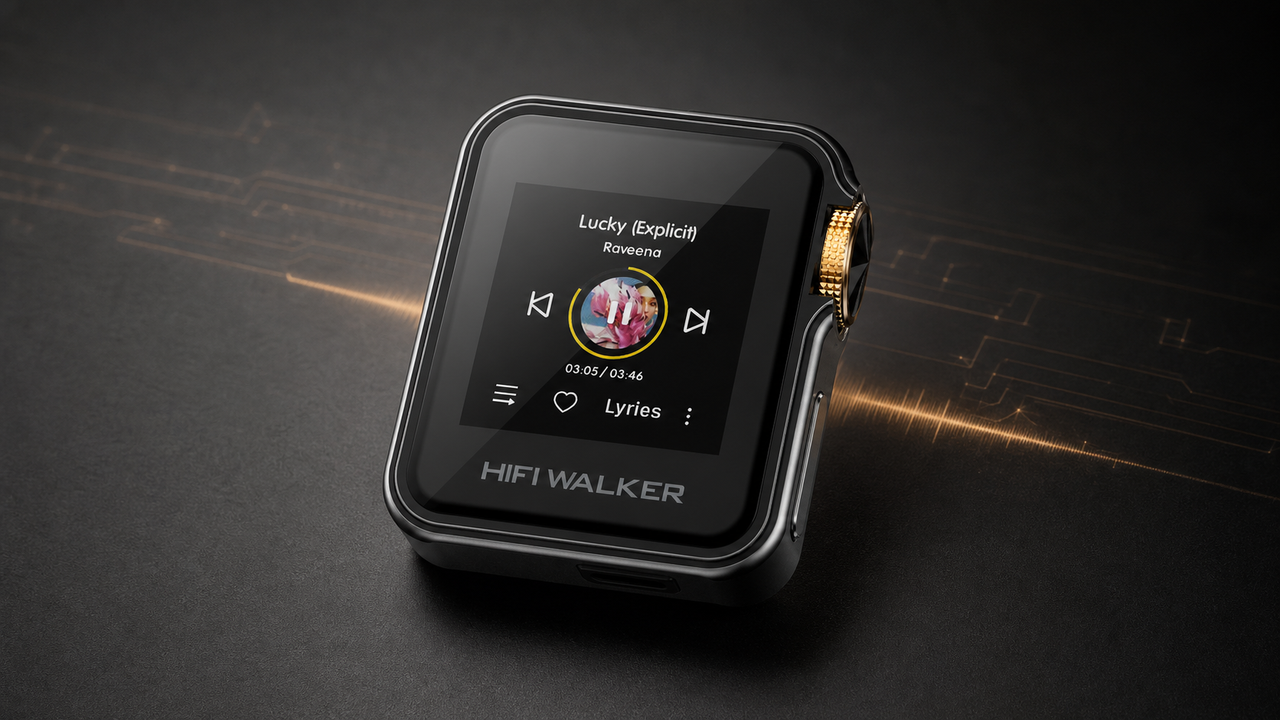
- Balanced output (4.4mm TRRRS) on flagship DAPs like the HIFI WALKER H20Ultra eliminates left-right channel crosstalk — a technical improvement that was architecturally impossible with single-ended cassette player circuitry.
The Nostalgia Trap: Why We Still Talk About Cassette Players
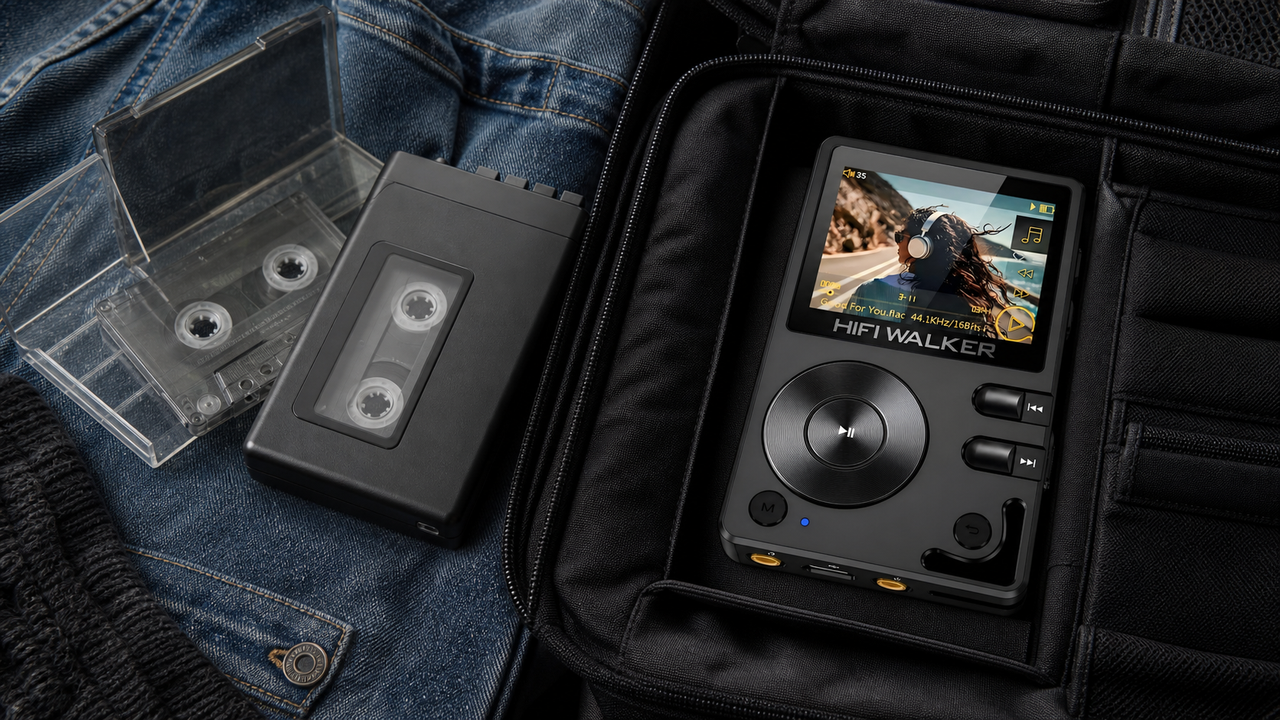
There's something undeniably romantic about a portable cassette player — the click of a tape deck, the satisfying rewind hiss, the tactile ritual of flipping a side. Millions of music lovers grew up with a Walkman tucked into their jacket pocket, and that emotional memory is powerful. But nostalgia, however warm, is not a sound quality argument.
In 2024, the conversation around portable audio has evolved dramatically. A new generation of Digital Audio Players (DAPs) now fits reference-grade sound into a device smaller than a deck of cards. This article puts the cassette era head-to-head against modern DAPs — honestly, with data, and with a deep respect for both worlds.

- ►1. The Nostalgia Trap: Why We Still Talk About Cassette Players
- ►2. How the Portable Cassette Player Actually Works — And Its Limits
- ►3. Sound Quality: The Numbers Don't Lie
- ►4. Real-World Usability: Where Digital Wins Without Debate
- ►5. The Best Modern DAPs Worth Owning Right Now
- ►6. Entry-Level DAPs: Better Than Any Cassette at Half the Price
- ►7. When to Keep (or Buy) a Cassette Player — An Honest Take
- ►8. Making the Switch: Your First Steps Into Hi-Res Portable Audio
How the Portable Cassette Player Actually Works — And Its Limits
A portable cassette player reads magnetic particles on a thin strip of polyester tape using a mechanical read head. The signal is inherently analog: it passes through a pre-amplification stage, equalisation circuit, and finally a headphone amplifier. Every single component in that chain introduces noise, distortion, and frequency response variation.
Cassette Player Weaknesses
- Signal-to-noise ratio: 50–60 dB (best case)
- Frequency response: 40 Hz – 14 kHz (Type I tape)
- Mechanical wow & flutter degrades pitch stability
- Tape degradation over time — playback quality drops
- No repeat, shuffle, or track search
- Battery life: 8–12 hours with fresh alkaline AA cells
- Susceptible to temperature, humidity, and magnetic fields
Modern DAP Advantages
- SNR: 120+ dB with a quality ESS Sabre DAC chip
- Frequency response: 20 Hz – 40 kHz (FLAC/DSD sources)
- Zero mechanical parts — zero wow & flutter
- Digital files never degrade; bit-perfect every time
- Full library search, playlist, and playback controls
- Battery life: 15–22 hours on a single charge
- Immune to physical media environmental damage
These aren't marginal differences. A 60 dB SNR versus 120 dB SNR represents a 1,000-fold improvement in dynamic range. In plain terms: the noise floor of the best portable cassette player sits audibly above the music during quiet passages. A modern DAP's noise floor is inaudible — period.
Sound Quality: The Numbers Don't Lie
Audio quality comparisons get heated online, but the technical measurements are clear-cut. Let's look at the key specifications side by side — using a well-regarded mid-range DAP as the benchmark against the best portable cassette players of their era.
THD+N (Total Harmonic Distortion plus Noise) below 0.005% means the device adds virtually nothing to the original recording. A cassette at 1% distortion is audible — you hear it as a slight 'warmth' many describe as pleasing, but that's coloration, not accuracy. Whether you prefer it is a taste question; whether it's technically superior is not.
Real-World Usability: Where Digital Wins Without Debate
Sound specs matter, but daily usability seals the deal for most listeners. Consider the actual friction of using a portable cassette player in 2024: you need physical tapes (increasingly rare), a working head-cleaning kit, replacement belts, and patience. Digital players eliminate every single one of those friction points.
Load Your Entire Music Library
Drop a 256GB microSD card into a modern DAP and store roughly 5,000 lossless FLAC albums. A cassette holds one album at roughly 45 minutes per side. The math ends the debate.
Instant Track Access
Want track 8 on a cassette? You're fast-forwarding through silence for 30–90 seconds. On a DAP, tap the track name — it plays in under a second, bit-perfectly.
Gapless Playback
Live albums, classical suites, DJ mixes — gapless playback is a DAP standard feature. Cassettes have an audible mechanical gap between every single track.
Streaming & Wi-Fi Apps
Android-based DAPs support Spotify, Tidal, Amazon Music HD, and Qobuz. A cassette player's idea of 'streaming' is holding a radio cassette adapter near a speaker.
Balanced Output for Audiophile Headphones
Flagship DAPs include 4.4mm balanced outputs that reduce crosstalk and double amplifier headroom. A cassette player has one 3.5mm jack — that's it, and it's noisy.
For audiophiles building a serious portable rig, balanced output alone is a compelling reason to upgrade. It measurably reduces interference between left and right channels — something physically impossible with single-ended cassette circuitry.
The Best Modern DAPs Worth Owning Right Now
If this comparison has you reconsidering your setup — or you're picking up portable hi-res audio for the first time — here are the HIFI WALKER players that deliver the most value at their respective price points. Browse the full HIFI WALKER portable audio collection for all available options.

The HIFI WALKER H20Ultra Hi-Res Audio Player represents the current pinnacle of HIFI WALKER's engineering. With a dual-DAC architecture delivering over 120 dB SNR and support for every major lossless format including DSD256 and MQA, it renders the concept of cassette tape fidelity entirely obsolete — but in the most respectful way possible.

For those who want flagship-adjacent performance without the flagship price, the HIFI WALKER H20 Pro Hi-Res Audio Player hits a genuine sweet spot. It delivers clean, balanced output and hi-res format support — everything a recovering cassette listener needs to hear their music properly for the first time.
↑ Back to Top
Back to Top ↑Entry-Level DAPs: Better Than Any Cassette at Half the Price
Not every audio upgrade requires a flagship investment. HIFI WALKER's entry-tier lineup absolutely destroys the portable cassette player experience at prices that compete with vintage tape decks on eBay — and they won't jam, eat your tape, or need a head-cleaning kit.

The HIFI WALKER H2 Mini Hi-Res Music Player at $109.99 plays FLAC, WAV, APE, and MP3 with a dedicated DAC/amp stage that no portable cassette player — at any price — has ever matched. For first-time hi-res buyers, this is an exceptional starting point. Check out our detailed DAP reviews for more in-depth analysis of the full range.

When to Keep (or Buy) a Cassette Player — An Honest Take
This article isn't a cassette funeral. There are legitimate reasons to own and enjoy a portable cassette player in 2024 — just not for sound quality. Let's be honest about both sides.
Valid Reasons to Keep a Cassette Player
- You own irreplaceable recordings only on tape
- You're a musician digitizing old home recordings
- The tactile ritual is part of your creative process
- Collecting and preserving audio history
- You enjoy the specific 'lo-fi' aesthetic intentionally
Reasons That Don't Hold Up Anymore
- 'Tape sounds warmer' — that's distortion, not warmth
- 'It's more authentic' — bit-perfect is more authentic
- 'Digital is cold' — poor DAC design is cold, not digital itself
- 'Cassettes are cheaper' — a good microSD card stores 5,000 albums
- 'I like the ritual' — modern DAP UX can be equally intentional
The audiophile community has largely moved past the analog-vs-digital wars of the 1990s. Today's consensus: a well-implemented DAC with a quality source file will outperform analog tape every time. If you love the cassette aesthetic, enjoy it — just don't mistake nostalgia for fidelity.
Making the Switch: Your First Steps Into Hi-Res Portable Audio
If you're coming from cassettes — or from smartphone streaming — the upgrade path to a dedicated DAP is surprisingly painless. Here's how to set yourself up for the best possible experience without overcomplicating it.
Choose Your DAP Budget Tier
Under $150: HIFI WALKER H2 Mini or H2 Hi-Res Audio Player. $150–$200: H20 Pro. $200+: H20Ultra for the full flagship experience with DSD and Android streaming.
Build Your Lossless Library
Rip your CDs to FLAC using dBpoweramp or EAC. Purchase lossless downloads from Bandcamp, Qobuz, or HDtracks. Most files are under 30MB — a 256GB card holds thousands.
Pair With Quality Headphones
A DAP upgrade is wasted on weak headphones. Aim for at least a pair of quality IEMs or over-ear headphones in the $50–$150 range to hear the difference properly.
Protect Your Investment
Pick up a quality case for your new player. HIFI WALKER offers dedicated protective cases — like the Protective PU Leather Case for the H20 Pro and H20 Ultra — that safeguard against everyday wear without adding bulk.
Explore the Full Ecosystem
Android-based DAPs like the H20Ultra support EQ apps, streaming services, and custom audio software. Your listening experience can keep evolving long after purchase.
The case ecosystem matters more than it sounds (pun intended). Explore the Protective PU Leather Case for H20 Ultra and the Protective PU Leather Case for H20 Pro to keep your investment protected. The full range of HIFI WALKER audio players and accessories makes building a complete portable rig straightforward.
Frequently Asked Questions
Q1: Is a portable cassette player worth buying in 2024?
For nostalgia, collecting, or digitizing old tapes — yes. For everyday music listening quality, no. A modern DAP at any price point will outperform the best portable cassette player ever made on every measurable audio metric: noise floor, distortion, frequency response, and dynamic range.
Q2: Do cassette tapes actually sound better than digital?
No — this is a persistent myth. Cassette tape introduces measurable noise (50–60 dB SNR), harmonic distortion (0.5–1.5% THD), limited frequency response (up to ~14 kHz on Type I tape), and mechanical pitch instability. What many describe as 'warmth' is actually coloration from those distortions. A quality DAC playing a lossless FLAC file is objectively more accurate to the original recording.
Q3: What's the best affordable alternative to a portable cassette player?
The HIFI WALKER H2 Mini Hi-Res Music Player at $109.99 is an excellent entry point. It supports FLAC, WAV, APE, and MP3, includes a dedicated DAC/amp stage, and fits easily in a pocket — everything a cassette player promised, delivered without compromise.
Q4: Can modern DAPs play music from streaming services like Spotify?
Yes — Android-based DAPs like the HIFI WALKER H20Ultra Hi-Res Audio Player run full Android 12, allowing you to install Spotify, Tidal, Amazon Music HD, Qobuz, and other streaming apps directly. You get the convenience of streaming plus the hardware quality of a dedicated audio player.
Q5: How much storage does a modern DAP have compared to a cassette?
A standard 90-minute cassette holds roughly one album. A modern DAP with a 256GB microSD card stores approximately 2,500–5,000 lossless FLAC albums depending on bitrate. Many DAPs support cards up to 2TB. The comparison is not even close.