


Expert Insights
- Digital audio players achieve signal-to-noise ratios exceeding 120dB, more than double what the best cassette players could accomplish, resulting in completely silent backgrounds and superior dynamic range.
- The transition from cassette to digital represents a fundamental shift from degrading analog storage to perfect digital reproduction - modern players maintain bit-perfect audio quality indefinitely without any loss.
- Battery efficiency improvements in digital players stem from eliminating mechanical components; while cassette players required power-hungry motors for tape transport, digital processing consumes minimal energy for vastly superior performance.
The Evolution from Cassette Tapes to Digital Audio Players
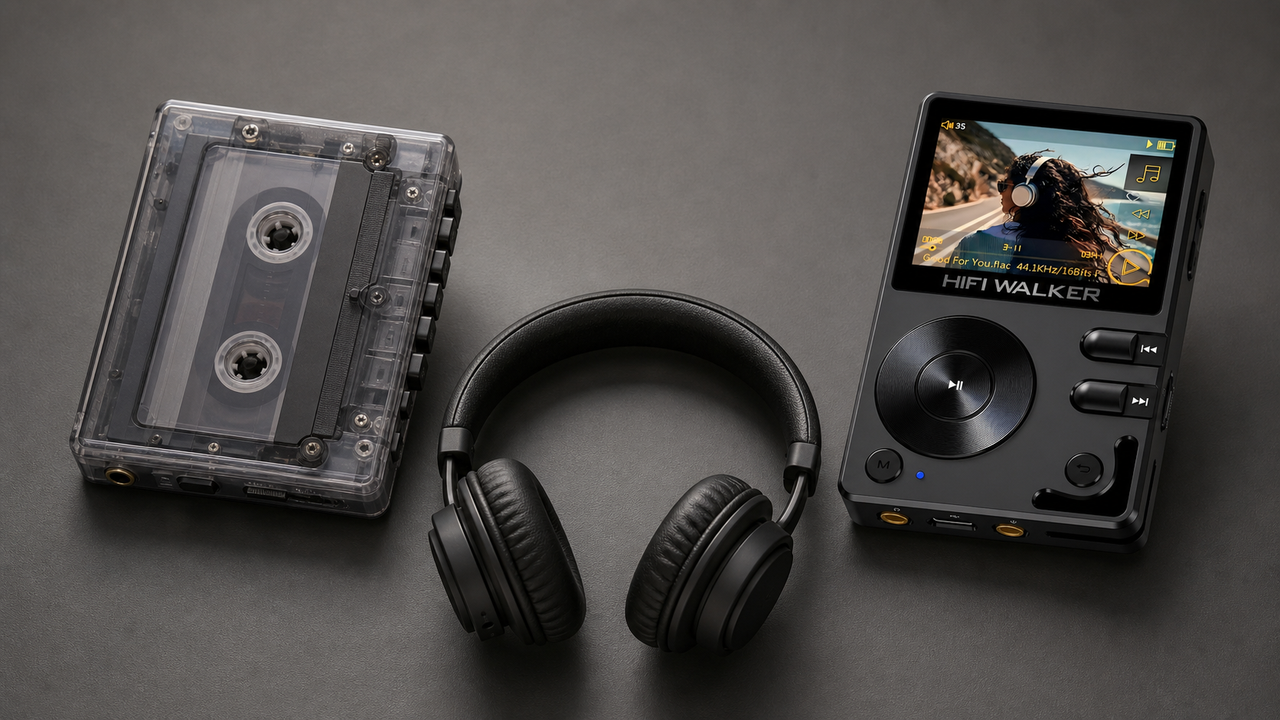
The portable audio cassette player dominated personal music consumption for decades, from the iconic Sony Walkman in 1979 to countless variations throughout the 1980s and 1990s. While these analog devices hold nostalgic charm and continue to attract collectors, modern digital audio players have revolutionized portable music with superior sound quality, convenience, and functionality.
Cassette Player Era
- Magnetic tape storage with inherent noise
- Limited 90-minute capacity per side
- Mechanical wear affects playback quality
- No random access to tracks
- Battery drain from motor mechanisms
Digital Audio Revolution
- Lossless digital formats like FLAC and DSD
- Thousands of hours storage capacity
- Perfect playback reproduction
- Instant track navigation and playlists
- Efficient digital processing extends battery life

Today's digital audio players represent the pinnacle of portable music technology, offering audiophile-grade components in compact form factors that would have been impossible during the cassette era.
- ►1. The Evolution from Cassette Tapes to Digital Audio Players
- ►2. Sound Quality: Analog Limitations vs Digital Precision
- ►3. Convenience and User Experience: Then vs Now
- ►4. Technical Specifications: Analog vs Digital Architecture
- ►5. Format Support and Audio Quality Standards
- ►6. Modern Digital Audio Player Recommendations
- ►7. Battery Life and Power Efficiency: Analog vs Digital
- ►8. The Verdict: Why Digital Players Have Superseded Cassette Technology
Sound Quality: Analog Limitations vs Digital Precision
The fundamental difference between portable audio cassette players and digital music players lies in their audio reproduction methods. Cassette tapes suffer from inherent analog limitations that modern digital technology has completely overcome.
Modern digital audio players eliminate the physical limitations of magnetic tape, delivering bit-perfect audio reproduction that maintains the original recording quality indefinitely. Professional DAC chips in today's players achieve signal-to-noise ratios exceeding 120dB, far surpassing any cassette player.

Convenience and User Experience: Then vs Now
Operating a portable audio cassette player required patience and physical interaction that modern users would find cumbersome. Today's digital players offer unprecedented convenience and control over your music library.
Music Access
Cassettes required flipping sides and rewinding, while digital players provide instant access to thousands of tracks with search functionality.
Storage Capacity
A single 256GB digital player holds equivalent of 800+ cassette tapes, eliminating the need to carry multiple physical media.
Playback Control
Digital players offer precise track skipping, custom playlists, shuffle modes, and EQ settings impossible with analog tape mechanisms.
Maintenance
No tape tangling, head cleaning, or mechanical repairs - digital players require minimal maintenance for years of reliable operation.

Technical Specifications: Analog vs Digital Architecture
Understanding the technical differences between cassette players and digital audio players reveals why modern devices deliver superior performance across all measurable parameters.
Cassette Player Components
- Magnetic tape head assembly
- Capstan and pinch roller mechanism
- Basic analog amplification circuit
- Mechanical transport motors
- Simple tone control (if any)
- Battery-hungry motor systems
Digital Player Architecture
- High-precision DAC chips (ES9038Q2M)
- Dedicated audio processing units
- Advanced headphone amplifiers
- Digital signal processing capabilities
- Parametric EQ and audio filters
- Efficient power management systems
Professional-grade digital audio players incorporate components that would have been impossible to miniaturize during the cassette era. The dual DAC architecture found in premium players provides balanced output capabilities that no analog cassette player could match.

Format Support and Audio Quality Standards
The limitation of cassette tapes to analog magnetic storage severely restricted audio quality and format options. Modern digital players support extensive format libraries with varying quality levels to suit different preferences and storage requirements.
Hi-Res audio formats like DSD256 and 32-bit/384kHz PCM available on modern players provide resolution far exceeding what any analog medium could achieve. This format flexibility allows audiophiles to choose between file size and quality based on their listening preferences.

Modern Digital Audio Player Recommendations
For listeners considering upgrading from vintage cassette players or exploring portable audio for the first time, modern digital audio players offer compelling advantages across all price ranges. HIFI WALKER's lineup provides options for different budgets while maintaining audiophile-grade performance.
Entry-Level Excellence
- H2 Hi-Res Audio Player - $119.20
- Essential hi-res format support
- 16-hour battery life
- Compact aluminum construction
- Perfect cassette player replacement
Professional Performance
- H20 Ultra - $239.99
- Dual ES9038Q2M DAC architecture
- Balanced and single-ended outputs
- DSD256 native playback
- 18-hour audiophile-grade performance

Each model delivers performance that completely surpasses any vintage cassette player while offering modern conveniences like advanced DAC technology and extensive format support that were impossible during the analog era.
Battery Life and Power Efficiency: Analog vs Digital
One surprising advantage of modern digital audio players over cassette players is significantly improved battery life despite vastly superior performance. Advanced power management and efficient digital processing eliminate the energy waste inherent in mechanical tape systems.
Modern digital players achieve 15-20 hour playback times through efficient ARM processors and optimized power management, while cassette players struggled to reach 8 hours due to mechanical inefficiencies and motor power requirements.

The Verdict: Why Digital Players Have Superseded Cassette Technology
While portable audio cassette players hold historical significance and nostalgic appeal, digital audio players have fundamentally transformed portable music with measurable improvements across every performance metric. The transition from analog to digital represents one of technology's clearest upgrade paths.
Superior Audio Quality
Digital players eliminate tape hiss, wow/flutter, and degradation while providing Hi-Res audio capabilities impossible with analog media.
Enhanced Convenience
Instant track access, massive storage capacity, and playlist functionality make digital players far more user-friendly than cassette systems.
Long-term Value
No ongoing tape costs, mechanical maintenance, or quality degradation - digital players provide years of consistent performance.
Future-Proof Technology
Support for emerging audio formats and streaming integration ensures compatibility with evolving music distribution methods.
For audiophiles seeking the ultimate portable listening experience, modern digital audio players like those in the HIFI WALKER collection represent the culmination of decades of audio engineering advancement, delivering performance that vintage cassette technology simply cannot match.

Frequently Asked Questions
Q1: Can digital audio players match the warmth of cassette tape sound?
While cassette tape's 'warmth' often comes from analog compression and harmonic distortion, modern digital players can reproduce the original recording with perfect accuracy. Many digital players offer analog-style sound signatures through advanced DAC implementations and tube-like amplification circuits, providing the best of both worlds.
Q2: Are there any advantages to using a portable cassette player in 2026?
Cassette players offer nostalgic appeal and the tactile experience of physical media. Some users appreciate the forced album listening experience and the unique analog sound character. However, from a pure performance standpoint, digital players surpass cassettes in every measurable audio quality metric.
Q3: How much storage capacity does a digital player have compared to cassettes?
A typical 256GB digital audio player can store approximately 800-1200 hours of high-quality music, equivalent to 800+ cassette tapes. This eliminates the need to carry physical media and provides instant access to your entire music library.
Q4: Do digital audio players require special headphones like cassette players did?
Digital audio players are more versatile than cassette players, supporting both high-impedance audiophile headphones and efficient portable models. Many modern players feature powerful headphone amplifiers and balanced outputs that can drive headphones that would have been impossible to use with battery-powered cassette players.
Q5: What's the learning curve for switching from cassette to digital audio players?
Modern digital audio players are generally more intuitive than cassette players. Instead of rewinding, fast-forwarding, and flipping tapes, users simply navigate touchscreen interfaces or use physical buttons for instant track access. Most users find digital players easier to use within minutes of first use.