


Last updated: June 26, 2026
Expert Insights: Streaming Audio in 2026
- 320kbps Ogg Vorbis and 256kbps AAC are closer in quality than the raw numbers suggest — AAC's psychoacoustic model is more efficient, making it competitive despite a lower bitrate.
- The biggest single upgrade for any streaming listener is not their subscription tier — it's replacing their smartphone DAC with a dedicated audio player. The HIFI WALKER G7 Pro delivers this upgrade for $104.
- Hi-Res Audio above 48kHz/24-bit shows diminishing audible returns in blind tests, but the higher-quality mastering that typically accompanies Hi-Res releases is itself a meaningful sonic benefit.
- Android DAPs like the G7 Pro run every streaming app natively while providing a cleaner audio signal path — making them the practical choice for listeners who stream AND keep local Hi-Res files.
Spotify vs Apple Music 2026: Which Really Sounds Better?
The Spotify vs Apple Music 2026 comparison is still one of the most-searched questions in streaming audio. Both platforms offer tens of millions of tracks, but their approach to sound quality is fundamentally different — and those differences become audible the moment you plug into a capable audio device. Here's what you actually need to know in 2026.
In this guide we cover bitrates, lossless formats, spatial audio, playlist discovery, and — crucially — why the hardware you use matters as much as the service you subscribe to. Whether you're a casual listener or a dedicated audiophile, the right player transforms both services.
What You'll Learn
- Bitrate & codec breakdown for both services
- Lossless vs lossy: real-world listening impact
- Spatial audio and Hi-Res certification explained
- How a dedicated Android DAP elevates both services
Quick Verdict 2026
- Best raw audio quality: Lossless streaming wins over 320kbps
- Best playlist discovery: Spotify's algorithm leads
- Best hardware pairing: Android DAP with Hi-Res DAC
- Best value upgrade: G7 Pro Android Player at $104
- ►1. Spotify vs Apple Music 2026: Which Really Sounds Better?
- ►2. What Is Audio Quality? Bitrates, Codecs & Lossless Explained
- ►3. Streaming Audio Quality in 2026: A Full Technical Comparison
- ►4. Lossless & Hi-Res Streaming: What You Gain at Each Quality Tier
- ►5. Why Your Hardware Determines How Good Both Services Sound
- ►6. HIFI WALKER G7 Pro: The Android DAP Built for Serious Streaming
- ►7. Which Streaming Service Should You Choose in 2026?
- ►8. Conclusion: Hardware Is the Great Equalizer
What Is Audio Quality? Bitrates, Codecs & Lossless Explained
Audio quality describes how accurately a digital file reproduces the original recording. Three factors dominate: bitrate (how much data per second), codec (how that data is compressed), and bit depth/sample rate (how finely the waveform is captured). Higher numbers in each category generally mean more detail, wider dynamic range, and less audible compression artifacting.

Understanding audio quality: bitrate, codec, and resolution all shape what you actually hear.
Bitrate
Measured in kbps (kilobits per second). 128kbps is basic streaming; 320kbps is Spotify Premium's ceiling; lossless formats like FLAC or ALAC carry 1,000–9,000+ kbps depending on sample rate.
Codec
The compression algorithm. AAC (Advanced Audio Codec) used by one major service is generally more efficient than Ogg Vorbis used by another — meaning a 256kbps AAC file can sound comparable to or better than a 320kbps Ogg Vorbis file.
Bit Depth & Sample Rate
CD quality is 16-bit/44.1kHz. Hi-Res Audio reaches 24-bit/192kHz — capturing more dynamic nuance and high-frequency detail. This is where lossless streaming truly separates itself from standard streaming.
DAC Quality
Your Digital-to-Analog Converter turns digital data into sound waves. A smartphone's integrated DAC often introduces noise. A dedicated Hi-Res DAP — like the G7 Pro — uses a dedicated audio chip to render every bit cleanly.
Streaming Audio Quality in 2026: A Full Technical Comparison
The apple music vs spotify 2026 comparison comes down to a clear technical gap at the top tier. One service streams at a maximum of 320kbps lossy Ogg Vorbis. The other goes all the way to 24-bit/192kHz lossless ALAC — roughly 37× more audio data per track. For casual earbuds use, you may not notice. On a proper DAP with quality IEMs, the difference is unmistakable.
The spotify vs apple music 2026 comparison reveals a trade-off: one service dominates on raw audio resolution and format support; the other leads on content discovery, social features, and playlist curation. Your priority determines the winner — but hardware quality affects both more than most listeners realize.
Lossless & Hi-Res Streaming: What You Gain at Each Quality Tier
Lossless streaming preserves every data point from the original studio master. Standard quality (256–320kbps) discards what psychoacoustic models consider inaudible — but on revealing equipment, those 'inaudible' details add up to a clearly more three-dimensional soundstage. Hi-Res Audio at 24-bit/192kHz goes further, capturing ultrasonic content that, while not directly heard, contributes to perceived spatial realism.
Standard 320kbps Streaming
- Good for commuting with earbuds
- Lossy compression removes some micro-detail
- Smaller file sizes — faster buffering
- Works on any hardware including entry-level
- Sufficient for background listening
Lossless & Hi-Res Streaming
- Bit-perfect reproduction of studio masters
- 24-bit/192kHz captures the full recording
- Audible improvement on quality IEMs & DAPs
- Requires a capable DAC to decode properly
- Essential for critical and audiophile listening

Side-by-side audio quality comparison between lossless and standard streaming in 2026.
Why Your Hardware Determines How Good Both Services Sound
Here's the insight most streaming comparisons miss: the DAC and amplifier in your playback device matter as much as the streaming format itself. A lossless stream played through a budget smartphone's noisy integrated DAC can sound worse than a 320kbps stream on a dedicated Hi-Res audio player. The conversion from digital bits to analog sound waves is where quality is won or lost.
A dedicated Android DAP (Digital Audio Player) runs the exact same streaming apps — including every major music service — but routes audio through a precision audiophile DAC chip and a low-noise headphone amplifier. The result: cleaner transients, lower noise floor, wider stereo imaging, and dramatically better dynamics from the same stream.

Install Any Streaming App
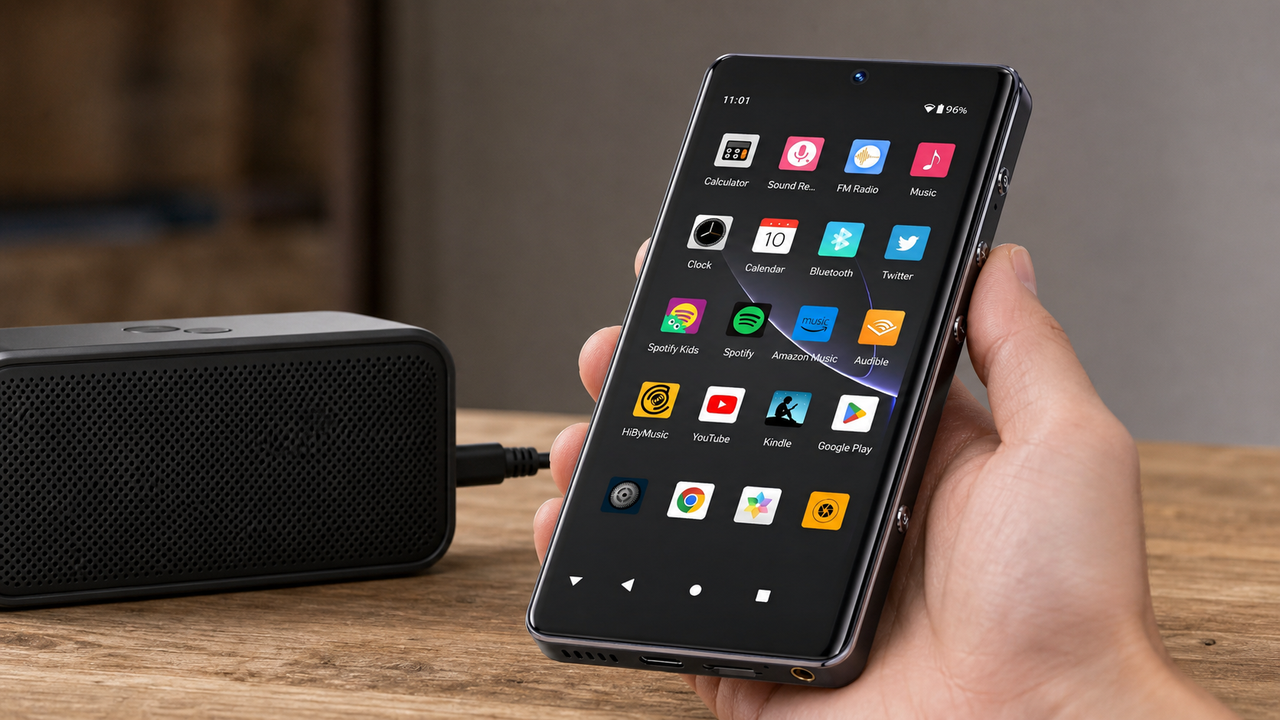
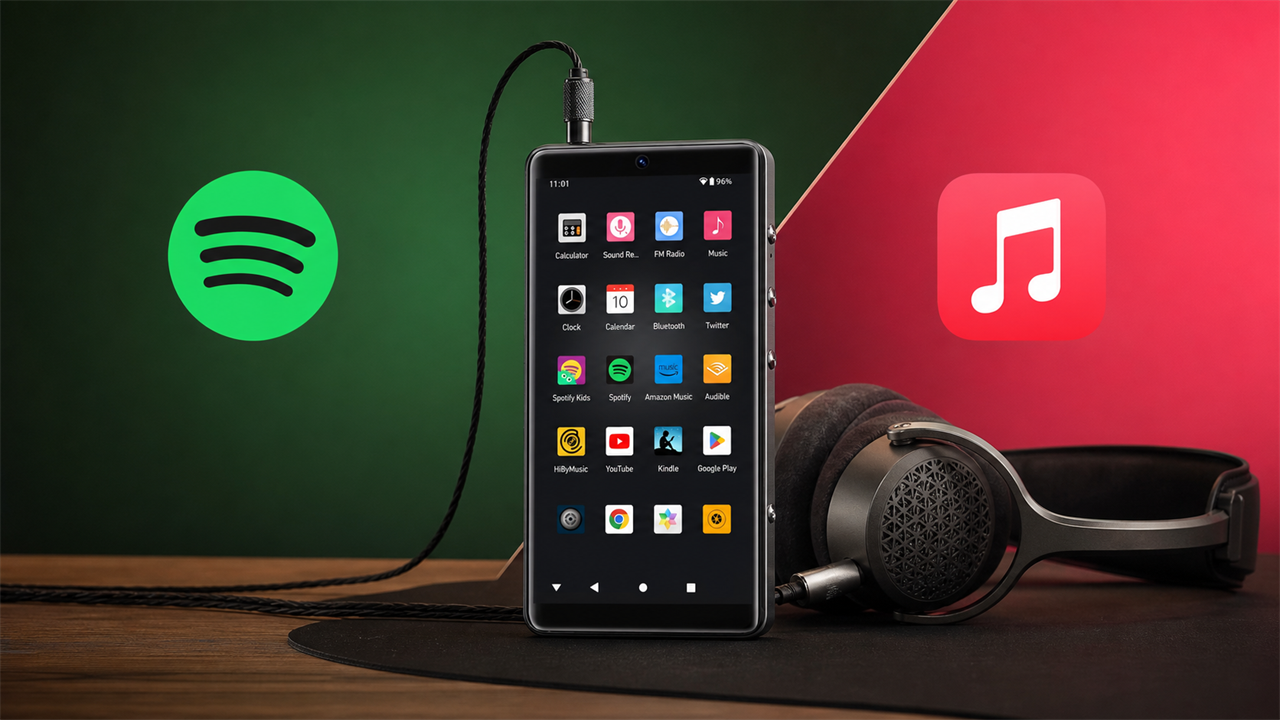
The G7 Pro runs full Android OS — install your preferred music service from the Google Play Store just like a phone. No sideloading required.
Stream Through a Dedicated DAC
Unlike a smartphone, the G7 Pro's audio path is isolated from phone calls, notifications, and electrical noise. Every stream is processed by a dedicated Hi-Res DAC chip.
Drive High-Quality Earphones Properly
The G7 Pro's headphone amplifier delivers clean, sufficient power for demanding IEMs and headphones. Low-impedance and high-impedance loads are both handled accurately.
Enable the Highest Quality Setting
Set your streaming app to maximum quality. The G7 Pro's 5.2-inch HD touchscreen makes navigating audio settings fast and comfortable — better than squinting at a tiny DAP screen.
↑ Back to Top
Back to Top ↑HIFI WALKER G7 Pro: The Android DAP Built for Serious Streaming
The HIFI WALKER G7 Pro Android Player at $104 sits at the intersection of streaming convenience and audiophile hardware. It runs a full Android ecosystem so every streaming app works natively, while its dedicated DAC and amplifier circuit handle the signal with precision a smartphone simply cannot match.
For listeners who want the best of both worlds — the open streaming ecosystem and Hi-Res local playback — the G7 Pro is the logical single device. Need more power for demanding headphones? The H20 Pro at $192 adds a balanced 4.4mm output and a more powerful amplifier stage.

Which Streaming Service Should You Choose in 2026?
The honest answer to the spotify vs apple music playlists comparison 2026 is that neither service wins on every dimension. Your choice should depend on what you actually value day-to-day — and how seriously you take sound quality as a priority.
Choose the Lossless Service If...
- You own quality IEMs, headphones, or a DAP
- You listen critically — jazz, classical, acoustic recordings
- Hi-Res Audio and lossless formats matter to you
- You want Dolby Atmos / spatial audio content
- You primarily listen to music, not podcasts
Choose the Discovery-First Service If...
- Playlist discovery and algorithmic recommendations are your priority
- You heavily use podcasts alongside music
- Social sharing and collaborative playlists are important
- You're satisfied with 320kbps on casual listening setups
- Cross-platform and smart speaker integration matters
The hardware upgrade is universally worthwhile regardless of your service choice. The G7 Pro Android Player improves both services substantially. Its dedicated DAC extracts cleaner sound from a 320kbps stream than any smartphone can manage — and when paired with a lossless service, it reveals the full benefit of that Hi-Res audio tier.
Conclusion: Hardware Is the Great Equalizer
In the apple music vs spotify 2026 comparison, raw audio format specifications clearly favor the lossless streaming service — 24-bit/192kHz ALAC versus 320kbps Ogg Vorbis is not a close contest on paper. But real-world listening is never just about the source file. The DAC, the amplifier, and the earphones in your signal chain determine how much of that quality you actually experience.
The HIFI WALKER G7 Pro Android Player gives you the open Android ecosystem to run any streaming service alongside its audiophile DAC hardware. At $104 it delivers a genuine step up from smartphone audio — whether you stream at 320kbps or 24-bit lossless, you'll hear the difference immediately.
For those who want to explore the full HIFI WALKER lineup, the Android DAP collection includes models at every price point from $87 to $240+. And if you already have a favorite streaming setup and just want to improve the earphone side, the A20Pro Hi-Fi Earphone at $63.99 is an outstanding complement to any DAP.
Read more → Spotify vs Amazon Music 2026: Audio Quality & DAP Compatibility Guide
Read more → Apple Music Player Options 2026: Device Compatibility Test Read more → Deezer HiFi Guide (2026): True Lossless Music Experience Read more → Apple Music Web Player 2026: Complete Setup & Quality Guide Read more → Best MP3 Players Compatible With Apple Music in 2026 Read more →
Frequently Asked Questions
Q1: What is the difference between lossless and standard streaming audio quality in 2026?
Lossless streaming preserves 100% of the original studio recording data — typically 16-bit/44.1kHz at minimum, up to 24-bit/192kHz at Hi-Res tier. Standard streaming uses lossy compression (like 320kbps Ogg Vorbis), which discards some audio data to reduce file size. On quality hardware like the HIFI WALKER G7 Pro Android Player, lossless audio delivers audibly wider soundstage, cleaner transients, and more micro-detail.
Q2: Does Spotify support lossless audio in 2026?
As of mid-2026, Spotify's lossless HiFi tier remains unreleased. Spotify Premium streams at a maximum of 320kbps Ogg Vorbis. This is decent quality for casual listening, but it falls significantly short of lossless ALAC at 24-bit/192kHz available on competing services. A dedicated DAP like the G7 Pro does improve how 320kbps sounds by using a higher-quality DAC chip than any smartphone.
Q3: Do I need special hardware to hear the difference between streaming quality tiers?
Yes — a capable DAC and good earphones are essential to hear lossless audio's advantages. Smartphone integrated DACs introduce noise that masks fine detail. A dedicated Android DAP like the HIFI WALKER G7 Pro ($104) uses an audiophile DAC chip and isolated amplifier circuit, making the quality difference between 320kbps and lossless immediately apparent. Pair it with quality IEMs and the improvement is dramatic.
Q4: Can the HIFI WALKER G7 Pro run Spotify and other streaming apps?
Yes. The G7 Pro runs full Android OS with Google Play Store access, so every major streaming service installs and runs natively — no workarounds required. Its 8-core processor handles streaming apps quickly, and its 5.2-inch HD touchscreen makes browsing playlists comfortable. Audio from all streaming apps is routed through the G7 Pro's dedicated Hi-Res DAC for superior sound.
Q5: What is the best DAP for streaming music in 2026?
For most listeners, the HIFI WALKER G7 Pro Android Player at $104 offers the best combination of streaming convenience and audio quality in 2026. It runs any streaming app on full Android, plays local Hi-Res files, and outputs through a dedicated audiophile DAC. Those needing more power can step up to the H20 Pro ($192) with balanced 4.4mm output, or the H20Ultra ($239.99) for flagship performance.
Q6: How does a spotify vs apple music playlists comparison look in 2026?
On playlist discovery and recommendation quality, the algorithm-driven service (with Discover Weekly, Daily Mixes, and social features) generally leads for finding new music. The lossless-focused service offers strong editorial curation and beats-per-minute sorting useful for workout playlists. Both work equally well on the G7 Pro Android Player — the hardware upgrade benefits whichever service you prefer.