


Expert Insights
- DAC technology has reached a point where implementation and analog design often matter more than the DAC chip specification itself
- The trend toward balanced outputs in portable players significantly improves noise performance and dynamic range for compatible headphones
- Software-based digital filters and upsampling algorithms are becoming increasingly sophisticated, allowing older recordings to benefit from modern DAC capabilities
Understanding DAC: The Heart of Digital Audio
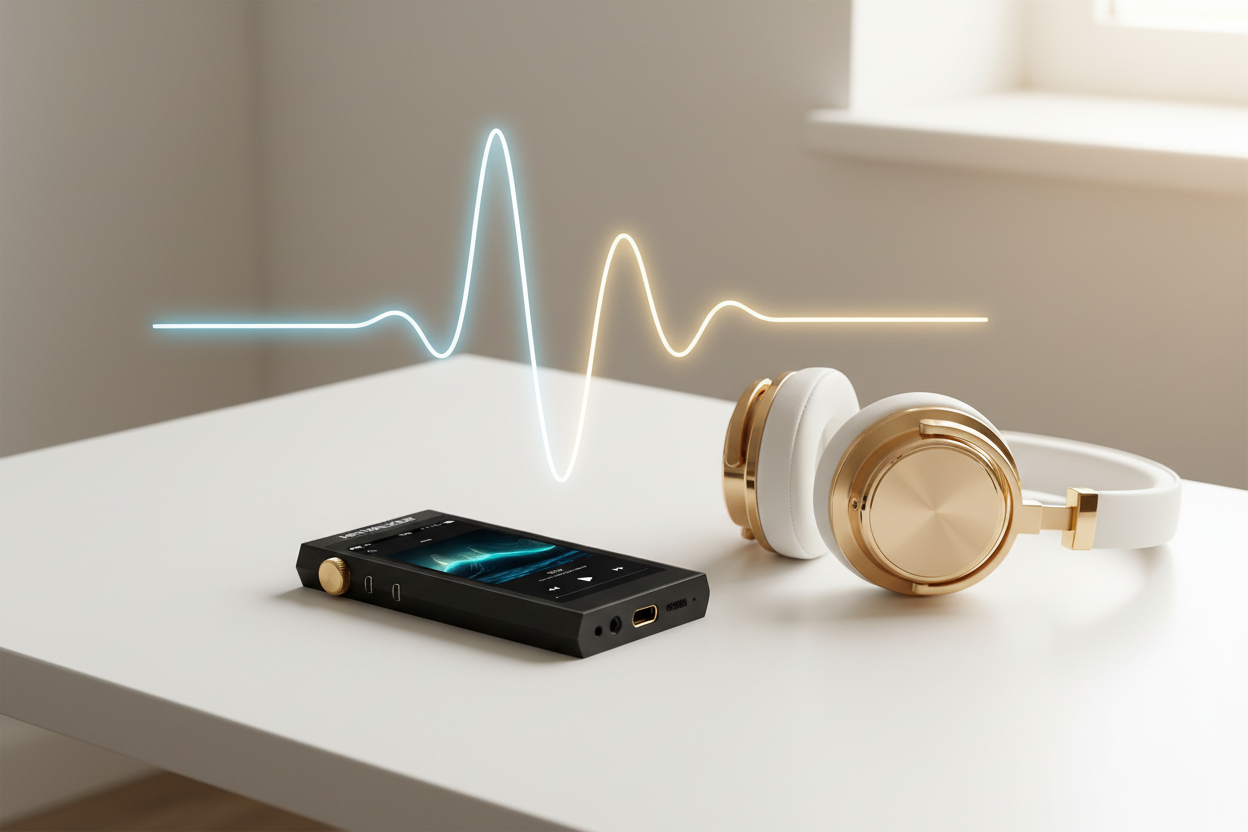
A DAC (Digital-to-Analog Converter) is the crucial component that bridges the gap between digital audio files and the analog sound waves we hear. Every time you listen to music from your phone, computer, or dedicated portable audio player, a DAC is working behind the scenes to convert those digital 1s and 0s into continuous analog signals.

Digital Audio Format
- Discrete binary values (0s and 1s)
- Sampled at specific intervals (44.1kHz, 96kHz)
- Quantized to fixed bit depths (16-bit, 24-bit)
- Perfect for storage and transmission
Analog Audio Output
- Continuous voltage variations
- Natural waveform representation
- Infinite resolution within bandwidth
- Direct reproduction of original sound
- ►1. Understanding DAC: The Heart of Digital Audio
- ►2. The Science Behind DAC Technology
- ►3. Types of DAC Architectures
- ►4. DAC Specifications That Matter
- ►5. High-Resolution Audio and Advanced DAC Features
- ►6. DACs in Portable Audio Players
- ►7. Optimizing DAC Performance
- ►8. The Future of DAC Technology
The Science Behind DAC Technology
The fundamental principle of DAC operation involves reconstructing analog signals from digital samples through sophisticated mathematical algorithms. The most common approach uses pulse code modulation (PCM) where each digital sample represents the amplitude of the analog signal at a specific point in time.
Sample Rate Conversion
The DAC receives digital samples at predetermined intervals (44.1kHz means 44,100 samples per second). Higher sample rates like 192kHz provide more accurate signal reconstruction.
Digital Filtering
Advanced digital filters remove aliasing artifacts and prepare the signal for conversion. This process eliminates unwanted frequencies above the Nyquist limit.
Voltage Generation
The DAC chip generates precise voltage levels corresponding to each digital value, creating stepped approximations of the original analog waveform.
Analog Reconstruction
Low-pass analog filters smooth the stepped output into continuous waveforms, removing residual digital artifacts while preserving the audio signal.
Modern DAC architectures employ various techniques including Delta-Sigma modulation, R-2R ladder networks, and current-steering designs. Each approach offers different advantages in terms of accuracy, noise performance, and manufacturing cost.
Types of DAC Architectures
Understanding different DAC architectures helps explain why some audio devices sound better than others. The choice of DAC topology significantly impacts sound quality, power consumption, and cost.

DAC Specifications That Matter
When evaluating DAC performance, several key specifications determine audio quality. These measurements provide objective data about a DAC's capabilities, though subjective listening remains equally important.
Critical Measurements
- Signal-to-Noise Ratio (SNR): >110dB excellent
- Total Harmonic Distortion (THD): <0.01% ideal
- Dynamic Range: >100dB for transparency
- Frequency Response: ±0.1dB precision
Real-World Impact
- Higher SNR = quieter background noise
- Lower THD = cleaner, more accurate sound
- Greater dynamic range = better detail resolution
- Flat frequency response = neutral tonality

Beyond specifications, implementation quality matters enormously. Factors like power supply design, analog output stages, and electromagnetic shielding all influence the final sound quality that specifications alone cannot capture.
High-Resolution Audio and Advanced DAC Features
Modern DAC technology extends far beyond CD-quality audio, supporting high-resolution formats that capture more musical detail. These advanced capabilities require sophisticated processing and premium components.
PCM Support
High-end DACs handle PCM up to 32-bit/384kHz, providing extraordinary resolution for studio-master recordings and audiophile content.
DSD Compatibility
DSD support is model-specific; for example, H20 Ultra supports DSD256, while other models have different confirmed limits.
Format Support Verification
Check the specific model's confirmed format list before relying on streaming-specific format features.
Upsampling Options
Advanced digital filters and upsampling algorithms enhance lower-resolution content, improving detail retrieval and spatial imaging.
↑ Back to Top
Back to Top ↑
DACs in Portable Audio Players
Dedicated portable audio players integrate carefully selected DAC chips optimized for mobile use. Unlike smartphones that prioritize battery life over audio quality, these devices focus on delivering the best possible sound reproduction in a portable format.

The integration of premium DAC technology in portable players requires careful engineering to balance power consumption, heat dissipation, and audio performance. This explains why dedicated audio devices often outperform general-purpose electronics for music reproduction.
Optimizing DAC Performance
Getting the best performance from any DAC requires attention to the entire signal chain, from source material quality to output connections. Small improvements in each area compound to create significantly better overall sound quality.
Source Optimization
- Use lossless audio formats (FLAC, ALAC)
- Ensure proper file bit depth matching
- Avoid unnecessary sample rate conversion
- Choose quality recordings over compressed files
Output Optimization
- Match impedance to headphone requirements
- Use balanced outputs when available
- Select appropriate gain settings
- Consider external amplification for demanding loads
Format Selection
Choose the highest quality source material available. FLAC files preserve all original data while DSD recordings offer a different sonic character that many prefer.
Player Configuration
Configure your audio player's DAC settings appropriately. Enable bit-perfect output and disable unnecessary digital signal processing for purest reproduction.
Output Matching
Match your headphones or speakers to the DAC's output capabilities. High-impedance headphones may require additional amplification for optimal performance.

The Future of DAC Technology
As digital audio continues evolving, DAC technology advances to meet new challenges. Emerging trends focus on improved efficiency, higher resolution capabilities, and innovative processing algorithms that promise even better sound quality.
Emerging Technologies
- AI-enhanced upsampling algorithms
- Quantum dot precision resistors
- Advanced power management systems
- Integration with spatial audio processing
Market Trends
- Increased emphasis on power efficiency
- Support for immersive audio formats
- Integration with streaming platforms
- Focus on sustainable manufacturing
The democratization of high-quality DAC technology means that exceptional audio performance is becoming more accessible. Today's mid-range portable players often exceed the specifications of professional equipment from just a few years ago, making audiophile-quality sound available to more music enthusiasts than ever before.
For those serious about audio quality, understanding DAC technology helps make informed decisions about audio equipment. Whether you choose a dedicated portable audio player or evaluate different options, knowing how these crucial components work empowers better choices for your listening preferences.
Frequently Asked Questions
Q1: What does DAC stand for and why is it important?
DAC stands for Digital-to-Analog Converter. It's essential because all digital audio devices need DACs to convert digital music files into analog signals that speakers and headphones can reproduce as sound waves we can hear.
Q2: Do more expensive DACs always sound better?
Not necessarily. While premium DACs often offer better specifications and components, the difference depends on your entire audio system, source material quality, and personal preferences. A well-implemented mid-range DAC can outperform a poorly designed expensive one.
Q3: What's the difference between PCM and DSD in DAC technology?
PCM (Pulse Code Modulation) uses traditional digital sampling at various bit depths and sample rates. DSD (Direct Stream Digital) uses a completely different approach with 1-bit samples at very high frequencies. Both can sound excellent, with DSD often praised for its natural, analog-like character.
Q4: How important are DAC specifications like SNR and THD?
These specifications provide important objective baselines for performance. SNR (Signal-to-Noise Ratio) above 100dB and THD (Total Harmonic Distortion) below 0.1% indicate good performance, but implementation quality and your listening preferences ultimately matter more than specifications alone.
Q5: Can external DACs improve smartphone audio quality?
Yes, external DACs bypass the smartphone's built-in DAC, which is typically designed for power efficiency rather than audio quality. A dedicated external DAC can provide cleaner power supplies, better analog circuits, and support for high-resolution audio formats that smartphones often can't handle properly.